Loading....
|
Press & Hold to Drag Around |
|||
|
Click Here to Close |
|||
Question 1 Report
In the diagram O is the center of the circle, if ?QRS = 62o, find the value of ?SQR.
Answer Details
Question 3 Report
The venn diagram below shows the number of students who studied Physics, Chemistry, and Mathematics in a certain school. How many students took at least two of the three subjects?
Answer Details
Question 4 Report
Calculate and correct to three significant figures, the length of an arc subtends an angle of 70o at the center of the circle radius 4cm. [Take π = 22/7]
Answer Details
Question 5 Report
If twice a certain integer is subtracted from 5 times the integer, the result is 63. Find the integer.
Answer Details
Question 7 Report
If logax = p, express x in terms of a and p
Answer Details
We know that logax = p This means that ap = x So, we can express x in terms of a and p as x = ap. Therefore, the answer is x = ap.
Question 8 Report
In an A.P the first term is 2, and the sum of the 1st and the 6th term is 161/2. What is the 4th term
Answer Details
Question 11 Report
Given that logp = 2 logx + 3logq, which of the following expresses p in terms of x and q?
Answer Details
We are given the equation: log p = 2 log x + 3 log q. We know that log a + log b = log(ab) and log a - log b = log(a/b). Using these properties, we can rewrite the given equation as follows: log p = log x^2 + log q^3 log p = log (x^2q^3) Now we can write the exponential form of this equation as: p = x^2q^3 Therefore, the expression for p in terms of x and q is p = x^2q^3. Hence, the correct answer is "p = x^2q^3".
Question 12 Report
For a class of 30 students, the scores in a Mathematics test out of 10 marks were as follows;
4,5,7,2,3,6,5,5,8,9,5,4,2,3,7,9,8,7,7,7,3,4,5,5,2,3,6,7,7,2
Answer Details
Range of a distribution refers to the difference between the highest and lowest value in a dataset. To find the range of the given Mathematics test scores, we need to determine the highest and lowest values. The lowest score in the test is 2, while the highest score is 9. Therefore, the range of the distribution is 9 - 2 = 7. Hence, the answer is 7.
Question 13 Report
An arc of a circle radius 7cm is 14cm long. What angle does the arc subtend at the center of circle?
[Take π = 22/7]
Answer Details
Question 14 Report
Instead of recording the number 1.23cm of the radius of a tube, a student recorded 1.32cm. Find the percentage of error, correct to one decimal place.
Answer Details
To find the percentage of error, we first need to find the absolute error, which is the difference between the measured value and the true value. In this case, the true value is 1.23 cm, and the measured value is 1.32 cm. Absolute error = |measured value - true value| = |1.32 - 1.23| = 0.09 cm Next, we can find the relative error, which is the ratio of the absolute error to the true value. Relative error = (absolute error / true value) x 100% Relative error = (0.09 / 1.23) x 100% = 7.32% Therefore, the percentage of error, correct to one decimal place, is 7.3%. The answer is option B.
Question 15 Report
If 3\(^y\) = 243, find the value of y.
Answer Details
Since 3 raised to what power gives 243, we need to find the exponent that makes this equation true: 3\(^y\) = 243 We can rewrite 243 as 3\(^5\), so the equation becomes: 3\(^y\) = 3\(^5\) Since the bases are equal, the exponents must also be equal. Therefore: y = 5 So the value of y is 5.
Question 16 Report
Evaluate, using logarithm tables \(\frac{5.34 \times 67.4}{2.7}\)
Answer Details
To evaluate this expression using logarithm tables, we can use the following steps: 1. Take the logarithm (base 10) of each of the numbers in the expression. 2. Add the logarithms of the two factors in the numerator. 3. Subtract the logarithm of the denominator from the result in step 2. 4. Take the antilogarithm (base 10) of the result in step 3. Using these steps, we get: log(5.34) = 0.727 log(67.4) = 1.829 log(2.7) = 0.431 log(5.34 x 67.4) = log(5.34) + log(67.4) = 0.727 + 1.829 = 2.556 log(5.34 x 67.4) - log(2.7) = 2.556 - 0.431 = 2.125 antilog(2.125) = 133.2 Therefore, the value of the expression is 133.2. The answer is option C.
Question 18 Report
The table above gives the scores of a group of students in an English Language test
Question 19 Report
In the diagram above, O is the center of the circle. Calculate the length of the chord AB if |OA| = 5cm, |OD| = 3cm and ?AOD = ?BOD
Question 20 Report
sinθ = 1/2 and cosθ = -√3/2, what is the value of θ?
Answer Details
We can use the fact that sin2θ + cos2θ = 1, to find the value of sinθ or cosθ given the other one. Since sinθ = 1/2, we know that sin2θ + cos2θ = 1 becomes: (1/2)2 + cos2θ = 1 Simplifying the equation, we get: 1/4 + cos2θ = 1 cos2θ = 3/4 Taking the square root of both sides, we get: cosθ = ±√3/2 Since we know that cosθ = -√3/2, we can conclude that θ = 150o (or 5π/6 radians) as this is the angle in the fourth quadrant that has a cosine of -√3/2. Therefore, the answer is option E: 150o.
Question 21 Report
What percentage of the population are married? correct to one decimal place
Answer Details
Question 22 Report
In the diagram above, O is the center of the circle QRT and PT is a tangent to the circle at T. Calculate the angle x
Answer Details
Question 23 Report
If the second and fourth term of a G.P are 8 and 32 respectively,what is the sum of the first four terms?
Answer Details
Question 24 Report
For a class of 30 students, the scores in a Mathematics test out of 10 marks were as follows;
4,5,7,2,3,6,5,5,8,9,5,4,2,3,7,9,8,7,7,7,3,4,5,5,2,3,6,7,7,2
Answer Details
The mode of a set of data is the value that appears most frequently. To find the mode of the scores in the Mathematics test, we need to determine which score occurs the most number of times. From the given data, we can see that the score "7" appears 6 times, which is more than any other score. Therefore, the mode of the score is 7. So the answer is (e) 7.
Question 25 Report
Points X and Y are respectively 20km North and 9km East of a point O. What is the bearing of Y from X? Correct to the nearest degree
Answer Details
Question 26 Report
In the diagram above, O is the center of the circle. If ?POR = 114o, calculate ?PQR
Answer Details
Question 27 Report
The angle of depression of a point on the ground from the top of a building is 20.3o. If the foot of the building is 40m, calculate the height of the building, correct to one decimal place
Answer Details
In this problem, we can use trigonometry to determine the height of the building. Let h be the height of the building and d be the distance from the point on the ground to the foot of the building. We can see that the angle of depression is the angle between the line of sight from the top of the building to the point on the ground and the horizontal line. Therefore, we can draw a right-angled triangle with the height of the building, the distance from the point on the ground to the foot of the building, and the line of sight from the top of the building to the point on the ground as the sides. From the triangle, we can use the tangent function since we have the opposite and adjacent sides. Therefore: tan(20.3°) = h/40 h = 40 tan(20.3°) ≈ 14.8m Therefore, the height of the building is approximately 14.8m. The correct answer is 14.8m.
Question 28 Report
The graph above is that of a quadratic function y = 2x2 - x - 6
The roots of the equation are
Answer Details
To find the roots of a quadratic function, we need to set y to zero and solve for x. Therefore, we have: 2x² - x - 6 = 0 We can factorize this quadratic equation by splitting the middle term: 2x² - 4x + 3x - 6 = 0 2x(x - 2) + 3(x - 2) = 0 (2x + 3)(x - 2) = 0 Setting each factor to zero, we get: 2x + 3 = 0 or x - 2 = 0 Solving for x in each equation, we get: x = -3/2 or x = 2 Therefore, the roots of the equation are -3/2 and 2. So the correct answer is (B) -1.5, 2.
Question 29 Report
Which of the following gives the point of intersection of the graph y = x2 and y = x + 6 shown above?
Answer Details
The problem is asking us to find the point of intersection of the two graphs y = x2 and y = x + 6. This can be done by solving the equations simultaneously. We need to find the values of x and y that satisfy both equations. We can do this by substituting y = x + 6 for y in the equation y = x2, giving us: x + 6 = x2 Rearranging this equation gives us: x2 - x - 6 = 0 We can factor this quadratic equation to obtain: (x - 3)(x + 2) = 0 Thus, the solutions are x = 3 or x = -2. To find the corresponding values of y, we can substitute these values of x into either of the original equations. For example, if we use y = x + 6, we get: When x = 3, y = 3 + 6 = 9, giving us the point (3, 9). When x = -2, y = -2 + 6 = 4, giving us the point (-2, 4). Therefore, the point of intersection of the two graphs is (3, 9) and (-2, 4).
Question 30 Report
What angle represents grown up girls ? Correct to one decimal place
Answer Details
Question 31 Report
Simplify \(\frac{9^{-\frac{1}{2}}}{27^{\frac{2}{3}}}\)
Answer Details
We can simplify this expression using the rules of exponents and radicals. First, we can rewrite 9 as \(3^2\) and 27 as \(3^3\): \(\frac{9^{-\frac{1}{2}}}{27^{\frac{2}{3}}} = \frac{(3^2)^{-\frac{1}{2}}}{(3^3)^{\frac{2}{3}}}\) Next, we can simplify the exponents using the product rule of exponents: \(\frac{(3^2)^{-\frac{1}{2}}}{(3^3)^{\frac{2}{3}}} = \frac{3^{-1}}{3^2} = \frac{1}{3^{1+2}} = \frac{1}{3^3} = \frac{1}{27}\) Therefore, the simplified expression is 1/27. The answer is option E.
Question 32 Report
The angle of elevation of X from Y is 30o. If XY = 40m, how high is X above the level of Y?
Answer Details
Question 33 Report
In the diagram above O is the center of the circle, if ∠PAQ = 75o, what is the value of ∠PBQ?
Answer Details
Question 35 Report
Evaluate \(\frac{0.009}{0.012}\), leaving your answer in standard form.
Answer Details
To evaluate \(\frac{0.009}{0.012}\) in standard form, we need to simplify the fraction and express the result in the form of \(a \times 10^b\), where \(1 \leq a < 10\) and \(b\) is an integer. We can simplify the fraction by dividing both the numerator and the denominator by 0.003: \[\frac{0.009}{0.012} = \frac{0.009 \div 0.003}{0.012 \div 0.003} = \frac{3}{4}\] Now we can express 3/4 in standard form: \[\frac{3}{4} = 0.75 = 7.5 \times 10^{-1}\] Therefore, the answer is option (C) 7.5 x 10⁻¹.
Question 36 Report
Calculate the surface area of a hallow cylinder which is closed at one end, if the base radius is 3.5cm and the height 8cm.[take π = 22/7]
Answer Details
Question 37 Report
For a class of 30 students, the scores in a Mathematics test out of 10 marks were as follows;
4,5,7,2,3,6,5,5,8,9,5,4,2,3,7,9,8,7,7,7,3,4,5,5,2,3,6,7,7,2
Answer Details
Question 38 Report
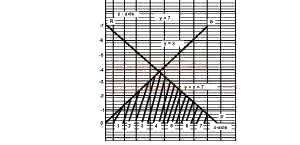
With reference to the graph above, which f the following solution sets is represented by ΔOPQ?
Answer Details
Question 39 Report
A sector is cut off from a circle radius 8.2cm to form a cone, if the radius of the resulting cone is 3.5cm, calculate the curved surface area of the cone. [take π = 22/7]
Answer Details
Question 41 Report
If A = {a,b,c}, B = {a,b,c,d,e} and C = {a,b,c,d,e,f}. Find (A∪B)∩(A∪C)
Answer Details
The union of sets A and B (A ∪ B) is the set of elements that are in either set A, set B or both. Similarly, the union of sets A and C (A ∪ C) is the set of elements that are in either set A, set C or both. The intersection of these two sets ((A ∪ B) ∩ (A ∪ C)) is the set of elements that are common to both sets. Therefore, we can first find the union of A and B which gives us {a, b, c, d, e}. Then, we can find the union of A and C which gives us {a, b, c, d, e, f}. The intersection of these two sets is the set of elements that are in both sets, which is {a, b, c, d, e}. Therefore, (A∪B)∩(A∪C) = {a, b, c, d, e}. So the correct answer is: {a,b,c,d,e}.
Question 42 Report
Solve for x: (x2 + 2x + 1) = 25
Answer Details
We are given the equation: x2 + 2x + 1 = 25 To solve for x, we first simplify the left-hand side of the equation by subtracting 24 from both sides: x2 + 2x - 24 = 0 We can then factor this quadratic equation as follows: (x + 6)(x - 4) = 0 Using the zero product property, we know that this equation is true if either (x + 6) = 0 or (x - 4) = 0. Solving for x in each case, we get: x + 6 = 0 or x - 4 = 0 x = -6 or x = 4 Therefore, the solutions to the original equation are x = -6 and x = 4. So the answer is: -6, 4
Question 43 Report
Using the above graph, if 10o < x < 60o, what is the value of x for which sin x = cos x?
Answer Details
Since sin x = cos x, we have: sin x = cos x Dividing both sides by cos x, we get: tan x = 1 Taking the inverse tangent (tan-1) of both sides, we get: x = 45o Therefore, the value of x for which sin x = cos x is 45o. Therefore, the correct option is (d) 45o.
Question 44 Report
In the diagram above ABDE and FCDE are parallelograms. If |FC| = 12.2cm and the height |PC| = 4.0cm, calculate the area of the parallelogram ABDE.
Answer Details
We know that ABDE and FCDE are parallelograms which means their opposite sides are equal and parallel. Therefore, |AB| = |DE| and |AE| = |BD|. We can calculate the area of parallelogram ABDE as follows: Area of ABDE = |AB| x |PC| We need to calculate |AB| and we can do this by finding the length of |DE|. In parallelogram FCDE, the opposite sides |DE| and |FC| are equal. Therefore, |DE| = |FC| = 12.2cm. Also, we know that FCDE is a parallelogram, so the height |PC| is equal to the height of parallelogram ABDE. Now, we can find the length of |AB| using the Pythagorean theorem. |AB|2 = |AE|2 + |DE|2 |AB|2 = (4.0cm)2 + (12.2cm)2 |AB|2 = 149.24cm2 |AB| = 12.2cm Therefore, the area of ABDE is: Area of ABDE = |AB| x |PC| = 12.2cm x 4.0cm = 48.8cm2 Therefore, the answer is 48.8cm2.
Question 45 Report
Find the volume of a cone of radius 3.5cm and vertical height 12cm [Take π = 22/7]
Answer Details
Question 46 Report
In the diagram above, TPS is a straight line, PQRS is a parallelogram with base QR and height 8cm. |QR| = 6cm and the area of triangle QST is 52cm2. Find the area of ?QPT
Answer Details
Question 47 Report
What is the probability that 3 customers waiting in a bank will be served in the sequence of their arrival at the bank
Answer Details
The probability that 3 customers waiting in a bank will be served in the sequence of their arrival at the bank can be calculated using the permutation formula. Since there are three customers waiting in line, the total number of possible arrangements is 3! = 6. However, only one arrangement results in the customers being served in the sequence of their arrival at the bank. Therefore, the probability of this happening is 1/6. Hence, the correct answer is 1/6.
Question 48 Report
In the diagram, O is the center of the circle, If ?POQ = 80o and ?PRQ = 5x, find the value of x.
Answer Details
In a circle, the angle subtended by an arc at the center is twice the angle subtended by the same arc at any point on the circumference of the circle. Using this property, we can find the value of ?PRQ: ?POQ = 80o (given) Therefore, ?PRQ = 1/2 ?POQ = 1/2 x 80o = 40o Now, we can use the value of ?PRQ to find the value of x: ?PRQ = 5x (given) Substituting the value of ?PRQ, we get: 40o = 5x Simplifying this equation, we get: x = 8 Therefore, the value of x is 8. The answer is option B.
Question 49 Report
(a) Without using Mathematical tables, find x, given that \(6 \log (x + 4) = \log 64\)
(b) If \(U = {1, 2, 3,4, 5, 6, 7, 8, 9, 10}, X = {1, 2, 4, 6, 7, 8, 9}, Y = {1, 2, 3, 4, 7, 9}\) and \(Z = {2, 3, 4, 7, 9}\). What is \(X \cap Y \cap Z' \)?
(a) \(6\log(x+4) = \log 64\)
\(\log(x+4)^6 = \log 64\)
\((x+4)^6 = 64 = 2^6\)
Taking the positive sixth root, \(x + 4 = 2\), so \(\mathbf{x = -2}\). (Check: \(x+4 = 2 > 0\), so the logarithm is defined.)
(b) \(U = \{1,2,3,4,5,6,7,8,9,10\}\), \(X = \{1,2,4,6,7,8,9\}\), \(Y = \{1,2,3,4,7,9\}\), \(Z = \{2,3,4,7,9\}\).
First, \(Z' = U \setminus Z = \{1,5,6,8,10\}\).
Next, \(X \cap Y = \{1,2,4,7,9\}\).
Then \((X \cap Y) \cap Z' = \{1,2,4,7,9\} \cap \{1,5,6,8,10\} = \mathbf{\{1\}}\).
Answer Details
(a) \(6\log(x+4) = \log 64\)
\(\log(x+4)^6 = \log 64\)
\((x+4)^6 = 64 = 2^6\)
Taking the positive sixth root, \(x + 4 = 2\), so \(\mathbf{x = -2}\). (Check: \(x+4 = 2 > 0\), so the logarithm is defined.)
(b) \(U = \{1,2,3,4,5,6,7,8,9,10\}\), \(X = \{1,2,4,6,7,8,9\}\), \(Y = \{1,2,3,4,7,9\}\), \(Z = \{2,3,4,7,9\}\).
First, \(Z' = U \setminus Z = \{1,5,6,8,10\}\).
Next, \(X \cap Y = \{1,2,4,7,9\}\).
Then \((X \cap Y) \cap Z' = \{1,2,4,7,9\} \cap \{1,5,6,8,10\} = \mathbf{\{1\}}\).
Question 50 Report
The diagram shows a wooden structure in the form of a cone, mounted on a hemispherical base. The vertical height of the cone is 24cm and the base height 7cm. Calculate, correct to three significant figures, the surface area of the structure. [Take \(\pi = \frac{22}{7}\)].
Surface area of the cone-on-hemisphere structure.
From the diagram, the common radius (from centre \(O\) to the base edge) is \(r=7\text{ cm}\), and the vertical height of the cone is \(h=24\text{ cm}\). The exposed surface is the curved surface of the cone plus the curved surface of the hemisphere; the flat circular join is internal and is not counted.
Slant height of the cone:
\[l=\sqrt{r^{2}+h^{2}}=\sqrt{7^{2}+24^{2}}=\sqrt{49+576}=\sqrt{625}=25\text{ cm}\]Curved surface area of the cone:
\[\pi r l=\frac{22}{7}\times7\times25=22\times25=550\text{ cm}^{2}\]Curved surface area of the hemisphere:
\[2\pi r^{2}=2\times\frac{22}{7}\times7^{2}=2\times\frac{22}{7}\times49=2\times22\times7=308\text{ cm}^{2}\]Total surface area:
\[550+308=858\text{ cm}^{2}\]Correct to three significant figures, the surface area is \(\mathbf{858\text{ cm}^{2}}\).
Answer Details
Surface area of the cone-on-hemisphere structure.
From the diagram, the common radius (from centre \(O\) to the base edge) is \(r=7\text{ cm}\), and the vertical height of the cone is \(h=24\text{ cm}\). The exposed surface is the curved surface of the cone plus the curved surface of the hemisphere; the flat circular join is internal and is not counted.
Slant height of the cone:
\[l=\sqrt{r^{2}+h^{2}}=\sqrt{7^{2}+24^{2}}=\sqrt{49+576}=\sqrt{625}=25\text{ cm}\]Curved surface area of the cone:
\[\pi r l=\frac{22}{7}\times7\times25=22\times25=550\text{ cm}^{2}\]Curved surface area of the hemisphere:
\[2\pi r^{2}=2\times\frac{22}{7}\times7^{2}=2\times\frac{22}{7}\times49=2\times22\times7=308\text{ cm}^{2}\]Total surface area:
\[550+308=858\text{ cm}^{2}\]Correct to three significant figures, the surface area is \(\mathbf{858\text{ cm}^{2}}\).
Question 51 Report
When a stone is thrown vertically upwards, its distance d metres after t seconds is given by the formula \(d = 60t - 10t^{2}\). Draw the graph of \(d = 60t - 10t^{2}\) for values of t from 1 to 5 seconds using 2cm to 1 unit on the t- axis and 2cm to 20 units on the d- axis.
(a) Using your graph, (i) how long does it take to reach a height of 70 metres? (ii) determine the height of the stone after 5 seconds. (iii) after how many seconds does it reach its maximum height.
(b) Determine the slope of the graph when t = 4 seconds.
Given: \(d=60t-10t^2\), where \(d\) is in metres and \(t\) is in seconds.
Using the stated scales, plot the following points and join them with a smooth curve.
| \(t\) (s) | 1 | 2 | 3 | 4 | 5 |
|---|---|---|---|---|---|
| \(d=60t-10t^2\) (m) | 50 | 80 | 90 | 80 | 50 |
Scale: \(2\text{ cm}\) represents \(1\text{ s}\) on the \(t\)-axis and \(2\text{ cm}\) represents \(20\text{ m}\) on the \(d\)-axis.
(a)(i) From the graph, \(d=70\) m at about \(t=1.6\) s on the upward journey. Therefore, it takes 1.6 s to reach a height of 70 m. (It passes through 70 m again at about \(4.4\) s while descending.)
(a)(ii) At \(t=5\), the graph gives \(d=50\). Hence, the height after 5 seconds is 50 m.
(a)(iii) The maximum point of the curve is \((3,90)\). Therefore, the stone reaches its maximum height after 3.0 s.
(b) Draw a tangent to the curve at \(t=4\). Using two points on the tangent, for example \((3.2,96)\) and \((4.8,64)\),
\[\text{slope}=\frac{64-96}{4.8-3.2}=\frac{-32}{1.6}=-20\text{ m s}^{-1}.\]
Therefore, the slope of the graph when \(t=4\) s is \(-20\text{ m s}^{-1}\).
Answer Details
Given: \(d=60t-10t^2\), where \(d\) is in metres and \(t\) is in seconds.
Using the stated scales, plot the following points and join them with a smooth curve.
| \(t\) (s) | 1 | 2 | 3 | 4 | 5 |
|---|---|---|---|---|---|
| \(d=60t-10t^2\) (m) | 50 | 80 | 90 | 80 | 50 |
Scale: \(2\text{ cm}\) represents \(1\text{ s}\) on the \(t\)-axis and \(2\text{ cm}\) represents \(20\text{ m}\) on the \(d\)-axis.
(a)(i) From the graph, \(d=70\) m at about \(t=1.6\) s on the upward journey. Therefore, it takes 1.6 s to reach a height of 70 m. (It passes through 70 m again at about \(4.4\) s while descending.)
(a)(ii) At \(t=5\), the graph gives \(d=50\). Hence, the height after 5 seconds is 50 m.
(a)(iii) The maximum point of the curve is \((3,90)\). Therefore, the stone reaches its maximum height after 3.0 s.
(b) Draw a tangent to the curve at \(t=4\). Using two points on the tangent, for example \((3.2,96)\) and \((4.8,64)\),
\[\text{slope}=\frac{64-96}{4.8-3.2}=\frac{-32}{1.6}=-20\text{ m s}^{-1}.\]
Therefore, the slope of the graph when \(t=4\) s is \(-20\text{ m s}^{-1}\).
Question 52 Report
(a) Triangle PQR is right-angled at Q. PQ = 3a cm and QR = 4a cm. Determine PR in terms of a.
(b) Ayo travels a distance of 24km from X on a bearing of 060° to Y. He then travels a distance of 18km to a point Z and Z is 30km from X.
(i) Draw the diagram to show the positions of X, Y and Z ; (ii) What is the bearing of Z from Y ; (iii) Calculate the bearing of X from Z.
(a)
Since triangle \(PQR\) is right-angled at \(Q\), by Pythagoras' theorem,
(b)(i) Diagram
The diagram below is drawn to scale in the correct relative positions. \(XY=24\text{ km}\) is on a bearing of \(060^\circ\), \(YZ=18\text{ km}\), and \(XZ=30\text{ km}\).
(ii) Bearing of \(Z\) from \(Y\)
Therefore, \(\angle XYZ=90^\circ\). The bearing of \(X\) from \(Y\) is \(240^\circ\). Hence,
Bearing of \(Z\) from \(Y\) = \(150^\circ\).
(iii) Bearing of \(X\) from \(Z\)
Using the cosine rule at \(Z\),
Since the bearing of \(Y\) from \(Z\) is \(150^\circ+180^\circ=330^\circ\),
Bearing of \(X\) from \(Z\) = \(277^\circ\).
Answer Details
(a)
Since triangle \(PQR\) is right-angled at \(Q\), by Pythagoras' theorem,
(b)(i) Diagram
The diagram below is drawn to scale in the correct relative positions. \(XY=24\text{ km}\) is on a bearing of \(060^\circ\), \(YZ=18\text{ km}\), and \(XZ=30\text{ km}\).
(ii) Bearing of \(Z\) from \(Y\)
Therefore, \(\angle XYZ=90^\circ\). The bearing of \(X\) from \(Y\) is \(240^\circ\). Hence,
Bearing of \(Z\) from \(Y\) = \(150^\circ\).
(iii) Bearing of \(X\) from \(Z\)
Using the cosine rule at \(Z\),
Since the bearing of \(Y\) from \(Z\) is \(150^\circ+180^\circ=330^\circ\),
Bearing of \(X\) from \(Z\) = \(277^\circ\).
Question 53 Report
Using a ruler and a pair of compasses only, construct a triangle ABC, given that |AB| = 8.4cm, |BC| = 6.5cm and < ABC = 30°. Construct the locus:
(a) \(l_{1}\) of points equidistant from AB and BC, and within the angle ABC;
(b) \(l_{2}\) of points equidistant from B and C. Locate the point of intersection P of \(l_{1}\) and \(l_{2}\). Measure |AP|.
Construction
From the completed construction,
\[|AP|\approx 5.2\text{ cm}.\]
Check: Since \(P\) lies on the bisector of \(30^\circ\), \(\angle ABP=15^\circ\). Also, \(PB=PC\). Hence
\[PB=\frac{BC}{2\cos 15^\circ}=\frac{6.5}{2\cos15^\circ}\approx3.36\text{ cm},\]
\[AP=\sqrt{8.4^2+3.36^2-2(8.4)(3.36)\cos15^\circ}\approx5.22\text{ cm}\approx5.2\text{ cm}.\]
Answer Details
Construction
From the completed construction,
\[|AP|\approx 5.2\text{ cm}.\]
Check: Since \(P\) lies on the bisector of \(30^\circ\), \(\angle ABP=15^\circ\). Also, \(PB=PC\). Hence
\[PB=\frac{BC}{2\cos 15^\circ}=\frac{6.5}{2\cos15^\circ}\approx3.36\text{ cm},\]
\[AP=\sqrt{8.4^2+3.36^2-2(8.4)(3.36)\cos15^\circ}\approx5.22\text{ cm}\approx5.2\text{ cm}.\]
Question 54 Report
(a) A pair of fair dice each numbered 1 to 6 is tossed. Find the probability of getting a sum of at least 9.
(b) If the probability that a civil servant owns a car is \(\frac{1}{6}\), find the probability that:
(i) two civil servants, A and B, selected at random each owns a car ; (ii) of two civil servants, C and D selected at random, only one owns a car ; (iii) of three civil servants, X, Y and Z, selected at random, only one owns a car.
(a) Two dice give \(6 \times 6 = 36\) equally likely outcomes. A sum of "at least 9" means a sum of 9, 10, 11 or 12.
Favourable outcomes \(= 4+3+2+1 = 10\).
\[ P(\text{sum} \ge 9) = \frac{10}{36} = \frac{5}{18}. \](b) Let \(P(\text{owns a car}) = \frac{1}{6}\), so \(P(\text{does not}) = \frac{5}{6}\). Selections are independent.
(i) Both A and B own a car:
\[ \frac{1}{6} \times \frac{1}{6} = \frac{1}{36}. \](ii) Of C and D, exactly one owns a car (owns-then-not, or not-then-owns):
\[ 2 \times \frac{1}{6} \times \frac{5}{6} = \frac{10}{36} = \frac{5}{18}. \](iii) Of X, Y and Z, exactly one owns a car. Choose which one (\(\binom{3}{1}=3\) ways):
\[ 3 \times \frac{1}{6} \times \left(\frac{5}{6}\right)^{2} = 3 \times \frac{25}{216} = \frac{75}{216} = \frac{25}{72}. \]Answer Details
(a) Two dice give \(6 \times 6 = 36\) equally likely outcomes. A sum of "at least 9" means a sum of 9, 10, 11 or 12.
Favourable outcomes \(= 4+3+2+1 = 10\).
\[ P(\text{sum} \ge 9) = \frac{10}{36} = \frac{5}{18}. \](b) Let \(P(\text{owns a car}) = \frac{1}{6}\), so \(P(\text{does not}) = \frac{5}{6}\). Selections are independent.
(i) Both A and B own a car:
\[ \frac{1}{6} \times \frac{1}{6} = \frac{1}{36}. \](ii) Of C and D, exactly one owns a car (owns-then-not, or not-then-owns):
\[ 2 \times \frac{1}{6} \times \frac{5}{6} = \frac{10}{36} = \frac{5}{18}. \](iii) Of X, Y and Z, exactly one owns a car. Choose which one (\(\binom{3}{1}=3\) ways):
\[ 3 \times \frac{1}{6} \times \left(\frac{5}{6}\right)^{2} = 3 \times \frac{25}{216} = \frac{75}{216} = \frac{25}{72}. \]Question 55 Report
The table shows the weights, to the nearest kilogram, of twelve students in a Further Mathematics class
| Weight in kg | 55 | 57 | 59 | 61 | 63 |
| No of students | 2 | 1 | 2 | 4 | 3 |
(a) Draw a bar chart to illustrate the above information;
(b) What is (i) the mode; (ii) the median of the distribution?
(c) Calculate the mean weight correct to the nearest kilogram.
(a) Bar chart
(b)(i) Mode
The highest frequency is 4, corresponding to a weight of 61 kg.
\[\boxed{\text{Mode}=61\text{ kg}}\]
(b)(ii) Median
There are \(12\) students. Therefore, the median is the mean of the 6th and 7th observations.
The ordered weights are:
\[55,\ 55,\ 57,\ 59,\ 59,\ \underbrace{61,\ 61}_{\text{6th and 7th}},\ 61,\ 61,\ 63,\ 63,\ 63\]
\[\text{Median}=\frac{61+61}{2}=\boxed{61\text{ kg}}\]
(c) Mean weight
\[\begin{aligned}\sum f&=2+1+2+4+3=12,\\\sum fx&=55(2)+57(1)+59(2)+61(4)+63(3)\\&=110+57+118+244+189\\&=718.\end{aligned}\]
\[\text{Mean}=\frac{\sum fx}{\sum f}=\frac{718}{12}=59.833\ldots\text{ kg}\]
\[\boxed{\text{Mean weight}=60\text{ kg, correct to the nearest kilogram}}\]
Answer Details
(a) Bar chart
(b)(i) Mode
The highest frequency is 4, corresponding to a weight of 61 kg.
\[\boxed{\text{Mode}=61\text{ kg}}\]
(b)(ii) Median
There are \(12\) students. Therefore, the median is the mean of the 6th and 7th observations.
The ordered weights are:
\[55,\ 55,\ 57,\ 59,\ 59,\ \underbrace{61,\ 61}_{\text{6th and 7th}},\ 61,\ 61,\ 63,\ 63,\ 63\]
\[\text{Median}=\frac{61+61}{2}=\boxed{61\text{ kg}}\]
(c) Mean weight
\[\begin{aligned}\sum f&=2+1+2+4+3=12,\\\sum fx&=55(2)+57(1)+59(2)+61(4)+63(3)\\&=110+57+118+244+189\\&=718.\end{aligned}\]
\[\text{Mean}=\frac{\sum fx}{\sum f}=\frac{718}{12}=59.833\ldots\text{ kg}\]
\[\boxed{\text{Mean weight}=60\text{ kg, correct to the nearest kilogram}}\]
Question 56 Report
(a)
In the diagram, O is the centre of the circle radius 3.2cm. If < PRQ = 42°, calculate, correct to two decimal places, the area of the:
(i) minor sector POQ ; (ii) shaded part.
(b) If the sector POQ in (a) is used to form the curved surface of a cone with vertex O, calculate the base radius of the cone, correct to one decimal place.
From the diagram, \(O\) is the centre, radius \(r = 3.2\ \text{cm}\), and \(\angle PRQ = 42^\circ\) is an angle at the circumference standing on chord \(PQ\).
Angle at the centre. The angle subtended at the centre is twice the angle at the circumference on the same arc:
\[ \angle POQ = 2 \times 42^\circ = 84^\circ \]
(a)(i) Area of minor sector POQ.
\[ A_{\text{sector}} = \frac{\theta}{360^\circ}\,\pi r^2 = \frac{84}{360}\times \pi \times (3.2)^2 \]
\[ = \frac{84}{360}\times \pi \times 10.24 = 0.23333 \times 32.1699 = 7.51\ \text{cm}^2 \]
(a)(ii) Area of the shaded part. The shaded region is the minor segment cut off by chord \(PQ\); it equals the sector minus triangle \(POQ\).
\[ A_{\triangle POQ} = \tfrac{1}{2} r^2 \sin\theta = \tfrac{1}{2}\times 10.24 \times \sin 84^\circ = 5.12 \times 0.99452 = 5.0920\ \text{cm}^2 \]
\[ A_{\text{shaded}} = 7.5063 - 5.0920 = 2.41\ \text{cm}^2 \]
(b) Base radius of the cone. When the sector is rolled into a cone, its arc length becomes the circumference of the base, while the sector radius becomes the slant height.
Arc length of sector:
\[ \ell = \frac{\theta}{360^\circ}\times 2\pi r = \frac{84}{360}\times 2\pi \times 3.2 = 4.6915\ \text{cm} \]
Set equal to base circumference \(2\pi R\):
\[ 2\pi R = 4.6915 \;\Rightarrow\; R = \frac{4.6915}{2\pi} = 0.7467 \approx 0.7\ \text{cm} \]
Answers: (i) \(7.51\ \text{cm}^2\); (ii) \(2.41\ \text{cm}^2\); (b) base radius \(\approx 0.7\ \text{cm}\).
Answer Details
From the diagram, \(O\) is the centre, radius \(r = 3.2\ \text{cm}\), and \(\angle PRQ = 42^\circ\) is an angle at the circumference standing on chord \(PQ\).
Angle at the centre. The angle subtended at the centre is twice the angle at the circumference on the same arc:
\[ \angle POQ = 2 \times 42^\circ = 84^\circ \]
(a)(i) Area of minor sector POQ.
\[ A_{\text{sector}} = \frac{\theta}{360^\circ}\,\pi r^2 = \frac{84}{360}\times \pi \times (3.2)^2 \]
\[ = \frac{84}{360}\times \pi \times 10.24 = 0.23333 \times 32.1699 = 7.51\ \text{cm}^2 \]
(a)(ii) Area of the shaded part. The shaded region is the minor segment cut off by chord \(PQ\); it equals the sector minus triangle \(POQ\).
\[ A_{\triangle POQ} = \tfrac{1}{2} r^2 \sin\theta = \tfrac{1}{2}\times 10.24 \times \sin 84^\circ = 5.12 \times 0.99452 = 5.0920\ \text{cm}^2 \]
\[ A_{\text{shaded}} = 7.5063 - 5.0920 = 2.41\ \text{cm}^2 \]
(b) Base radius of the cone. When the sector is rolled into a cone, its arc length becomes the circumference of the base, while the sector radius becomes the slant height.
Arc length of sector:
\[ \ell = \frac{\theta}{360^\circ}\times 2\pi r = \frac{84}{360}\times 2\pi \times 3.2 = 4.6915\ \text{cm} \]
Set equal to base circumference \(2\pi R\):
\[ 2\pi R = 4.6915 \;\Rightarrow\; R = \frac{4.6915}{2\pi} = 0.7467 \approx 0.7\ \text{cm} \]
Answers: (i) \(7.51\ \text{cm}^2\); (ii) \(2.41\ \text{cm}^2\); (b) base radius \(\approx 0.7\ \text{cm}\).
Question 57 Report
(a) If \(\cos \alpha = 0.6717\), use mathematical tables to find (i) \(\alpha\) ; (ii) \(\sin \alpha\)
(b) The angle of depression of a point P on the ground, from the top T of a building is 23.6°. If the distance of P from the foot of the building is 50m, calculate the height of the building, correct to the nearest metre.
(a)(i) \(\cos\alpha = 0.6717\). From the cosine tables, \(\alpha = \cos^{-1}(0.6717) \approx \mathbf{47.8°}\).
(ii) Using \(\sin^2\alpha + \cos^2\alpha = 1\):
\(\sin\alpha = \sqrt{1 - (0.6717)^2} = \sqrt{1 - 0.4512} = \sqrt{0.5488} = \mathbf{0.7408}\)
(Equivalently, \(\sin 47.8° = 0.7408\).)
(b) The angle of depression of \(P\) from the top \(T\) equals the angle of elevation of \(T\) from \(P\) (alternate angles), \(= 23.6°\). The horizontal distance from the foot of the building to \(P\) is \(50\text{ m}\).
\(\tan 23.6° = \dfrac{\text{height}}{50}\)
\(\text{height} = 50 \times \tan 23.6° = 50 \times 0.4369 = 21.85\text{ m}\)
Height of the building \(\approx \mathbf{22\text{ m}}\) (to the nearest metre).
Answer Details
(a)(i) \(\cos\alpha = 0.6717\). From the cosine tables, \(\alpha = \cos^{-1}(0.6717) \approx \mathbf{47.8°}\).
(ii) Using \(\sin^2\alpha + \cos^2\alpha = 1\):
\(\sin\alpha = \sqrt{1 - (0.6717)^2} = \sqrt{1 - 0.4512} = \sqrt{0.5488} = \mathbf{0.7408}\)
(Equivalently, \(\sin 47.8° = 0.7408\).)
(b) The angle of depression of \(P\) from the top \(T\) equals the angle of elevation of \(T\) from \(P\) (alternate angles), \(= 23.6°\). The horizontal distance from the foot of the building to \(P\) is \(50\text{ m}\).
\(\tan 23.6° = \dfrac{\text{height}}{50}\)
\(\text{height} = 50 \times \tan 23.6° = 50 \times 0.4369 = 21.85\text{ m}\)
Height of the building \(\approx \mathbf{22\text{ m}}\) (to the nearest metre).
Question 58 Report
(a) In an A.P, the difference between the 8th and 4th terms is 20 and the 8th term is \(1\frac{1}{2}\) times the 4th term. What is the:
(i) common difference ; (ii) first term of the sequence?
(b) The value of a machine depreciates each year by 5% of its value at the beginning of that year. If its value when new on 1st January 1980 was N10,250.00, what was its value in January 1989 when it was 9 years old? Give your answer correct to three significant figures.
(a) Let the first term be \(a\) and the common difference be \(d\). The \(n\)th term is \(T_n = a + (n-1)d\).
The 8th and 4th terms are \(T_8 = a + 7d\) and \(T_4 = a + 3d\).
(i) Their difference is 20:
\[ (a + 7d) - (a + 3d) = 20 \implies 4d = 20 \implies d = 5. \]The common difference is 5.
(ii) The 8th term is \(1\tfrac{1}{2}\) times the 4th term:
\[ a + 7d = \tfrac{3}{2}(a + 3d). \]Substitute \(d = 5\):
\[ a + 35 = \tfrac{3}{2}(a + 15) \implies 2(a + 35) = 3(a + 15) \implies 2a + 70 = 3a + 45. \] \[ a = 25. \]The first term is 25.
(b) A 5% depreciation each year multiplies the value by \(0.95\) annually. After 9 years:
\[ V = 10250 \times (0.95)^{9}. \]Now \((0.95)^{9} = 0.6302\) (to 4 d.p.), so
\[ V = 10250 \times 0.6302 = 6460.06. \]Correct to three significant figures, the value in January 1989 is N6 460.00.
Answer Details
(a) Let the first term be \(a\) and the common difference be \(d\). The \(n\)th term is \(T_n = a + (n-1)d\).
The 8th and 4th terms are \(T_8 = a + 7d\) and \(T_4 = a + 3d\).
(i) Their difference is 20:
\[ (a + 7d) - (a + 3d) = 20 \implies 4d = 20 \implies d = 5. \]The common difference is 5.
(ii) The 8th term is \(1\tfrac{1}{2}\) times the 4th term:
\[ a + 7d = \tfrac{3}{2}(a + 3d). \]Substitute \(d = 5\):
\[ a + 35 = \tfrac{3}{2}(a + 15) \implies 2(a + 35) = 3(a + 15) \implies 2a + 70 = 3a + 45. \] \[ a = 25. \]The first term is 25.
(b) A 5% depreciation each year multiplies the value by \(0.95\) annually. After 9 years:
\[ V = 10250 \times (0.95)^{9}. \]Now \((0.95)^{9} = 0.6302\) (to 4 d.p.), so
\[ V = 10250 \times 0.6302 = 6460.06. \]Correct to three significant figures, the value in January 1989 is N6 460.00.
Question 59 Report
(a) Derive the smallest equation whose coefficients are integers and which has roots of \(\frac{1}{2}\) and -7.
(b) Three years ago, a father was four times as old as his daughter is now. The product of their present ages is 430. Calculate the ages of the father and daughter.
(a) If the roots are \(\tfrac{1}{2}\) and \(-7\), the equation is
\[ \left(x - \tfrac{1}{2}\right)(x + 7) = 0. \]Multiply the first factor by 2 to clear the fraction (using \((2x-1)\)):
\[ (2x - 1)(x + 7) = 0 \implies 2x^2 + 14x - x - 7 = 0. \] \[ 2x^2 + 13x - 7 = 0. \]This is the smallest equation with integer coefficients.
(b) Let the daughter's present age be \(d\) and the father's present age be \(f\).
"Three years ago the father was four times as old as the daughter is now":
\[ f - 3 = 4d \implies f = 4d + 3. \]"The product of their present ages is 430":
\[ f \cdot d = 430 \implies (4d + 3)d = 430 \implies 4d^2 + 3d - 430 = 0. \]Using the quadratic formula, \(\;d = \dfrac{-3 \pm \sqrt{3^2 + 4(4)(430)}}{2(4)} = \dfrac{-3 \pm \sqrt{6889}}{8} = \dfrac{-3 \pm 83}{8}.\)
Taking the positive root, \(d = \dfrac{80}{8} = 10\), so \(f = 4(10) + 3 = 43\).
The daughter is 10 years old and the father is 43 years old (product \(= 430\)).
Answer Details
(a) If the roots are \(\tfrac{1}{2}\) and \(-7\), the equation is
\[ \left(x - \tfrac{1}{2}\right)(x + 7) = 0. \]Multiply the first factor by 2 to clear the fraction (using \((2x-1)\)):
\[ (2x - 1)(x + 7) = 0 \implies 2x^2 + 14x - x - 7 = 0. \] \[ 2x^2 + 13x - 7 = 0. \]This is the smallest equation with integer coefficients.
(b) Let the daughter's present age be \(d\) and the father's present age be \(f\).
"Three years ago the father was four times as old as the daughter is now":
\[ f - 3 = 4d \implies f = 4d + 3. \]"The product of their present ages is 430":
\[ f \cdot d = 430 \implies (4d + 3)d = 430 \implies 4d^2 + 3d - 430 = 0. \]Using the quadratic formula, \(\;d = \dfrac{-3 \pm \sqrt{3^2 + 4(4)(430)}}{2(4)} = \dfrac{-3 \pm \sqrt{6889}}{8} = \dfrac{-3 \pm 83}{8}.\)
Taking the positive root, \(d = \dfrac{80}{8} = 10\), so \(f = 4(10) + 3 = 43\).
The daughter is 10 years old and the father is 43 years old (product \(= 430\)).
Question 60 Report
(a) (i) Prove that the angle which an arc of a circle subtends at the centre is twice that which it subtends at any point on the remaining part of the circumference.
(ii) In the diagram above, O is the centre of the circle and PT is a diameter. If < PTQ = 22° and < TOR = 98°, calculate < QRS.
(b) ABCD is a cyclic quadrilateral and the diagonals AC and BD intersect at H. If < DAC = 41° and < AHB = 70°, calculate < ABC.
Would you like to proceed with this action?