Reactions have a speed limit (and a gas pedal)
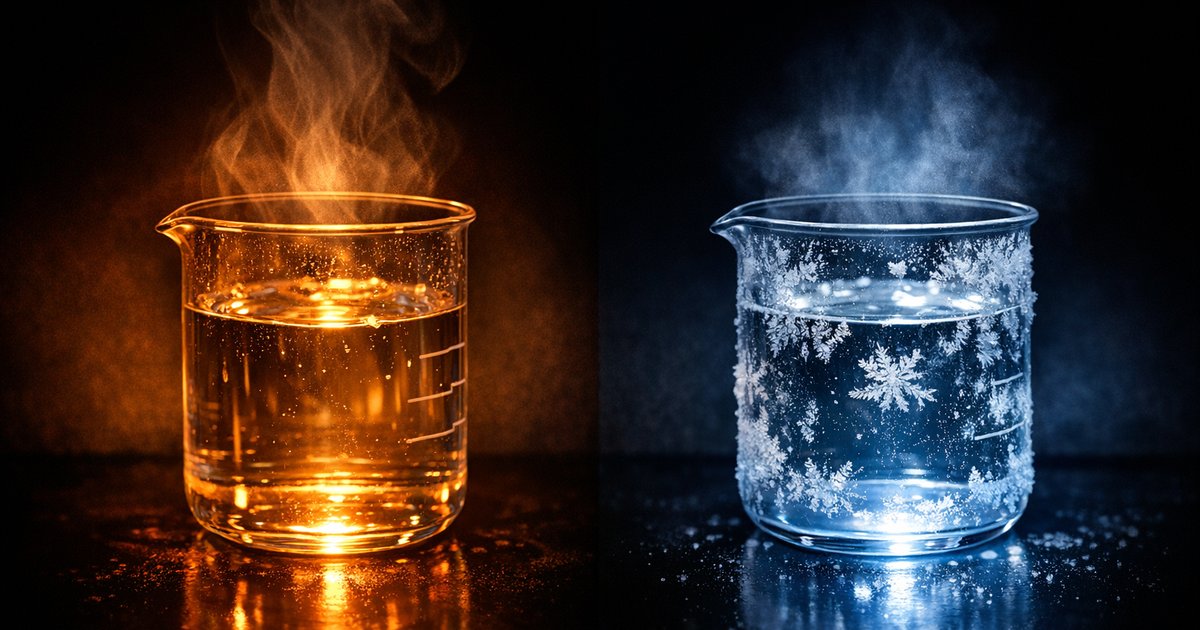
You have probably waited for a kettle to boil. You know, roughly, that it takes a couple of minutes. Now imagine filling that same kettle with ice-cold water instead of tap water. It takes noticeably longer. The water still boils in the end, but the starting conditions changed how quickly you got there. Chemical reactions work the same way: the final products might be identical, but the time it takes to reach them can vary enormously depending on the conditions you set up.
That idea is rate of reaction, and it appears across almost every paper on the Cambridge IGCSE Chemistry syllabus (0620). Understanding it well gives you a reliable route into questions on experimental design, graph interpretation and collision theory. So let's start with a clean definition and build from there.
Definition
Rate of reaction is the speed at which reactants are converted into products. More precisely, it is the change in the amount (or concentration) of a reactant or product per unit time. A fast reaction (like an explosion) converts large amounts in a very short time. A slow reaction (like iron rusting) converts small amounts over days, weeks or even years.
Key Facts
- Rate of reaction measures how fast reactants turn into products.
- It can be calculated by measuring the volume of gas produced over time, the mass lost over time, or the time taken for a visible change (such as a cross disappearing behind a cloudy solution).
- Collision theory explains why different conditions change the rate.
- Four main factors affect rate: temperature, concentration (or pressure for gases), surface area, and the presence of a catalyst.
- On a graph, a steeper curve means a faster reaction. The curve levels off when the reaction is complete.
- A catalyst speeds up a reaction without being used up and works by lowering the activation energy.
Collision theory: the engine behind every rate question
Before you can explain why temperature or concentration changes the rate, you need the theory that ties everything together. Here it is in plain terms.
For a reaction to happen, particles of the reactants must collide. But not every collision leads to a reaction. Two conditions have to be met:
- The particles must collide with enough energy. The minimum energy needed for a successful collision is called the activation energy. Any collision below that energy threshold just bounces off without reacting.
- The particles must collide with the correct orientation. Even if two particles smash together with plenty of energy, they need to hit in the right geometric arrangement for bonds to break and reform.
A collision that meets both conditions is called a successful collision (sometimes called an "effective collision"). The rate of reaction depends on how many successful collisions happen per second. Anything that increases the frequency of collisions, or the proportion of collisions with enough energy, will speed the reaction up.
Four factors that change the rate
Every factor the IGCSE exam can ask about works through collision theory. Learn the factor, then explain it in terms of collisions, and you'll pick up the full marks every time.
1. Temperature
Raising the temperature makes particles move faster. Faster-moving particles collide more often and with greater energy. Both effects matter: there are more collisions per second, and a larger proportion of those collisions exceed the activation energy. The result is a faster rate of reaction.
2. Concentration (and pressure for gases)
Increasing the concentration of a solution means packing more solute particles into the same volume. More particles in the same space means more frequent collisions, which means more successful collisions per second and a faster rate. For gaseous reactions, increasing the pressure has the same effect: the particles are squeezed closer together.
3. Surface area
Breaking a solid into smaller pieces exposes more of its surface to the other reactant. A whole marble chip reacting with acid only lets acid touch the outer surface. Crush that chip into powder and suddenly every tiny grain has acid touching it. More exposed surface means more collisions happening at once, so the reaction is faster.
This is why IGCSE Chemistry exams often compare a lump of calcium carbonate with powdered calcium carbonate reacting with hydrochloric acid. Same total mass, same acid, but the powder reacts much faster because its surface area is far greater.
4. Catalysts
A catalyst is a substance that increases the rate of a reaction without being chemically changed or used up at the end. It works by providing an alternative reaction pathway with a lower activation energy. Because the energy barrier is lower, a greater proportion of collisions now have enough energy to succeed, so the rate increases.
Catalysts are not consumed, so a small amount can speed up a large quantity of reaction. They are specific: a catalyst for one reaction may do nothing for a different one. Biological catalysts (enzymes) follow the same principle.
Summary table
| Factor | Change | Effect on rate | Collision theory explanation |
|---|---|---|---|
| Temperature | Increase | Faster | Particles move faster; more frequent collisions and more collisions exceed activation energy |
| Concentration | Increase | Faster | More particles per unit volume; more frequent collisions |
| Surface area | Increase (smaller pieces) | Faster | More surface exposed to other reactant; more collisions at the same time |
| Catalyst | Added | Faster | Lowers activation energy; greater proportion of collisions are successful |
Reading rate-of-reaction graphs
Graphs are one of the IGCSE examiners' favourite tools for testing this topic. You will almost always see a curve of "volume of gas produced" (y-axis) against "time" (x-axis), or sometimes "mass of flask and contents" against "time." Here is how to read them confidently.
- The steeper the curve, the faster the reaction. A steep initial slope means lots of product is forming quickly. A gentle slope means the reaction is slower.
- The curve levels off when the reaction is complete. Once all the limiting reactant has been used up, no more product can form, so the line becomes flat (horizontal).
- Two curves on the same axes let you compare rates. If one curve is steeper at the start, that reaction was faster. If both curves level off at the same final volume, the same total amount of product was made (meaning the same amount of limiting reactant was present). If one curve levels off at a lower volume, less product was formed, which tells you less reactant was available.
When the exam asks you to compare two experiments on a graph, use three observations: which curve is steeper (faster initial rate), which levels off first (finishes sooner), and whether they reach the same final value (same total product or different).
How changing conditions shifts the graph
| Change made | Effect on curve shape | Effect on final volume |
|---|---|---|
| Higher temperature (same amounts) | Steeper initial slope | Same final volume |
| Higher concentration (same total moles) | Steeper initial slope | Same final volume |
| Smaller pieces (same mass) | Steeper initial slope | Same final volume |
| Catalyst added (same amounts) | Steeper initial slope | Same final volume |
| Less acid used (limiting reactant reduced) | May be less steep | Lower final volume |
Measuring rate of reaction in the lab
The IGCSE Chemistry syllabus expects you to know three practical methods for measuring rate. Each tracks a different observable change over time.
- Gas syringe method: Collect the gas produced in a syringe and record the volume at regular time intervals. Plot volume against time. This works well for reactions that produce a gas (e.g. magnesium reacting with hydrochloric acid to produce hydrogen).
- Mass loss method: Place the reaction flask on a balance and record the mass at intervals. As gas escapes, the mass decreases. Plot mass lost against time. This is commonly used for calcium carbonate reacting with acid (carbon dioxide escapes).
- Disappearing cross method (the "sodium thiosulfate and acid" experiment): A cross is drawn on paper beneath the flask. Sodium thiosulfate reacts with hydrochloric acid to produce a cloudy sulfur precipitate. Time how long it takes for the cross to disappear from view. A shorter time means a faster rate. This method gives a single data point per experiment rather than a continuous curve.
Worked exam-style question
(a) Sketch two curves on the same axes to show the expected results. Label them Curve A (lumps) and Curve B (powder). [3 marks]
(b) Explain, using collision theory, why the shapes of the two curves differ. [3 marks]
(c) State and explain one change the student could make to increase the rate of reaction further, without changing the calcium carbonate. [2 marks]
Answer (a): Both curves start at the origin. Curve B (powder) rises steeply and levels off quickly at a certain final volume. Curve A (lumps) rises more gradually and levels off at the same final volume but takes longer to get there. Both curves plateau at the same height because the same mass of calcium carbonate and the same amount of acid were used, so the same total volume of CO2 is produced.
Answer (b): The powdered calcium carbonate has a much larger surface area than the lumps. A larger surface area means more calcium carbonate particles are exposed to the hydrochloric acid at any given moment. This increases the frequency of collisions between acid particles and carbonate particles per unit time. More frequent collisions mean more successful collisions per second, so the rate of reaction is faster and the curve is steeper.
Answer (c): Increase the temperature. At a higher temperature, the acid particles have more kinetic energy, so they move faster. This increases both the frequency of collisions and the proportion of collisions that exceed the activation energy, resulting in a faster rate of reaction.
Common exam mistakes to avoid
- Writing "particles move faster" without linking to collisions. Always complete the chain: particles move faster, so they collide more often, and more collisions have enough energy to overcome the activation energy.
- Saying a catalyst "gives energy" to the particles. A catalyst does not add energy. It provides an alternative pathway with a lower activation energy.
- Forgetting that the final volume of gas stays the same when you only change rate factors (temperature, surface area, catalyst) but keep the amounts of reactants the same. Only changing the amount of the limiting reactant changes the final volume.
- Confusing rate with total amount of product. A faster reaction does not make more product. It makes the same product in less time.
- Using "react" instead of "collide" in collision theory answers. Particles collide first. Only successful collisions lead to a reaction. The distinction matters for full marks.
Self-check questions
These are styled after real IGCSE exam questions. Try each one on paper before checking the answer. Writing it out, rather than just reading, builds the recall you need in the exam hall.
Question 1: Define rate of reaction in one sentence.
Reveal Answer
Rate of reaction is the change in the amount of reactant used up, or product formed, per unit time.
Question 2: A student carries out the sodium thiosulfate and hydrochloric acid experiment at 20 degrees Celsius and the cross disappears after 45 seconds. She repeats it at 40 degrees Celsius and the cross disappears after 18 seconds. Explain, using collision theory, why the reaction was faster at 40 degrees Celsius.
Reveal Answer
At 40 degrees Celsius the particles have more kinetic energy and move faster. They collide more frequently, and a greater proportion of those collisions have energy equal to or greater than the activation energy. This means more successful collisions occur per second, so the sulfur precipitate forms faster and the cross disappears sooner.
Question 3: On a graph of volume of gas against time, how can you tell which of two reactions was faster?
Reveal Answer
The reaction with the steeper initial slope (curve rises more sharply at the start) was faster. A steeper gradient means more gas was produced per unit time.
Question 4: Explain why adding a catalyst does not change the total volume of gas produced in a reaction.
Reveal Answer
A catalyst speeds up the reaction by lowering the activation energy, but it does not change the amounts of reactants present. Since the same amount of reactant is available to react, the same total amount of product (and therefore the same volume of gas) is formed. The reaction simply reaches that final volume sooner.
Question 5: A student has large marble chips and dilute hydrochloric acid. Describe two changes she could make to increase the rate of reaction, and explain each using collision theory.
Reveal Answer
First, she could crush the marble chips into a powder. This increases the surface area, exposing more calcium carbonate particles to the acid, which increases the frequency of collisions and therefore the rate. Second, she could heat the acid to a higher temperature. Higher temperature gives particles more kinetic energy, so they collide more often and with greater energy, meaning more collisions exceed the activation energy and the rate increases.

This guide explains rate of reaction for Cambridge IGCSE Chemistry, covering the definition, collision theory, factors that speed up or slow down reactions (temperature, concentration, surface area and catalysts), how to read rate-of-reaction graphs, and common exam traps. Everyday analogies, worked examples and self-check questions help you revise with confidence.

Comment(s)