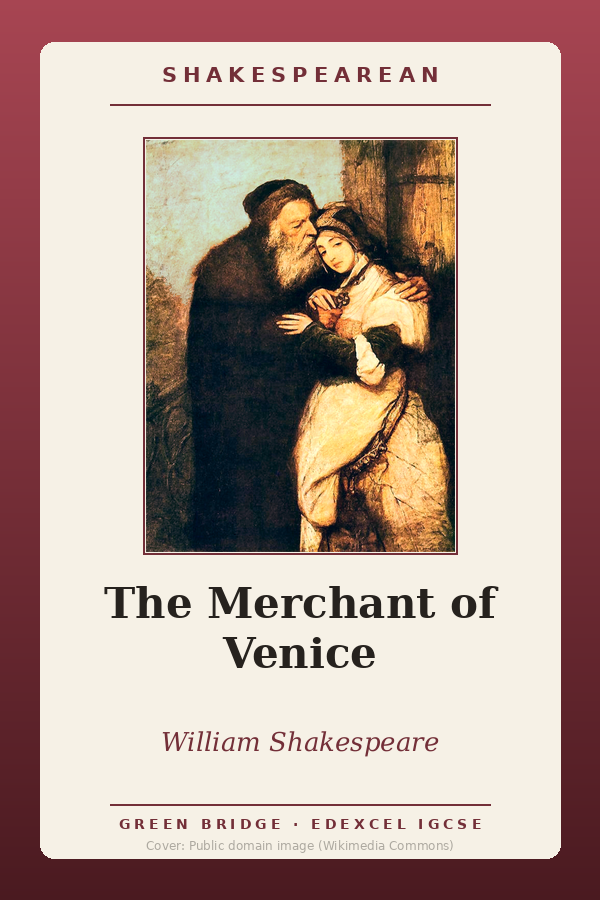
The Merchant of Venice
Pearson Edexcel International GCSE English Literature (4ET1) set text - complete study and revision guide
Overview
The Merchant of Venice (written around 1596-1597) is one of Shakespeare's most debated plays, classified sometimes as a comedy and sometimes as a problem play. It interweaves two main plots: the bond between the merchant Antonio and the Jewish moneylender Shylock, and the romantic quest of Bassanio to win the hand of the wealthy heiress Portia at Belmont. The play explores themes of justice and mercy, prejudice and exclusion, love and loyalty, and the relationship between appearance and reality.
Setting
The action alternates between two contrasting worlds: Venice, the great commercial city where money, law and trade dominate, and Belmont, Portia's country estate, a place of music, romance and fairy-tale casket tests. Venice is a world of contracts and obligations; Belmont is a world of love and generosity. The play's dramatic tension arises from the collision of these two worlds when Portia travels to Venice disguised as the lawyer Balthazar to save Antonio's life.
The central movement
Bassanio borrows three thousand ducats from Shylock, using Antonio's credit, to fund his courtship of Portia. The bond specifies a pound of Antonio's flesh as the penalty for default. Bassanio wins Portia by choosing the lead casket, but news arrives that Antonio's ships have been lost and Shylock demands his bond. Portia, disguised as a young lawyer, defeats Shylock in the courtroom by insisting on the exact letter of the law: flesh but no blood. Shylock loses his wealth, his religion and his dignity. The play ends at Belmont with the resolution of the ring plot and the news that Antonio's ships have returned safely.
Why it matters for the exam
For the Pearson Edexcel International GCSE English Literature qualification, The Merchant of Venice is a Component 2/3 Literary Heritage text. Component 2 is an open book examination (Section B, 30-mark essay, assessing AO1, AO2 and AO4). You must be able to analyse how Shakespeare presents characters, themes and ideas, using specific textual evidence. Component 3 offers a non-examined assessment route to the same content. This guide provides scene-by-scene analysis, character studies, themes, grounded quotations, key passages and full essay practice to help you prepare.
The rest of the study guide
Chapter breakdowns, quotations and exam practice for this text are in the app.
- Chapter by chapter breakdown
- Key quotations, explained
- Character studies
- Themes and motifs
- Essay prompts and model answers
Literature summary available on the Green Bridge App
Get the Green Bridge CBT app on your phone or computer for the complete IGCSE library: past papers, mark schemes, mind maps, flashcards and audio lessons.