The Bhagavad Gita (prescribed selections)
The Song of the Lord: Krishna's teaching to Arjuna, from the Mahabharata
Overview
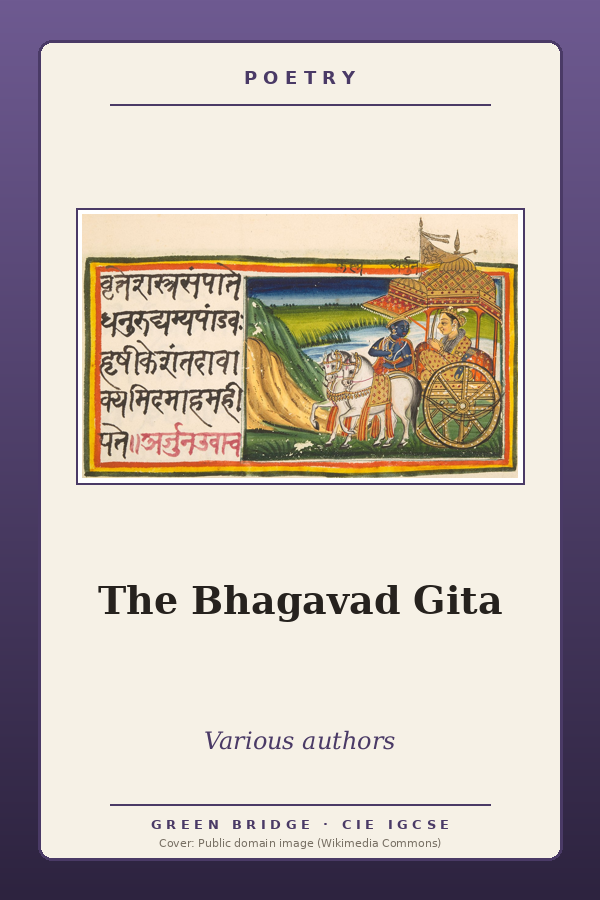
The Bhagavad Gita ('Song of the Lord') is a dialogue of about 700 verses set within the great Sanskrit epic, the Mahabharata. On the eve of the battle of Kurukshetra, the warrior-prince Arjuna, seeing his own kinsmen, teachers and friends arrayed against him in the enemy ranks, is overwhelmed by grief and refuses to fight. His charioteer, who is the god Krishna in human form, answers his despair with a sustained teaching on duty, the nature of the soul, action, knowledge and devotion.
The prescribed selection covers the heart of that teaching. In Chapter I Arjuna's spirit collapses: he lets his bow Gandiva slip from his hand and sinks down in the chariot. In Chapter II (Sankhya-Yoga) Krishna rebuts his grief on two grounds: first that the soul (atman) is immortal and indestructible, so death is only the soul's changing of bodies as a man changes worn-out clothes; and second that Arjuna's duty (svadharma) as a warrior is to fight a righteous war, performing action without attachment to its fruits - the famous doctrine of karma-yoga: 'Let right deeds be thy motive, not the fruit which comes from them.' In Chapter XII (Bhakti-Yoga) Krishna teaches that loving devotion to God is the surest path of all, open to everyone, and describes the qualities of the devotee who is dear to him.
The Gita is at once a chapter of an epic, a religious scripture central to Hindu thought, and a profound philosophical poem on how to act rightly in the world.
The rest of the study guide
Chapter breakdowns, quotations and exam practice for this text are in the app.
- Chapter by chapter breakdown
- Key quotations, explained
- Character studies
- Themes and motifs
- Essay prompts and model answers
Literature summary available on the Green Bridge App
Get the Green Bridge CBT app on your phone or computer for the complete IGCSE library: past papers, mark schemes, mind maps, flashcards and audio lessons.