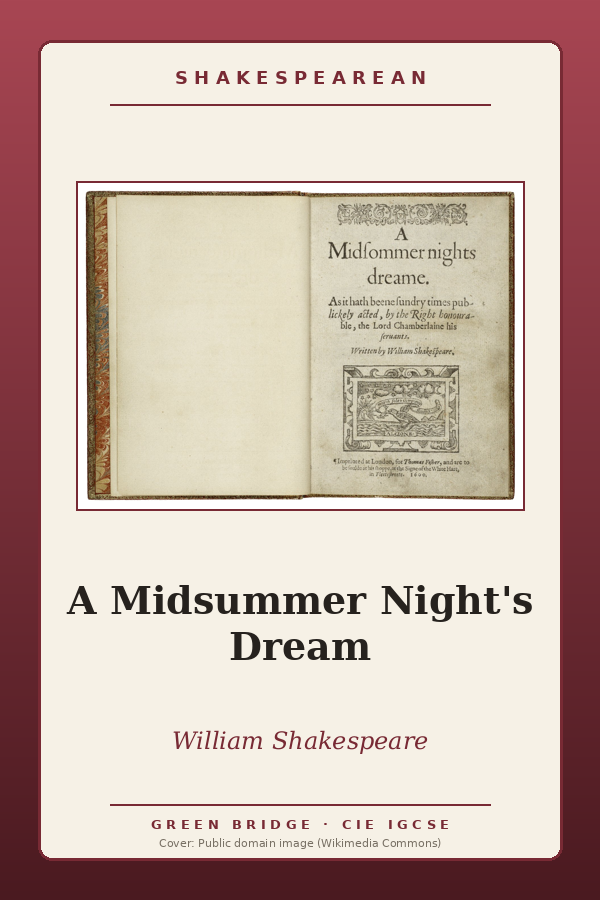
A Midsummer Night's Dream
Cambridge IGCSE Literature in English (0992) set text - complete study and revision guide
Overview
A Midsummer Night's Dream (written about 1595-96) is Shakespeare's best-loved romantic comedy. It weaves together four worlds: the court of Duke Theseus of Athens, who is preparing to marry Hippolyta; four young Athenian lovers (Hermia, Lysander, Helena, Demetrius) whose tangled affections are thrown into chaos in the wood; a band of amateur actors, the 'mechanicals', led by the weaver Bottom, rehearsing a play for the wedding; and the fairy king and queen, Oberon and Titania, whose own quarrel disorders the natural world. The mischievous sprite Puck sets the comic confusion in motion with a magic love-juice.
Setting
The play moves from the rational, daylight world of Athens, governed by law and the authority of Theseus and the father Egeus, into the moonlit wood outside the city, a magical 'green world' where identities dissolve, lovers are bewitched, and ordinary rules no longer hold. The journey out into the wood and back to Athens mirrors the movement of festive comedy from order, through liberating disorder, to a renewed and happier order.
The central movement
Egeus insists his daughter Hermia marry Demetrius, though she loves Lysander; Athenian law threatens her with death or a convent. The lovers flee into the wood, where Oberon's love-juice, misapplied by Puck, makes both young men suddenly adore Helena and abandon Hermia, producing a night of jealousy, insult and farce. Meanwhile Titania, also charmed, falls in love with Bottom, whose head Puck has turned into that of an ass. By morning the magic is undone, the right couples are united, Theseus overrules Egeus, and three weddings are crowned by the mechanicals' gloriously inept performance of Pyramus and Thisbe. Puck's epilogue invites us to think of the whole as a dream.
Why it matters for the exam
For Cambridge IGCSE Drama you must discuss how Shakespeare creates comedy and meaning on the stage: his contrasts of verse and prose, his dramatic irony, his stagecraft, and the way the play explores love, imagination and transformation. This guide gives you a scene-by-scene account, the characters, themes, context, language and dramatic technique, key passages, a quotation bank and full exam practice, with attention throughout to performance and theatrical effect.
The rest of the study guide
Chapter breakdowns, quotations and exam practice for this text are in the app.
- Chapter by chapter breakdown
- Key quotations, explained
- Character studies
- Themes and motifs
- Essay prompts and model answers
Literature summary available on the Green Bridge App
Get the Green Bridge CBT app on your phone or computer for the complete IGCSE library: past papers, mark schemes, mind maps, flashcards and audio lessons.