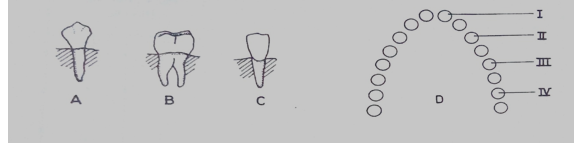
Diagrams A, B and C are illustrations of different types of teeth in humans. Diagram D is a representation of the arrangement of teeth in the lower jaw of a human.
Study them and answer questions (a) to (f).
(a) (i) Name the type of teeth in diagrams A, B, and C.
(ii) Which of the teeth would be found in positions I, II and IV?
(iii)State one function each of the teeth illustrated in diagrams A, B and C.
(iv) State one reason each for the answers in (a) (iii).
(b)If the tooth labeled B is decayed, list two factors that may be responsible.
(c)What is the total number of each of the teeth labeled A, B and C in the dentition of an adult human?
(d)Which of the teeth would be absent in a rabbit?
(e)(i) Name the tooth that would be found in position III of diagram D.
(ii) In which of the parts labeled I, II, III and IV would a tooth not be found in an infant?
(f) State five ways of caring for the teeth in humans.
(a)(i) Type of teeth in A, B and C:
- A = Canine
- B = Molar
- C = Incisor
(a)(ii) Teeth found in positions I, II and IV:
- I = Incisor
- II = Canine
- IV = Molar
(a)(iii) One function each
- A (canine): for tearing flesh and piercing food.
- B (molar): for breaking, crushing, chewing and grinding food.
- C (incisor): for cutting and biting food.
(a)(iv) One reason each
- A (canine): it is conical, sharp and pointed.
- B (molar): it is broad with ridges (cusps) on its surface.
- C (incisor): it has a flat, sharp, chisel-shaped edge.
(b) Two factors that may cause decay of tooth B
- Accumulation of acid together with bacterial (microbial) activity on the tooth.
- Food remnants from sweet, sugary or sticky foods, and lack of proper dental care.
(c) Total number in the dentition of an adult human
- A (canines): 4
- B (molars): 12
- C (incisors): 8
(d) Tooth absent in a rabbit: the canine (tooth A). A rabbit has a gap (diastema) in its place.
(e)(i) Tooth in position III of diagram D: premolar.
(e)(ii) Position where a tooth is not found in an infant: position IV (the molar), because molars are absent in the milk (deciduous) dentition.
(f) Five ways of caring for the teeth
- Brush the teeth regularly, after meals and before going to bed.
- Reduce the intake of sweet, sticky and sugary foods, and avoid smoking and excessive alcohol.
- Eat foods rich in vitamins and minerals, such as fruits, for strong teeth.
- Remove food particles with a tooth pick and floss the teeth.
- Visit the dentist at least twice a year (every six months) for check-ups.
(a)(i) Type of teeth in A, B and C:
- A = Canine
- B = Molar
- C = Incisor
(a)(ii) Teeth found in positions I, II and IV:
- I = Incisor
- II = Canine
- IV = Molar
(a)(iii) One function each
- A (canine): for tearing flesh and piercing food.
- B (molar): for breaking, crushing, chewing and grinding food.
- C (incisor): for cutting and biting food.
(a)(iv) One reason each
- A (canine): it is conical, sharp and pointed.
- B (molar): it is broad with ridges (cusps) on its surface.
- C (incisor): it has a flat, sharp, chisel-shaped edge.
(b) Two factors that may cause decay of tooth B
- Accumulation of acid together with bacterial (microbial) activity on the tooth.
- Food remnants from sweet, sugary or sticky foods, and lack of proper dental care.
(c) Total number in the dentition of an adult human
- A (canines): 4
- B (molars): 12
- C (incisors): 8
(d) Tooth absent in a rabbit: the canine (tooth A). A rabbit has a gap (diastema) in its place.
(e)(i) Tooth in position III of diagram D: premolar.
(e)(ii) Position where a tooth is not found in an infant: position IV (the molar), because molars are absent in the milk (deciduous) dentition.
(f) Five ways of caring for the teeth
- Brush the teeth regularly, after meals and before going to bed.
- Reduce the intake of sweet, sticky and sugary foods, and avoid smoking and excessive alcohol.
- Eat foods rich in vitamins and minerals, such as fruits, for strong teeth.
- Remove food particles with a tooth pick and floss the teeth.
- Visit the dentist at least twice a year (every six months) for check-ups.
