WAEC SSCE - Further Mathematics - 2014 (Essay)
Question 1 Report

Find the direction of the resultant of the forces in the diagram.
Reading the diagram, the three forces make these angles, measured anticlockwise from the positive \(x\)-axis:
- \(8\sqrt2\ \text{N}\): \(45^\circ\) from the \(y\)-axis in the first quadrant, i.e. at \(45^\circ\)
- \(10\ \text{N}\): \(30^\circ\) from the \(y\)-axis in the second quadrant, i.e. at \(120^\circ\)
- \(20\ \text{N}\): \(60^\circ\) below the negative \(x\)-axis in the third quadrant, i.e. at \(240^\circ\)
Resolve horizontally:
\[\sum F_x=8\sqrt2\cos45^\circ+10\cos120^\circ+20\cos240^\circ.\]
\[\sum F_x=8\sqrt2\cdot\tfrac{\sqrt2}{2}+10(-0.5)+20(-0.5)=8-5-10=-7\ \text{N}.\]
Resolve vertically:
\[\sum F_y=8\sqrt2\sin45^\circ+10\sin120^\circ+20\sin240^\circ.\]
\[\sum F_y=8+8.660+(-17.321)=-0.660\ \text{N}.\]
Both components are negative, so the resultant lies in the third quadrant, just below the negative \(x\)-axis. The acute angle it makes with the negative \(x\)-axis is
\[\alpha=\tan^{-1}\!\left(\frac{|\sum F_y|}{|\sum F_x|}\right)=\tan^{-1}\!\left(\frac{0.660}{7}\right)=\tan^{-1}(0.0943)\approx 5.4^\circ.\]
Measured anticlockwise from the positive \(x\)-axis, the direction of the resultant is
\[\theta=180^\circ+5.4^\circ\approx \mathbf{185.4^\circ}.\]
That is, the resultant points along the negative \(x\)-direction, inclined about \(5.4^\circ\) below it. (For reference its magnitude is \(\sqrt{(-7)^2+(-0.66)^2}\approx 7.03\ \text{N}\).)
Answer Details
Reading the diagram, the three forces make these angles, measured anticlockwise from the positive \(x\)-axis:
- \(8\sqrt2\ \text{N}\): \(45^\circ\) from the \(y\)-axis in the first quadrant, i.e. at \(45^\circ\)
- \(10\ \text{N}\): \(30^\circ\) from the \(y\)-axis in the second quadrant, i.e. at \(120^\circ\)
- \(20\ \text{N}\): \(60^\circ\) below the negative \(x\)-axis in the third quadrant, i.e. at \(240^\circ\)
Resolve horizontally:
\[\sum F_x=8\sqrt2\cos45^\circ+10\cos120^\circ+20\cos240^\circ.\]
\[\sum F_x=8\sqrt2\cdot\tfrac{\sqrt2}{2}+10(-0.5)+20(-0.5)=8-5-10=-7\ \text{N}.\]
Resolve vertically:
\[\sum F_y=8\sqrt2\sin45^\circ+10\sin120^\circ+20\sin240^\circ.\]
\[\sum F_y=8+8.660+(-17.321)=-0.660\ \text{N}.\]
Both components are negative, so the resultant lies in the third quadrant, just below the negative \(x\)-axis. The acute angle it makes with the negative \(x\)-axis is
\[\alpha=\tan^{-1}\!\left(\frac{|\sum F_y|}{|\sum F_x|}\right)=\tan^{-1}\!\left(\frac{0.660}{7}\right)=\tan^{-1}(0.0943)\approx 5.4^\circ.\]
Measured anticlockwise from the positive \(x\)-axis, the direction of the resultant is
\[\theta=180^\circ+5.4^\circ\approx \mathbf{185.4^\circ}.\]
That is, the resultant points along the negative \(x\)-direction, inclined about \(5.4^\circ\) below it. (For reference its magnitude is \(\sqrt{(-7)^2+(-0.66)^2}\approx 7.03\ \text{N}\).)
Question 2 Report
(a) Given that \(x = 3i - j, y = 2i + kj\) and the cosine of the angle between x and y is \(\frac{\sqrt{5}}{5}\), find the values of the constant k.
(b) In the quadrilateral ABCD,

\(\overrightarrow{AB} = \begin{pmatrix} -5 \\ -1 \end{pmatrix}, \overrightarrow{AC} = \begin{pmatrix} -6 \\ -9 \end{pmatrix}\)
and \(\overrightarrow{BD} = \begin{pmatrix} 4 \\ -7 \end{pmatrix}\). Show whether or not ABCD is a parallelogram.
(a) With \(x=3i-j\) and \(y=2i+kj\):
\[x\cdot y=(3)(2)+(-1)(k)=6-k,\quad |x|=\sqrt{3^2+(-1)^2}=\sqrt{10},\quad |y|=\sqrt{4+k^2}.\]
Given \(\cos\theta=\dfrac{\sqrt5}{5}=\dfrac{1}{\sqrt5}\):
\[\frac{6-k}{\sqrt{10}\,\sqrt{4+k^2}}=\frac{1}{\sqrt5}.\]
Cross-multiply and square:
\[\sqrt5\,(6-k)=\sqrt{10}\,\sqrt{4+k^2}\;\Rightarrow\;5(6-k)^2=10(4+k^2).\]
\[(6-k)^2=2(4+k^2)\;\Rightarrow\;36-12k+k^2=8+2k^2.\]
\[k^2+12k-28=0\;\Rightarrow\;(k-2)(k+14)=0.\]
So \(k=2\) or \(k=-14\). Both keep \(6-k>0\) (so \(\cos\theta>0\)), hence both are valid: \(\mathbf{k=2}\) or \(\mathbf{k=-14}\).
(b) Take \(A\) as the origin. Then, using the given vectors:
\[\overrightarrow{AB}=\begin{pmatrix}-5\\-1\end{pmatrix}\Rightarrow B=(-5,-1),\qquad \overrightarrow{AC}=\begin{pmatrix}-6\\-9\end{pmatrix}\Rightarrow C=(-6,-9).\]
\[D=B+\overrightarrow{BD}=\begin{pmatrix}-5\\-1\end{pmatrix}+\begin{pmatrix}4\\-7\end{pmatrix}=\begin{pmatrix}-1\\-8\end{pmatrix}\Rightarrow D=(-1,-8).\]
For ABCD (vertices in order) to be a parallelogram, opposite sides must be equal, i.e. \(\overrightarrow{AB}=\overrightarrow{DC}\). Now
\[\overrightarrow{DC}=C-D=\begin{pmatrix}-6-(-1)\\-9-(-8)\end{pmatrix}=\begin{pmatrix}-5\\-1\end{pmatrix}=\overrightarrow{AB}.\]
Since \(\overrightarrow{AB}=\overrightarrow{DC}\), the side AB is equal and parallel to DC. As a check, \(\overrightarrow{AD}=D-A=\begin{pmatrix}-1\\-8\end{pmatrix}\) and \(\overrightarrow{BC}=C-B=\begin{pmatrix}-1\\-8\end{pmatrix}\), so \(\overrightarrow{AD}=\overrightarrow{BC}\) as well. (Equivalently, the diagonals bisect each other: midpoint of \(AC=(-3,-4.5)=\) midpoint of \(BD\).)
Therefore ABCD is a parallelogram.
Answer Details
(a) With \(x=3i-j\) and \(y=2i+kj\):
\[x\cdot y=(3)(2)+(-1)(k)=6-k,\quad |x|=\sqrt{3^2+(-1)^2}=\sqrt{10},\quad |y|=\sqrt{4+k^2}.\]
Given \(\cos\theta=\dfrac{\sqrt5}{5}=\dfrac{1}{\sqrt5}\):
\[\frac{6-k}{\sqrt{10}\,\sqrt{4+k^2}}=\frac{1}{\sqrt5}.\]
Cross-multiply and square:
\[\sqrt5\,(6-k)=\sqrt{10}\,\sqrt{4+k^2}\;\Rightarrow\;5(6-k)^2=10(4+k^2).\]
\[(6-k)^2=2(4+k^2)\;\Rightarrow\;36-12k+k^2=8+2k^2.\]
\[k^2+12k-28=0\;\Rightarrow\;(k-2)(k+14)=0.\]
So \(k=2\) or \(k=-14\). Both keep \(6-k>0\) (so \(\cos\theta>0\)), hence both are valid: \(\mathbf{k=2}\) or \(\mathbf{k=-14}\).
(b) Take \(A\) as the origin. Then, using the given vectors:
\[\overrightarrow{AB}=\begin{pmatrix}-5\\-1\end{pmatrix}\Rightarrow B=(-5,-1),\qquad \overrightarrow{AC}=\begin{pmatrix}-6\\-9\end{pmatrix}\Rightarrow C=(-6,-9).\]
\[D=B+\overrightarrow{BD}=\begin{pmatrix}-5\\-1\end{pmatrix}+\begin{pmatrix}4\\-7\end{pmatrix}=\begin{pmatrix}-1\\-8\end{pmatrix}\Rightarrow D=(-1,-8).\]
For ABCD (vertices in order) to be a parallelogram, opposite sides must be equal, i.e. \(\overrightarrow{AB}=\overrightarrow{DC}\). Now
\[\overrightarrow{DC}=C-D=\begin{pmatrix}-6-(-1)\\-9-(-8)\end{pmatrix}=\begin{pmatrix}-5\\-1\end{pmatrix}=\overrightarrow{AB}.\]
Since \(\overrightarrow{AB}=\overrightarrow{DC}\), the side AB is equal and parallel to DC. As a check, \(\overrightarrow{AD}=D-A=\begin{pmatrix}-1\\-8\end{pmatrix}\) and \(\overrightarrow{BC}=C-B=\begin{pmatrix}-1\\-8\end{pmatrix}\), so \(\overrightarrow{AD}=\overrightarrow{BC}\) as well. (Equivalently, the diagonals bisect each other: midpoint of \(AC=(-3,-4.5)=\) midpoint of \(BD\).)
Therefore ABCD is a parallelogram.
Question 3 Report
(a) A(-1, 2), B(3, 5) and C(4, 8) are the vertices of triangle ABC. Forces whose magnitudes are 5N and \(3\sqrt{10}\)N act along \(\overrightarrow{AB}\) and \(\overrightarrow{CB}\) respectively. Find the direction of the resultant of the forces.
(b) A particle starts from rest and moves in a straight line. It attains a velocity of 20 m/s after covering a distance of 8 metres. Calculate :
(i) its acceleration ; (ii) the time it will take to cover a distance of 40 metres.
(a) Direction of the resultant of the two forces.
\(\overrightarrow{AB}=B-A=(3-(-1),\,5-2)=(4,3),\) with \(|\overrightarrow{AB}|=\sqrt{16+9}=5.\) A force of 5 N along \(\overrightarrow{AB}\) is \(\mathbf{F_1}=5\cdot\dfrac{(4,3)}{5}=(4,3).\)
\(\overrightarrow{CB}=B-C=(3-4,\,5-8)=(-1,-3),\) with \(|\overrightarrow{CB}|=\sqrt{1+9}=\sqrt{10}.\) A force of \(3\sqrt{10}\) N along \(\overrightarrow{CB}\) is \(\mathbf{F_2}=3\sqrt{10}\cdot\dfrac{(-1,-3)}{\sqrt{10}}=(-3,-9).\)
Resultant \(\mathbf{R}=\mathbf{F_1}+\mathbf{F_2}=(4-3,\,3-9)=(1,-6).\)
The resultant lies in the fourth quadrant. Its direction with the positive x-axis:
\[\theta=\tan^{-1}\!\left(\frac{-6}{1}\right),\qquad \tan^{-1}6=80.5^\circ.\]
So the resultant acts at \(80.5^\circ\) below the positive x-axis (equivalently a direction of \(-80.5^\circ,\) or \(279.5^\circ\) measured anticlockwise). Its magnitude, for reference, is \(\sqrt{1^2+6^2}=\sqrt{37}\approx6.08\text{ N}.\)
(b) Straight-line motion from rest.
(i) Acceleration. \(u=0,\ v=20\text{ m/s},\ s=8\text{ m}.\) Using \(v^2=u^2+2as:\)
\[400=0+2a(8)\Rightarrow a=\frac{400}{16}=25\text{ m/s}^2.\]
(ii) Time to cover 40 m. Using \(s=ut+\tfrac12 at^2\) with \(u=0:\)
\[40=\tfrac12(25)t^2\Rightarrow t^2=\frac{40}{12.5}=3.2\Rightarrow t=\sqrt{3.2}\approx1.79\text{ s}.\]
Answer Details
(a) Direction of the resultant of the two forces.
\(\overrightarrow{AB}=B-A=(3-(-1),\,5-2)=(4,3),\) with \(|\overrightarrow{AB}|=\sqrt{16+9}=5.\) A force of 5 N along \(\overrightarrow{AB}\) is \(\mathbf{F_1}=5\cdot\dfrac{(4,3)}{5}=(4,3).\)
\(\overrightarrow{CB}=B-C=(3-4,\,5-8)=(-1,-3),\) with \(|\overrightarrow{CB}|=\sqrt{1+9}=\sqrt{10}.\) A force of \(3\sqrt{10}\) N along \(\overrightarrow{CB}\) is \(\mathbf{F_2}=3\sqrt{10}\cdot\dfrac{(-1,-3)}{\sqrt{10}}=(-3,-9).\)
Resultant \(\mathbf{R}=\mathbf{F_1}+\mathbf{F_2}=(4-3,\,3-9)=(1,-6).\)
The resultant lies in the fourth quadrant. Its direction with the positive x-axis:
\[\theta=\tan^{-1}\!\left(\frac{-6}{1}\right),\qquad \tan^{-1}6=80.5^\circ.\]
So the resultant acts at \(80.5^\circ\) below the positive x-axis (equivalently a direction of \(-80.5^\circ,\) or \(279.5^\circ\) measured anticlockwise). Its magnitude, for reference, is \(\sqrt{1^2+6^2}=\sqrt{37}\approx6.08\text{ N}.\)
(b) Straight-line motion from rest.
(i) Acceleration. \(u=0,\ v=20\text{ m/s},\ s=8\text{ m}.\) Using \(v^2=u^2+2as:\)
\[400=0+2a(8)\Rightarrow a=\frac{400}{16}=25\text{ m/s}^2.\]
(ii) Time to cover 40 m. Using \(s=ut+\tfrac12 at^2\) with \(u=0:\)
\[40=\tfrac12(25)t^2\Rightarrow t^2=\frac{40}{12.5}=3.2\Rightarrow t=\sqrt{3.2}\approx1.79\text{ s}.\]
Question 4 Report
A committee of 3 is formed from a panel of 5 men and 3 women. Find the :
(a) number of ways of forming the committee ;
(b) probability that at least one woman is on the committee.
The panel has \(5\) men and \(3\) women, i.e. \(8\) people, from which a committee of \(3\) is chosen. Order does not matter, so we use combinations.
(a) Number of ways of forming the committee
\[\binom{8}{3}=\frac{8\times 7\times 6}{3\times 2\times 1}=56.\]
There are \(56\) possible committees.
(b) Probability that at least one woman is on the committee
Use the complement "no woman", i.e. an all-men committee chosen from the \(5\) men:
\[\binom{5}{3}=\frac{5\times 4\times 3}{3\times 2\times 1}=10.\]
\[P(\text{no woman})=\frac{10}{56}=\frac{5}{28}.\]
Therefore
\[P(\text{at least one woman})=1-\frac{5}{28}=\frac{23}{28}.\]
Answer Details
The panel has \(5\) men and \(3\) women, i.e. \(8\) people, from which a committee of \(3\) is chosen. Order does not matter, so we use combinations.
(a) Number of ways of forming the committee
\[\binom{8}{3}=\frac{8\times 7\times 6}{3\times 2\times 1}=56.\]
There are \(56\) possible committees.
(b) Probability that at least one woman is on the committee
Use the complement "no woman", i.e. an all-men committee chosen from the \(5\) men:
\[\binom{5}{3}=\frac{5\times 4\times 3}{3\times 2\times 1}=10.\]
\[P(\text{no woman})=\frac{10}{56}=\frac{5}{28}.\]
Therefore
\[P(\text{at least one woman})=1-\frac{5}{28}=\frac{23}{28}.\]
Question 5 Report
Find the gradient of \(xy^{2} + x^{2} y = 4xy\) at the point (1, 3).
Differentiate \(xy^{2}+x^{2}y=4xy\) implicitly with respect to \(x\), treating \(y\) as a function of \(x\) and using the product rule on each term.
\[\underbrace{y^{2}+2xy\frac{dy}{dx}}_{\frac{d}{dx}(xy^{2})}+\underbrace{2xy+x^{2}\frac{dy}{dx}}_{\frac{d}{dx}(x^{2}y)}=\underbrace{4y+4x\frac{dy}{dx}}_{\frac{d}{dx}(4xy)}.\]
Collect the \(\dfrac{dy}{dx}\) terms on one side:
\[(2xy+x^{2}-4x)\frac{dy}{dx}=4y-y^{2}-2xy,\]
\[\frac{dy}{dx}=\frac{4y-y^{2}-2xy}{2xy+x^{2}-4x}.\]
Substitute the point \((1,3)\):
\[\text{Numerator}=4(3)-3^{2}-2(1)(3)=12-9-6=-3,\]
\[\text{Denominator}=2(1)(3)+1^{2}-4(1)=6+1-4=3.\]
\[\frac{dy}{dx}=\frac{-3}{3}=-1.\]
The gradient at \((1,3)\) is \(-1\).
Answer Details
Differentiate \(xy^{2}+x^{2}y=4xy\) implicitly with respect to \(x\), treating \(y\) as a function of \(x\) and using the product rule on each term.
\[\underbrace{y^{2}+2xy\frac{dy}{dx}}_{\frac{d}{dx}(xy^{2})}+\underbrace{2xy+x^{2}\frac{dy}{dx}}_{\frac{d}{dx}(x^{2}y)}=\underbrace{4y+4x\frac{dy}{dx}}_{\frac{d}{dx}(4xy)}.\]
Collect the \(\dfrac{dy}{dx}\) terms on one side:
\[(2xy+x^{2}-4x)\frac{dy}{dx}=4y-y^{2}-2xy,\]
\[\frac{dy}{dx}=\frac{4y-y^{2}-2xy}{2xy+x^{2}-4x}.\]
Substitute the point \((1,3)\):
\[\text{Numerator}=4(3)-3^{2}-2(1)(3)=12-9-6=-3,\]
\[\text{Denominator}=2(1)(3)+1^{2}-4(1)=6+1-4=3.\]
\[\frac{dy}{dx}=\frac{-3}{3}=-1.\]
The gradient at \((1,3)\) is \(-1\).
Question 6 Report
The position vectors of P, Q and R are \(11i + j, 5i + \frac{13}{3}j\) and \(2i + 6j\) respectively.
(a) Show that P, Q and R lie on a straight line.
(b) Find the ratio of \(|\overrightarrow{PQ}| : |\overrightarrow{QR}|\)
The position vectors give \(P(11,1)\), \(Q\left(5,\tfrac{13}{3}\right)\), \(R(2,6)\).
(a) Show P, Q, R are collinear
Find the displacement vectors \(\overrightarrow{PQ}\) and \(\overrightarrow{QR}\):
\[\overrightarrow{PQ}=Q-P=\left(5-11,\;\tfrac{13}{3}-1\right)=\left(-6,\;\tfrac{10}{3}\right),\]
\[\overrightarrow{QR}=R-Q=\left(2-5,\;6-\tfrac{13}{3}\right)=\left(-3,\;\tfrac{5}{3}\right).\]
Compare them: \(\overrightarrow{PQ}=2\left(-3,\tfrac{5}{3}\right)=2\,\overrightarrow{QR}\). Since \(\overrightarrow{PQ}\) is a scalar multiple of \(\overrightarrow{QR}\), the two vectors are parallel; and because they share the common point \(Q\), the points \(P\), \(Q\) and \(R\) lie on one straight line.
(b) Ratio \(|\overrightarrow{PQ}|:|\overrightarrow{QR}|\)
From \(\overrightarrow{PQ}=2\,\overrightarrow{QR}\), the magnitudes satisfy \(|\overrightarrow{PQ}|=2\,|\overrightarrow{QR}|\). Hence
\[|\overrightarrow{PQ}|:|\overrightarrow{QR}|=2:1.\]
Answer Details
The position vectors give \(P(11,1)\), \(Q\left(5,\tfrac{13}{3}\right)\), \(R(2,6)\).
(a) Show P, Q, R are collinear
Find the displacement vectors \(\overrightarrow{PQ}\) and \(\overrightarrow{QR}\):
\[\overrightarrow{PQ}=Q-P=\left(5-11,\;\tfrac{13}{3}-1\right)=\left(-6,\;\tfrac{10}{3}\right),\]
\[\overrightarrow{QR}=R-Q=\left(2-5,\;6-\tfrac{13}{3}\right)=\left(-3,\;\tfrac{5}{3}\right).\]
Compare them: \(\overrightarrow{PQ}=2\left(-3,\tfrac{5}{3}\right)=2\,\overrightarrow{QR}\). Since \(\overrightarrow{PQ}\) is a scalar multiple of \(\overrightarrow{QR}\), the two vectors are parallel; and because they share the common point \(Q\), the points \(P\), \(Q\) and \(R\) lie on one straight line.
(b) Ratio \(|\overrightarrow{PQ}|:|\overrightarrow{QR}|\)
From \(\overrightarrow{PQ}=2\,\overrightarrow{QR}\), the magnitudes satisfy \(|\overrightarrow{PQ}|=2\,|\overrightarrow{QR}|\). Hence
\[|\overrightarrow{PQ}|:|\overrightarrow{QR}|=2:1.\]
Question 7 Report
The probabilities that Kofi, Kwasi and Ama will pass a certain examination are \(\frac{9}{10}, \frac{4}{5}\) and x respectively. If the probability that only one of them will pass the examination is \(\frac{9}{50}\), find the :
(a) value of x ;
(b) probability that at least one of them will pass the examination.
Let the passing probabilities be \(P(K)=\dfrac{9}{10},\ P(W)=\dfrac{4}{5},\ P(A)=x,\) with failing probabilities \(\dfrac{1}{10},\ \dfrac{1}{5},\ (1-x)\) respectively.
(a) Value of x. "Only one passes" means exactly one of the three succeeds while the other two fail:
\[P(\text{only one})=\underbrace{\tfrac{9}{10}\cdot\tfrac{1}{5}\cdot(1-x)}_{K\text{ only}}+\underbrace{\tfrac{1}{10}\cdot\tfrac{4}{5}\cdot(1-x)}_{W\text{ only}}+\underbrace{\tfrac{1}{10}\cdot\tfrac{1}{5}\cdot x}_{A\text{ only}}.\]
\[=\frac{9}{50}(1-x)+\frac{4}{50}(1-x)+\frac{1}{50}x=\frac{13(1-x)+x}{50}=\frac{13-12x}{50}.\]
Set equal to \(\dfrac{9}{50}:\)
\[13-12x=9\Rightarrow 12x=4\Rightarrow x=\frac{1}{3}.\]
(b) Probability that at least one passes. Use the complement (none pass). With \(P(A)=\dfrac13,\) failing \(A=\dfrac23:\)
\[P(\text{none})=\frac{1}{10}\cdot\frac{1}{5}\cdot\frac{2}{3}=\frac{2}{150}=\frac{1}{75}.\]
\[P(\text{at least one})=1-\frac{1}{75}=\frac{74}{75}.\]
Answer Details
Let the passing probabilities be \(P(K)=\dfrac{9}{10},\ P(W)=\dfrac{4}{5},\ P(A)=x,\) with failing probabilities \(\dfrac{1}{10},\ \dfrac{1}{5},\ (1-x)\) respectively.
(a) Value of x. "Only one passes" means exactly one of the three succeeds while the other two fail:
\[P(\text{only one})=\underbrace{\tfrac{9}{10}\cdot\tfrac{1}{5}\cdot(1-x)}_{K\text{ only}}+\underbrace{\tfrac{1}{10}\cdot\tfrac{4}{5}\cdot(1-x)}_{W\text{ only}}+\underbrace{\tfrac{1}{10}\cdot\tfrac{1}{5}\cdot x}_{A\text{ only}}.\]
\[=\frac{9}{50}(1-x)+\frac{4}{50}(1-x)+\frac{1}{50}x=\frac{13(1-x)+x}{50}=\frac{13-12x}{50}.\]
Set equal to \(\dfrac{9}{50}:\)
\[13-12x=9\Rightarrow 12x=4\Rightarrow x=\frac{1}{3}.\]
(b) Probability that at least one passes. Use the complement (none pass). With \(P(A)=\dfrac13,\) failing \(A=\dfrac23:\)
\[P(\text{none})=\frac{1}{10}\cdot\frac{1}{5}\cdot\frac{2}{3}=\frac{2}{150}=\frac{1}{75}.\]
\[P(\text{at least one})=1-\frac{1}{75}=\frac{74}{75}.\]
Question 8 Report
A binary operation \(\ast\) is defined on the set of rational numbers by \(m \ast n = \frac{m^{2} - n^{2}}{2mn}, m \neq 0 ; n \neq 0\).
(a) Find \(-3 \ast 2\).
(b) Show whether or not \(\ast\) is associative.
The operation is \(m\ast n=\dfrac{m^{2}-n^{2}}{2mn}\).
(a) Evaluate \(-3\ast 2\)
\[-3\ast 2=\frac{(-3)^{2}-2^{2}}{2(-3)(2)}=\frac{9-4}{-12}=\frac{5}{-12}=-\frac{5}{12}.\]
(b) Is \(\ast\) associative?
The operation is associative only if \((m\ast n)\ast p=m\ast(n\ast p)\) for all admissible values. Test the counterexample \(m=1,\;n=2,\;p=3\).
First \(m\ast n=\dfrac{1-4}{2(1)(2)}=-\dfrac{3}{4}\). Then
\[(m\ast n)\ast p=\left(-\tfrac{3}{4}\right)\ast 3=\frac{\left(-\frac{3}{4}\right)^{2}-3^{2}}{2\left(-\frac{3}{4}\right)(3)}=\frac{\frac{9}{16}-9}{-\frac{9}{2}}=\frac{-\frac{135}{16}}{-\frac{9}{2}}=\frac{135}{16}\times\frac{2}{9}=\frac{15}{8}.\]
Next \(n\ast p=\dfrac{4-9}{2(2)(3)}=-\dfrac{5}{12}\). Then
\[m\ast(n\ast p)=1\ast\left(-\tfrac{5}{12}\right)=\frac{1-\frac{25}{144}}{2(1)\left(-\frac{5}{12}\right)}=\frac{\frac{119}{144}}{-\frac{5}{6}}=\frac{119}{144}\times\left(-\frac{6}{5}\right)=-\frac{119}{120}.\]
Since \(\dfrac{15}{8}\neq -\dfrac{119}{120}\), we have \((m\ast n)\ast p\neq m\ast(n\ast p)\). Therefore \(\ast\) is not associative.
Answer Details
The operation is \(m\ast n=\dfrac{m^{2}-n^{2}}{2mn}\).
(a) Evaluate \(-3\ast 2\)
\[-3\ast 2=\frac{(-3)^{2}-2^{2}}{2(-3)(2)}=\frac{9-4}{-12}=\frac{5}{-12}=-\frac{5}{12}.\]
(b) Is \(\ast\) associative?
The operation is associative only if \((m\ast n)\ast p=m\ast(n\ast p)\) for all admissible values. Test the counterexample \(m=1,\;n=2,\;p=3\).
First \(m\ast n=\dfrac{1-4}{2(1)(2)}=-\dfrac{3}{4}\). Then
\[(m\ast n)\ast p=\left(-\tfrac{3}{4}\right)\ast 3=\frac{\left(-\frac{3}{4}\right)^{2}-3^{2}}{2\left(-\frac{3}{4}\right)(3)}=\frac{\frac{9}{16}-9}{-\frac{9}{2}}=\frac{-\frac{135}{16}}{-\frac{9}{2}}=\frac{135}{16}\times\frac{2}{9}=\frac{15}{8}.\]
Next \(n\ast p=\dfrac{4-9}{2(2)(3)}=-\dfrac{5}{12}\). Then
\[m\ast(n\ast p)=1\ast\left(-\tfrac{5}{12}\right)=\frac{1-\frac{25}{144}}{2(1)\left(-\frac{5}{12}\right)}=\frac{\frac{119}{144}}{-\frac{5}{6}}=\frac{119}{144}\times\left(-\frac{6}{5}\right)=-\frac{119}{120}.\]
Since \(\dfrac{15}{8}\neq -\dfrac{119}{120}\), we have \((m\ast n)\ast p\neq m\ast(n\ast p)\). Therefore \(\ast\) is not associative.
Question 9 Report
If \(\alpha\) and \(\beta\) are the roots of \(3x^{2} + 5x + 1 = 0\), evaluate \(27(\alpha^{3} + \beta^{3})\).
For \(3x^{2}+5x+1=0\) with roots \(\alpha,\beta\), the sum and product of roots are
\[\alpha+\beta=-\frac{5}{3},\qquad \alpha\beta=\frac{1}{3}.\]
Use the identity for the sum of cubes:
\[\alpha^{3}+\beta^{3}=(\alpha+\beta)^{3}-3\alpha\beta(\alpha+\beta).\]
Substitute the values:
\[\alpha^{3}+\beta^{3}=\left(-\frac{5}{3}\right)^{3}-3\left(\frac{1}{3}\right)\left(-\frac{5}{3}\right)=-\frac{125}{27}+\frac{5}{3}.\]
Writing over a common denominator of \(27\):
\[\alpha^{3}+\beta^{3}=-\frac{125}{27}+\frac{45}{27}=-\frac{80}{27}.\]
Therefore
\[27(\alpha^{3}+\beta^{3})=27\times\left(-\frac{80}{27}\right)=-80.\]
Answer Details
For \(3x^{2}+5x+1=0\) with roots \(\alpha,\beta\), the sum and product of roots are
\[\alpha+\beta=-\frac{5}{3},\qquad \alpha\beta=\frac{1}{3}.\]
Use the identity for the sum of cubes:
\[\alpha^{3}+\beta^{3}=(\alpha+\beta)^{3}-3\alpha\beta(\alpha+\beta).\]
Substitute the values:
\[\alpha^{3}+\beta^{3}=\left(-\frac{5}{3}\right)^{3}-3\left(\frac{1}{3}\right)\left(-\frac{5}{3}\right)=-\frac{125}{27}+\frac{5}{3}.\]
Writing over a common denominator of \(27\):
\[\alpha^{3}+\beta^{3}=-\frac{125}{27}+\frac{45}{27}=-\frac{80}{27}.\]
Therefore
\[27(\alpha^{3}+\beta^{3})=27\times\left(-\frac{80}{27}\right)=-80.\]
Question 10 Report
(a) Differentiate \((x - 3)(x^{2} + 5)\) with respect to x.
(b) If \((x + 1)^{2}\) is a factor of \(f(x) = x^{3} + ax^{2} + bx + 3\), where a and b are constants, find the :
(i) values of a and b ; (ii) zeros of f(x).
(a) Differentiate \((x-3)(x^2+5)\).
Expanding first: \((x-3)(x^2+5)=x^3+5x-3x^2-15=x^3-3x^2+5x-15.\)
Differentiating term by term:
\[\frac{dy}{dx}=3x^2-6x+5.\]
(The product rule gives the same result: \((1)(x^2+5)+(x-3)(2x)=x^2+5+2x^2-6x=3x^2-6x+5.\))
(b) \((x+1)^2\) is a factor of \(f(x)=x^3+ax^2+bx+3\).
(i) Values of a and b. If \((x+1)^2\) divides \(f(x)\), then \(x=-1\) is a repeated root, so both \(f(-1)=0\) and \(f'(-1)=0\).
\(f(-1)=-1+a-b+3=0\Rightarrow a-b=-2.\)
\(f'(x)=3x^2+2ax+b,\) so \(f'(-1)=3-2a+b=0\Rightarrow 2a-b=3.\)
Subtracting the first from the second: \(a=5.\) Then \(b=a+2=7.\)
\[a=5,\quad b=7.\]
(ii) Zeros of f(x). Now \(f(x)=x^3+5x^2+7x+3.\) Since \((x+1)^2=x^2+2x+1\) is a factor, divide:
\[x^3+5x^2+7x+3=(x+1)^2(x+3).\]
Therefore the zeros are \(x=-1\) (a double/repeated root) and \(x=-3.\)
Answer Details
(a) Differentiate \((x-3)(x^2+5)\).
Expanding first: \((x-3)(x^2+5)=x^3+5x-3x^2-15=x^3-3x^2+5x-15.\)
Differentiating term by term:
\[\frac{dy}{dx}=3x^2-6x+5.\]
(The product rule gives the same result: \((1)(x^2+5)+(x-3)(2x)=x^2+5+2x^2-6x=3x^2-6x+5.\))
(b) \((x+1)^2\) is a factor of \(f(x)=x^3+ax^2+bx+3\).
(i) Values of a and b. If \((x+1)^2\) divides \(f(x)\), then \(x=-1\) is a repeated root, so both \(f(-1)=0\) and \(f'(-1)=0\).
\(f(-1)=-1+a-b+3=0\Rightarrow a-b=-2.\)
\(f'(x)=3x^2+2ax+b,\) so \(f'(-1)=3-2a+b=0\Rightarrow 2a-b=3.\)
Subtracting the first from the second: \(a=5.\) Then \(b=a+2=7.\)
\[a=5,\quad b=7.\]
(ii) Zeros of f(x). Now \(f(x)=x^3+5x^2+7x+3.\) Since \((x+1)^2=x^2+2x+1\) is a factor, divide:
\[x^3+5x^2+7x+3=(x+1)^2(x+3).\]
Therefore the zeros are \(x=-1\) (a double/repeated root) and \(x=-3.\)
Question 11 Report
The table shows the distribution of the lengths of 20 iron rods measured in metres :
| Length (m) | 1.0 - 1.1 | 1.2 - 1.3 | 1.4 - 1.5 | 1.6 - 1.7 | 1.8 - 1.9 |
| Frequency | 2 | 3 | 8 | 5 | 2 |
Using an assumed mean of 1.45, calculate the mean of the distribution.
Method. Assumed mean \(A = 1.45\), class width \(c = 0.2\), \(u = \dfrac{x - 1.45}{0.2}\) where \(x\) is the class midpoint.
| Length (m) | Midpoint \(x\) | \(u\) | \(f\) | \(fu\) |
|---|---|---|---|---|
| 1.0 - 1.1 | 1.05 | -2 | 2 | -4 |
| 1.2 - 1.3 | 1.25 | -1 | 3 | -3 |
| 1.4 - 1.5 | 1.45 | 0 | 8 | 0 |
| 1.6 - 1.7 | 1.65 | 1 | 5 | 5 |
| 1.8 - 1.9 | 1.85 | 2 | 2 | 4 |
| Total | 20 | 2 |
Mean.
\[ \bar{x} = A + \left(\frac{\sum fu}{\sum f}\right)c = 1.45 + \frac{2}{20}\times 0.2 = 1.45 + 0.02 = \mathbf{1.47 \text{ m}} \]Answer Details
Method. Assumed mean \(A = 1.45\), class width \(c = 0.2\), \(u = \dfrac{x - 1.45}{0.2}\) where \(x\) is the class midpoint.
| Length (m) | Midpoint \(x\) | \(u\) | \(f\) | \(fu\) |
|---|---|---|---|---|
| 1.0 - 1.1 | 1.05 | -2 | 2 | -4 |
| 1.2 - 1.3 | 1.25 | -1 | 3 | -3 |
| 1.4 - 1.5 | 1.45 | 0 | 8 | 0 |
| 1.6 - 1.7 | 1.65 | 1 | 5 | 5 |
| 1.8 - 1.9 | 1.85 | 2 | 2 | 4 |
| Total | 20 | 2 |
Mean.
\[ \bar{x} = A + \left(\frac{\sum fu}{\sum f}\right)c = 1.45 + \frac{2}{20}\times 0.2 = 1.45 + 0.02 = \mathbf{1.47 \text{ m}} \]Question 12 Report
(a) Express \(\frac{5 + \sqrt{2}}{3 - \sqrt{2}} - \frac{5 - \sqrt{2}}{3 + \sqrt{2}}\) in the form \(a + b\sqrt{2}\).
(b) Solve the following equations simultaneously using the determinant method.
\(3x - y - z = -2\)
\(x + 5y + 2z = 5 \)
\(2x + 3y + z = 0\)
(a) Simplify \(\dfrac{5+\sqrt2}{3-\sqrt2}-\dfrac{5-\sqrt2}{3+\sqrt2}\).
Rationalise each fraction. For the first, multiply by \(\dfrac{3+\sqrt2}{3+\sqrt2}\):
\[\frac{(5+\sqrt2)(3+\sqrt2)}{(3-\sqrt2)(3+\sqrt2)}=\frac{15+5\sqrt2+3\sqrt2+2}{9-2}=\frac{17+8\sqrt2}{7}.\]
For the second, multiply by \(\dfrac{3-\sqrt2}{3-\sqrt2}\):
\[\frac{(5-\sqrt2)(3-\sqrt2)}{9-2}=\frac{15-5\sqrt2-3\sqrt2+2}{7}=\frac{17-8\sqrt2}{7}.\]
Subtracting:
\[\frac{17+8\sqrt2}{7}-\frac{17-8\sqrt2}{7}=\frac{16\sqrt2}{7}.\]
So in the form \(a+b\sqrt2\): \(a=0,\ b=\dfrac{16}{7},\) i.e. \(\dfrac{16}{7}\sqrt2.\)
(b) Solve by the determinant (Cramer's) method:
\(3x-y-z=-2,\quad x+5y+2z=5,\quad 2x+3y+z=0.\)
Main determinant:
\[D=\begin{vmatrix}3&-1&-1\\1&5&2\\2&3&1\end{vmatrix}=3(5-6)+1(1-4)-1(3-10)=-3-3+7=1.\]
\[D_x=\begin{vmatrix}-2&-1&-1\\5&5&2\\0&3&1\end{vmatrix}=-2(5-6)+1(5-0)-1(15-0)=2+5-15=-8.\]
\[D_y=\begin{vmatrix}3&-2&-1\\1&5&2\\2&0&1\end{vmatrix}=3(5-0)+2(1-4)-1(0-10)=15-6+10=19.\]
\[D_z=\begin{vmatrix}3&-1&-2\\1&5&5\\2&3&0\end{vmatrix}=3(0-15)+1(0-10)-2(3-10)=-45-10+14=-41.\]
Therefore
\[x=\frac{D_x}{D}=-8,\quad y=\frac{D_y}{D}=19,\quad z=\frac{D_z}{D}=-41.\]
Check in equation (1): \(3(-8)-19-(-41)=-24-19+41=-2.\) Correct.
Answer Details
(a) Simplify \(\dfrac{5+\sqrt2}{3-\sqrt2}-\dfrac{5-\sqrt2}{3+\sqrt2}\).
Rationalise each fraction. For the first, multiply by \(\dfrac{3+\sqrt2}{3+\sqrt2}\):
\[\frac{(5+\sqrt2)(3+\sqrt2)}{(3-\sqrt2)(3+\sqrt2)}=\frac{15+5\sqrt2+3\sqrt2+2}{9-2}=\frac{17+8\sqrt2}{7}.\]
For the second, multiply by \(\dfrac{3-\sqrt2}{3-\sqrt2}\):
\[\frac{(5-\sqrt2)(3-\sqrt2)}{9-2}=\frac{15-5\sqrt2-3\sqrt2+2}{7}=\frac{17-8\sqrt2}{7}.\]
Subtracting:
\[\frac{17+8\sqrt2}{7}-\frac{17-8\sqrt2}{7}=\frac{16\sqrt2}{7}.\]
So in the form \(a+b\sqrt2\): \(a=0,\ b=\dfrac{16}{7},\) i.e. \(\dfrac{16}{7}\sqrt2.\)
(b) Solve by the determinant (Cramer's) method:
\(3x-y-z=-2,\quad x+5y+2z=5,\quad 2x+3y+z=0.\)
Main determinant:
\[D=\begin{vmatrix}3&-1&-1\\1&5&2\\2&3&1\end{vmatrix}=3(5-6)+1(1-4)-1(3-10)=-3-3+7=1.\]
\[D_x=\begin{vmatrix}-2&-1&-1\\5&5&2\\0&3&1\end{vmatrix}=-2(5-6)+1(5-0)-1(15-0)=2+5-15=-8.\]
\[D_y=\begin{vmatrix}3&-2&-1\\1&5&2\\2&0&1\end{vmatrix}=3(5-0)+2(1-4)-1(0-10)=15-6+10=19.\]
\[D_z=\begin{vmatrix}3&-1&-2\\1&5&5\\2&3&0\end{vmatrix}=3(0-15)+1(0-10)-2(3-10)=-45-10+14=-41.\]
Therefore
\[x=\frac{D_x}{D}=-8,\quad y=\frac{D_y}{D}=19,\quad z=\frac{D_z}{D}=-41.\]
Check in equation (1): \(3(-8)-19-(-41)=-24-19+41=-2.\) Correct.
Question 13 Report
Solve \((\log_{2} m)^{2} - \log_{2} m^{3} = 10\).
Let \(u=\log_{2}m\). Using the power law of logarithms, \(\log_{2}m^{3}=3\log_{2}m=3u\). The equation becomes a quadratic in \(u\):
\[u^{2}-3u=10\;\Rightarrow\; u^{2}-3u-10=0.\]
Factorising,
\[(u-5)(u+2)=0\;\Rightarrow\; u=5\quad\text{or}\quad u=-2.\]
Now convert back to \(m\) using \(u=\log_{2}m\Rightarrow m=2^{u}\):
- \(u=5:\quad m=2^{5}=32.\)
- \(u=-2:\quad m=2^{-2}=\dfrac{1}{4}.\)
Both values are positive, so both are valid solutions:
\[m=32\quad\text{or}\quad m=\tfrac{1}{4}.\]
Answer Details
Let \(u=\log_{2}m\). Using the power law of logarithms, \(\log_{2}m^{3}=3\log_{2}m=3u\). The equation becomes a quadratic in \(u\):
\[u^{2}-3u=10\;\Rightarrow\; u^{2}-3u-10=0.\]
Factorising,
\[(u-5)(u+2)=0\;\Rightarrow\; u=5\quad\text{or}\quad u=-2.\]
Now convert back to \(m\) using \(u=\log_{2}m\Rightarrow m=2^{u}\):
- \(u=5:\quad m=2^{5}=32.\)
- \(u=-2:\quad m=2^{-2}=\dfrac{1}{4}.\)
Both values are positive, so both are valid solutions:
\[m=32\quad\text{or}\quad m=\tfrac{1}{4}.\]
Question 14 Report
(a) If \(f(x) = \frac{x - 3}{2x - 1} , x \neq \frac{1}{2}\) and \(g(x) = \frac{x - 1}{x + 1}, x \neq -1\), fing \(g \circ f\).
(b)(i) Sketch the curve \(y = 9x - x^{3}\) ; (ii) Calculate the total area bounded by the x- axis and the curve \(y = 9x - x^{3}\).
(a)
\[\begin{aligned} (g\circ f)(x)&=g(f(x))\\ &=\frac{f(x)-1}{f(x)+1}\\ &=\frac{\dfrac{x-3}{2x-1}-1}{\dfrac{x-3}{2x-1}+1}\\ &=\frac{\dfrac{x-3-2x+1}{2x-1}}{\dfrac{x-3+2x-1}{2x-1}}\\ &=\frac{-x-2}{3x-4}. \end{aligned}\]
Hence,
\[\boxed{(g\circ f)(x)=-\frac{x+2}{3x-4}}\]
The restrictions are \(x\ne\frac12\) and \(x\ne\frac43\).
(b)(i) For \(y=9x-x^3\),
\[y=x(9-x^2)=x(3-x)(3+x).\]
Therefore, the curve cuts the \(x\)-axis at \((-3,0)\), \((0,0)\), and \((3,0)\).
\[\frac{dy}{dx}=9-3x^2.\]
At turning points,
\[9-3x^2=0\implies x=\pm\sqrt3.\]
\[\begin{aligned}y\bigl(\sqrt3\bigr)&=6\sqrt3\approx10.39,\\y\bigl(-\sqrt3\bigr)&=-6\sqrt3\approx-10.39.\end{aligned}\]
Also, \(\dfrac{d^2y}{dx^2}=-6x\); hence \((\sqrt3,6\sqrt3)\) is a maximum point and \((-\sqrt3,-6\sqrt3)\) is a minimum point. The curve is symmetric about the origin.
| \(x\) | \(-5\) | \(-4\) | \(-3\) | \(-2\) | \(-1\) | \(0\) | \(1\) | \(2\) | \(3\) | \(4\) | \(5\) |
|---|---|---|---|---|---|---|---|---|---|---|---|
| \(y=9x-x^3\) | \(80\) | \(28\) | \(0\) | \(-10\) | \(-8\) | \(0\) | \(8\) | \(10\) | \(0\) | \(-28\) | \(-80\) |

(b)(ii) The part of the curve from \(0\) to \(3\) lies above the \(x\)-axis. By symmetry, the two bounded areas, from \(-3\) to \(0\) and from \(0\) to \(3\), are equal.
\[\begin{aligned}\text{Total area}&=2\int_0^3(9x-x^3)\,dx\\&=2\left[\frac{9x^2}{2}-\frac{x^4}{4}\right]_0^3\\&=2\left(\frac{81}{2}-\frac{81}{4}\right)\\&=\frac{81}{2}.\end{aligned}\]
\[\boxed{\text{Total area}=\frac{81}{2}\text{ square units}=40.5\text{ square units}.}\]
Answer Details
(a)
\[\begin{aligned} (g\circ f)(x)&=g(f(x))\\ &=\frac{f(x)-1}{f(x)+1}\\ &=\frac{\dfrac{x-3}{2x-1}-1}{\dfrac{x-3}{2x-1}+1}\\ &=\frac{\dfrac{x-3-2x+1}{2x-1}}{\dfrac{x-3+2x-1}{2x-1}}\\ &=\frac{-x-2}{3x-4}. \end{aligned}\]
Hence,
\[\boxed{(g\circ f)(x)=-\frac{x+2}{3x-4}}\]
The restrictions are \(x\ne\frac12\) and \(x\ne\frac43\).
(b)(i) For \(y=9x-x^3\),
\[y=x(9-x^2)=x(3-x)(3+x).\]
Therefore, the curve cuts the \(x\)-axis at \((-3,0)\), \((0,0)\), and \((3,0)\).
\[\frac{dy}{dx}=9-3x^2.\]
At turning points,
\[9-3x^2=0\implies x=\pm\sqrt3.\]
\[\begin{aligned}y\bigl(\sqrt3\bigr)&=6\sqrt3\approx10.39,\\y\bigl(-\sqrt3\bigr)&=-6\sqrt3\approx-10.39.\end{aligned}\]
Also, \(\dfrac{d^2y}{dx^2}=-6x\); hence \((\sqrt3,6\sqrt3)\) is a maximum point and \((-\sqrt3,-6\sqrt3)\) is a minimum point. The curve is symmetric about the origin.
| \(x\) | \(-5\) | \(-4\) | \(-3\) | \(-2\) | \(-1\) | \(0\) | \(1\) | \(2\) | \(3\) | \(4\) | \(5\) |
|---|---|---|---|---|---|---|---|---|---|---|---|
| \(y=9x-x^3\) | \(80\) | \(28\) | \(0\) | \(-10\) | \(-8\) | \(0\) | \(8\) | \(10\) | \(0\) | \(-28\) | \(-80\) |
(b)(ii) The part of the curve from \(0\) to \(3\) lies above the \(x\)-axis. By symmetry, the two bounded areas, from \(-3\) to \(0\) and from \(0\) to \(3\), are equal.
\[\begin{aligned}\text{Total area}&=2\int_0^3(9x-x^3)\,dx\\&=2\left[\frac{9x^2}{2}-\frac{x^4}{4}\right]_0^3\\&=2\left(\frac{81}{2}-\frac{81}{4}\right)\\&=\frac{81}{2}.\end{aligned}\]
\[\boxed{\text{Total area}=\frac{81}{2}\text{ square units}=40.5\text{ square units}.}\]
Question 15 Report
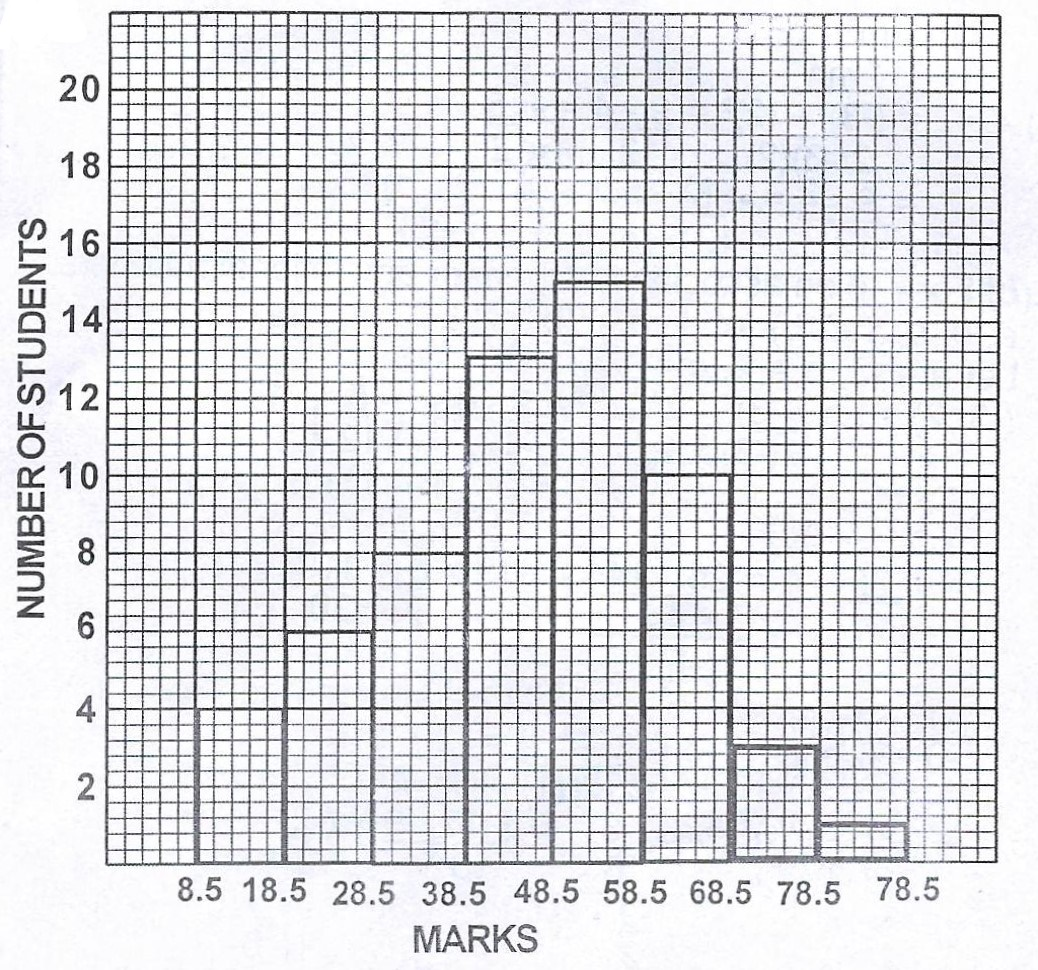
The histogram above represents the scores of some candidates in an examination.
(a) Using the histogram, construct a frequency distribution table indicating clearly the class intervals ;
(b) Draw a cumulative frequency curve of the distribution and use it to estimate the :
(i) median ; (ii) quartile deviation.
(a) Frequency distribution table
| Score | Frequency, \(f\) |
|---|---|
| 9–18 | 4 |
| 19–28 | 6 |
| 29–38 | 8 |
| 39–48 | 13 |
| 49–58 | 15 |
| 59–68 | 10 |
| 69–78 | 3 |
| 79–88 | 1 |
| Total | 60 |
(b) Cumulative frequency curve
| Upper class boundary | Cumulative frequency |
|---|---|
| 8.5 | 0 |
| 18.5 | 4 |
| 28.5 | 10 |
| 38.5 | 18 |
| 48.5 | 31 |
| 58.5 | 46 |
| 68.5 | 56 |
| 78.5 | 59 |
| 88.5 | 60 |
Plot the cumulative frequencies against the corresponding upper class boundaries to obtain the less-than ogive shown below.

(i) Median
\[\frac{N}{2}=\frac{60}{2}=30.\]
From cumulative frequency 30, the score read from the ogive is
\[\boxed{\text{Median}=48.4}\]
(ii) Quartile deviation
\[Q_1=\frac{N}{4}=15\text{th score},\qquad Q_3=\frac{3N}{4}=45\text{th score}.\]
From the ogive, \(Q_1=35.5\) and \(Q_3=57.5\).
\[\text{Quartile deviation}=\frac{Q_3-Q_1}{2}=\frac{57.5-35.5}{2}=\boxed{11.0}.\]
Answer Details
(a) Frequency distribution table
| Score | Frequency, \(f\) |
|---|---|
| 9–18 | 4 |
| 19–28 | 6 |
| 29–38 | 8 |
| 39–48 | 13 |
| 49–58 | 15 |
| 59–68 | 10 |
| 69–78 | 3 |
| 79–88 | 1 |
| Total | 60 |
(b) Cumulative frequency curve
| Upper class boundary | Cumulative frequency |
|---|---|
| 8.5 | 0 |
| 18.5 | 4 |
| 28.5 | 10 |
| 38.5 | 18 |
| 48.5 | 31 |
| 58.5 | 46 |
| 68.5 | 56 |
| 78.5 | 59 |
| 88.5 | 60 |
Plot the cumulative frequencies against the corresponding upper class boundaries to obtain the less-than ogive shown below.
(i) Median
\[\frac{N}{2}=\frac{60}{2}=30.\]
From cumulative frequency 30, the score read from the ogive is
\[\boxed{\text{Median}=48.4}\]
(ii) Quartile deviation
\[Q_1=\frac{N}{4}=15\text{th score},\qquad Q_3=\frac{3N}{4}=45\text{th score}.\]
From the ogive, \(Q_1=35.5\) and \(Q_3=57.5\).
\[\text{Quartile deviation}=\frac{Q_3-Q_1}{2}=\frac{57.5-35.5}{2}=\boxed{11.0}.\]


