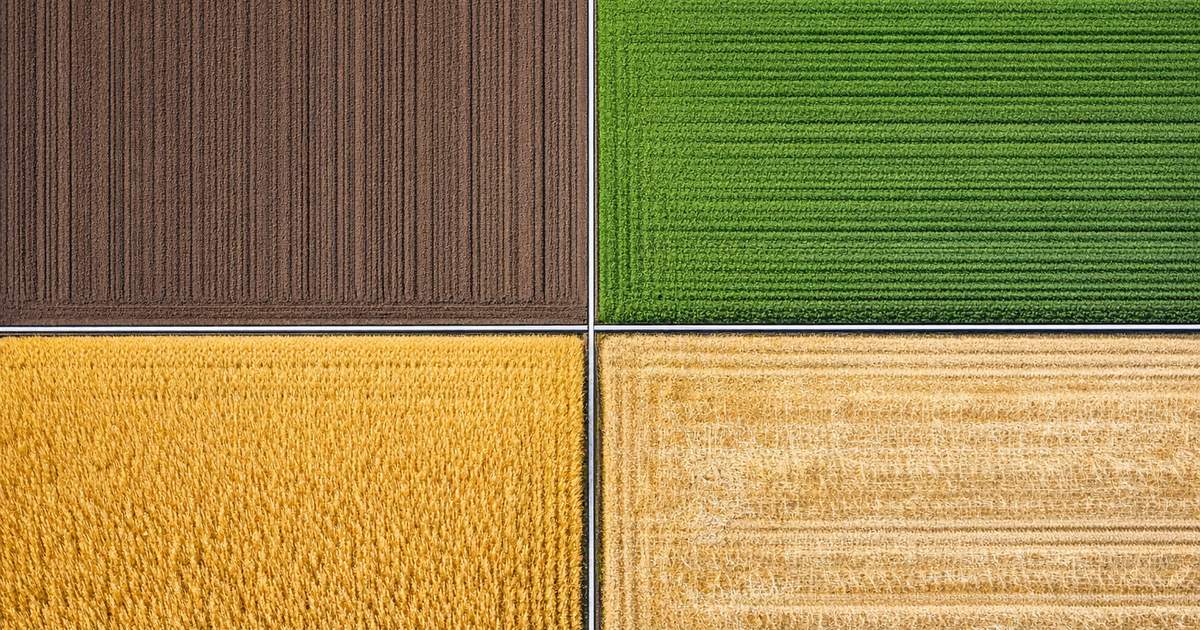
Here's a problem: two fields sit side by side on the same farm, under the same sky, receiving the same rainfall
Field A has heavy clay soil. Field B has coarse sandy soil. After a week of rain, Field A is waterlogged and the maize seedlings are rotting at the roots. After a dry spell, Field B drains so fast the crops wilt within days. The farmer's neighbour, working loam soil, has healthy crops through both wet and dry periods. Why does the same weather produce three completely different outcomes?
That question sits at the heart of the Land topic in IGCSE Environmental Management (0680). Soil composition, weather patterns, growing conditions, food production, and soil erosion are all tightly connected. Get the logic of how they link together, and you can handle any exam question on this topic with confidence. Let's break each piece down step by step.
Soil Composition: The Four Components
Soil isn't just "dirt." The Cambridge syllabus requires you to describe four distinct components:
- Mineral particles - fragments of broken-down rock, classified as sand, silt, or clay depending on their size
- Organic content (humus) - decomposed plant and animal material that darkens the soil
- Water - held in the spaces (pores) between soil particles
- Air (gases) - filling the gaps not occupied by water
The ratio of these four components determines everything about how a soil behaves: drainage, water retention, root penetration, and nutrient availability. Change the ratio, and you change the soil's entire character.
Sand, Silt, and Clay: The Particle Size Logic
Most exam marks on soil composition come down to particle size. Sand, silt, and clay differ in one fundamental way: the size of their grains. That single difference controls drainage, aeration, and water-holding capacity.
| Particle Type | Size | Drainage | Water Retention | Texture |
|---|---|---|---|---|
| Sand | Largest (over 0.05 mm) | Very fast - large air gaps between particles | Poor - water passes straight through | Gritty |
| Silt | Medium (0.002 - 0.05 mm) | Moderate | Moderate - holds nutrients better than sand | Smooth, silky |
| Clay | Smallest (under 0.002 mm) | Very slow - tiny gaps trap water | High - waterlogging risk | Sticky when wet, hard when dry |
Why Organic Content Matters
Humus does three critical things. First, it improves soil structure by binding mineral particles into crumbs (called aggregates), which creates a mix of large and small pore spaces. Second, it increases water retention in sandy soils by acting like a sponge. Third, it releases nutrients steadily as it continues to decompose. A soil rich in humus is almost always more fertile than one without it, regardless of the mineral particle mix.
Why Loam Soils Are Best for Crop Growth
This is one of the most frequently tested questions on the Land topic, and the answer follows directly from the particle-size logic above.
Loam is a balanced mixture of sand, silt, and clay, combined with a good proportion of humus. It takes the useful properties of each component and avoids the extremes:
- Sand fraction: provides drainage and aeration, preventing waterlogging
- Clay fraction: retains water and nutrients, preventing drought stress between rainfalls
- Silt fraction: offers moderate retention and drainage, bridging the gap
- Humus: binds particles into crumbly aggregates, supplies nutrients, and boosts water-holding capacity
The practical result? Loam drains well enough to keep roots from rotting, holds enough moisture to sustain plants through dry spells, allows roots to penetrate easily through its crumbly structure, and stores nutrients where roots can absorb them. That's exactly why the farmer's neighbour in our opening scenario had healthy crops while the clay and sandy fields struggled.
Weather, Seasons, and Growing Conditions
Defining Weather
The syllabus requires a precise definition. Weather is the condition of the atmosphere at a specific place and time. It includes temperature, rainfall, humidity, wind speed, and cloud cover. Weather changes from day to day, even hour to hour.
Don't confuse weather with climate. Climate is the average weather pattern of a region measured over a long period, typically 30 years or more. For this section of the syllabus, the focus is on weather and how short-term atmospheric conditions shape what farmers can grow and when.
Wet and Dry Seasons
Many tropical and subtropical regions experience distinct wet and dry seasons rather than the four-season pattern familiar in temperate zones. These seasonal shifts directly control agricultural decisions:
- Wet season: regular rainfall provides the water needed for seed germination and crop growth. Farmers typically plant at the start of the wet season to harness natural irrigation.
- Dry season: rainfall drops sharply or stops entirely. Crops that aren't drought-tolerant will fail unless irrigation is available. Some farmers leave land fallow during this period.
Timing is everything. Plant too early, and seeds may sit in dry soil and fail to germinate. Plant too late, and the crop won't mature before the dry season arrives. Farmers who misjudge the onset of rains risk losing an entire growing season.
Conditions for Optimum Crop Growth
Photosynthesis drives crop growth, requiring light energy, water, and carbon dioxide. But the Cambridge syllabus asks you to think more broadly. Three conditions must align for optimum growth:
- An adequate growing season - a continuous period of warm-enough temperatures for the crop to complete its full life cycle, from germination through to harvest
- Suitable weather - sufficient rainfall (or irrigation) without excessive flooding, combined with temperatures within the crop's preferred range
- Sufficient daylight hours - plants need light for photosynthesis. Longer days mean more hours of photosynthetic activity and faster biomass accumulation. Tropical regions near the equator receive roughly 12 hours of daylight year-round, which partly explains their capacity for continuous cropping.
Food Production and Crop Yield
Crop yield is the quantity of food harvested per unit area of land. Governments and farmers track yield closely because it determines whether a population can feed itself from its own land.
Factors That Increase Yield
| Factor | How It Increases Yield |
|---|---|
| Fertilisers | Supply nitrogen, phosphorus, and potassium (NPK) that may be depleted from the soil after repeated harvests |
| Irrigation | Provides water during dry periods, extending the effective growing season beyond the wet season |
| Pesticides | Reduce crop losses from insects, fungi, and competing weeds |
| Improved crop varieties | Selectively bred or genetically modified for higher output, disease resistance, or drought tolerance |
| Mechanisation | Enables larger areas to be planted, maintained, and harvested efficiently |
The Environmental Cost of Intensification
Pushing for higher yields carries real environmental costs, and this is a favourite area for extended-response questions:
- Excess fertiliser runs off into rivers and lakes, triggering eutrophication (algal blooms that deplete dissolved oxygen and kill aquatic life)
- Pesticides can harm non-target organisms, including pollinators like bees, and accumulate in food chains through bioaccumulation
- Over-irrigation can deplete groundwater reserves or cause salinisation, where evaporating water leaves salt deposits that poison the soil
- Monoculture (growing the same crop repeatedly on the same land) depletes specific soil nutrients and increases vulnerability to pests and disease
Soil Erosion: Causes and Prevention
Soil erosion is the removal of topsoil by wind or water. Topsoil matters because it's where most humus, nutrients, and biological activity concentrate. Lose the topsoil, and you lose the most productive layer of land.
What Causes Soil Erosion?
Natural factors:
- Heavy rainfall dislodges particles on impact, then surface runoff carries them downhill (progressing from sheet erosion to rill erosion to gully erosion as channels deepen)
- Strong winds lift dry, loose topsoil and transport it long distances
- Steep slopes accelerate runoff speed, increasing erosion severity
Human factors:
- Deforestation - removing tree cover eliminates the root networks that bind soil together and exposes bare ground to direct raindrop impact
- Overgrazing - livestock eat vegetation faster than it regenerates, leaving bare patches of exposed soil
- Over-cultivation - continuous farming without fallow periods depletes organic matter, weakening soil structure
- Poor ploughing practice - ploughing straight up and down a slope creates furrows that channel water runoff directly downhill, accelerating erosion
Methods to Prevent or Reduce Soil Erosion
| Method | How It Works |
|---|---|
| Terracing | Cuts hillsides into stepped flat platforms, reducing slope length and slowing runoff so water infiltrates rather than flowing over the surface |
| Contour ploughing | Ploughing along the contour lines of a slope (horizontally) rather than up and down, creating ridges that trap water and reduce its downhill speed |
| Windbreaks (shelterbelts) | Rows of trees planted perpendicular to prevailing winds, reducing wind speed at ground level and protecting exposed soil |
| Strip cropping | Alternating strips of crops with strips of grass or ground cover to slow water runoff between planted rows |
| Mulching | Covering soil with organic material (straw, leaves) to shield it from raindrop impact and reduce evaporation |
| Crop rotation | Alternating different crops each season to maintain soil structure, nutrient balance, and continuous root cover |
| Afforestation | Planting trees on degraded or bare land to stabilise soil with deep root systems and restore canopy cover |
Worked Example 1: Diagnosing a Soil Problem
Question: A farmer in a tropical region reports that her crops fail every dry season even though they grow well during the rains. The soil feels gritty and drains very quickly after rainfall. Explain what type of soil she is likely farming and suggest two improvements. [4 marks]
Step-by-step reasoning:
- Identify the soil type from the clues. "Gritty" texture and "drains very quickly" are characteristic of sandy soil, where large particle sizes create wide air gaps (1 mark).
- Explain the core problem. Sandy soil cannot retain enough water between rainfalls. During the dry season, the little moisture that enters the soil drains away before roots can absorb it (1 mark).
- Improvement 1: Incorporate organic matter (compost or manure) into the soil. Humus acts like a sponge, improving water retention and also supplying nutrients (1 mark).
- Improvement 2: Install drip irrigation to deliver small, steady amounts of water directly to the root zone during the dry season (1 mark).
Worked Example 2: Tracing an Erosion Chain
Question: Explain how deforestation on a steep hillside can lead to soil erosion and reduced crop yields on farmland downstream. [5 marks]
Step-by-step reasoning:
- Deforestation removes tree cover, eliminating the root networks that previously held soil particles in place (1 mark).
- Without canopy, raindrops strike bare soil directly, dislodging particles from the surface through splash erosion (1 mark).
- On a steep slope, surface water flows rapidly downhill, picking up loosened particles and forming rills that can widen into gullies (1 mark).
- The eroded material is topsoil - the layer richest in humus and nutrients. Its removal leaves the hillside with poor, infertile subsoil (1 mark).
- The sediment carried downstream deposits on farmland or clogs irrigation channels, smothering crops and reducing the productive area available for agriculture (1 mark).
Common Mistakes to Avoid
- Confusing soil composition with soil type. Composition means the four components (mineral particles, organic content, water, air). Soil type (sandy, clay, loam) describes the ratio of mineral particle sizes. Both can appear on the same paper, so read the question carefully.
- Saying "loam is the best soil" without explaining why. You need to describe how its balanced mixture provides specific benefits: drainage from sand, retention from clay, nutrients from humus, easy root penetration from its crumbly structure.
- Listing erosion prevention methods without explaining mechanisms. "Terracing prevents erosion" earns fewer marks than "Terracing creates flat platforms on a slope, reducing the slope length and slowing water runoff so it infiltrates the soil rather than flowing over the surface."
- Ignoring human causes of erosion. Many students describe only natural erosion (rain, wind) and forget deforestation, overgrazing, and poor ploughing practices as accelerating factors.
- Writing that fertilisers "fix" degraded soil. Fertilisers add nutrients, but they don't repair poor structure, restore lost humus, or stop erosion. Match the solution to the actual problem.
- Confusing weather and climate in the growing-conditions section. Weather is short-term (today's temperature and rainfall). Climate is the long-term average. The syllabus tests both definitions, often on the same paper.
Self-Check Questions
Try answering each one in two to three sentences, then check your response against the relevant section above.
- Name the four components of soil as required by the IGCSE syllabus.
- Explain why clay soils are prone to waterlogging while sandy soils are prone to drought stress.
- Why is loam considered the best soil for crop growth? Identify at least three specific properties.
- Define weather. How does it differ from climate?
- Describe two ways in which wet and dry seasons affect farming decisions in tropical regions.
- List the three conditions needed for optimum crop growth and explain why each matters.
- A hillside has been cleared of trees for cattle grazing. Describe the chain of events that could lead to soil erosion on that hillside.
- Name and explain three methods a farmer could use to reduce soil erosion on sloping land.
Connecting the Whole System
Every part of the Land topic feeds into every other part. Soil composition determines drainage and nutrient availability, which control crop growth. Weather patterns dictate when farmers can plant and harvest. Efforts to boost food production through fertilisers, pesticides, and land clearance can degrade the very soil that makes production possible. Soil erosion reduces future yields, which pressures farmers to clear more land, which triggers more erosion. It's a feedback loop.
The strongest exam answers trace these connections explicitly. Don't treat soil composition, crop growth, and erosion as three separate topics. They're three interlocking parts of one system. When you can walk through a scenario from cause to mechanism to consequence to solution, step by step, using the right terminology at each stage, you'll consistently earn strong marks across the Land section of Cambridge IGCSE Environmental Management.

A thorough revision guide to the Land topic for IGCSE Environmental Management (0680), covering soil composition, loam and crop growth, weather and growing seasons, food production, and soil erosion with worked examples, common mistakes, and self-check questions.




Àsìkò méjì (Comment(s))