Why experimental skills carry so much weight
Across European and international examination boards, practical chemistry has always occupied a distinctive place. Cambridge IGCSE Chemistry is no exception. Whether you sit Paper 5 (Practical Test) or Paper 6 (Alternative to Practical), the same core of experimental reasoning runs through both. Even the theory papers regularly test your ability to choose apparatus, interpret chromatograms, or predict the outcome of a flame test. The techniques in this topic are not confined to one chapter of the syllabus; they resurface wherever a question asks you to prove, identify, or separate.
Choosing the right apparatus
Every measurement has an instrument best suited to it. Examiners frequently set questions that ask you to name the most appropriate piece of equipment for a given task, and marks depend on precision of language.
- Time - stopwatch (not "clock" or "timer")
- Temperature - thermometer
- Mass - balance (top-pan balance for routine work)
- Volume of liquid (precise) - burette or volumetric pipette
- Volume of liquid (approximate) - measuring cylinder
- Volume of gas - gas syringe
A burette measures to the nearest 0.05 cm3 and is used when you need to add a variable, controlled volume, as in a titration. A volumetric pipette delivers one fixed volume with high accuracy. A measuring cylinder is less precise but perfectly adequate when exact volumes are not critical. Selecting the wrong instrument does not just lose you marks in a practical context; it also signals to the examiner that you have not grasped the purpose of the measurement.
Separation and purification
The IGCSE syllabus expects you to match each separation technique to the type of mixture it handles. Think of it as a decision tree: the nature of the mixture determines the method.
Key separation techniques
| Technique | Used for | Principle |
|---|---|---|
| Filtration | Insoluble solid from a liquid | Particle size: solid trapped by filter paper, liquid passes through |
| Evaporation | Dissolved solid from a solution | Liquid driven off by heat, solid remains |
| Simple distillation | Solvent from a solution | Liquid boiled off, vapour condensed and collected |
| Fractional distillation | Two or more miscible liquids | Different boiling points; fractionating column provides repeated condensation and re-evaporation |
| Paper chromatography | Components of a dissolved mixture (e.g. dyes, inks) | Differential solubility in solvent vs. attraction to paper |
When examining past papers from Cambridge, you will notice that the examiner often asks you to explain why a technique works, not merely to name it. For distillation, for instance, the mark scheme rewards candidates who mention that the liquid with the lower boiling point evaporates first and is then condensed separately.
Testing purity
A pure substance has a sharp, fixed melting point and boiling point. Impurities lower the melting point and raise the boiling point of a substance, and they broaden the range over which the change of state occurs. This is one of the simplest and most reliable checks for purity, and it appears on IGCSE papers with reliable frequency.
Acid-base titrations
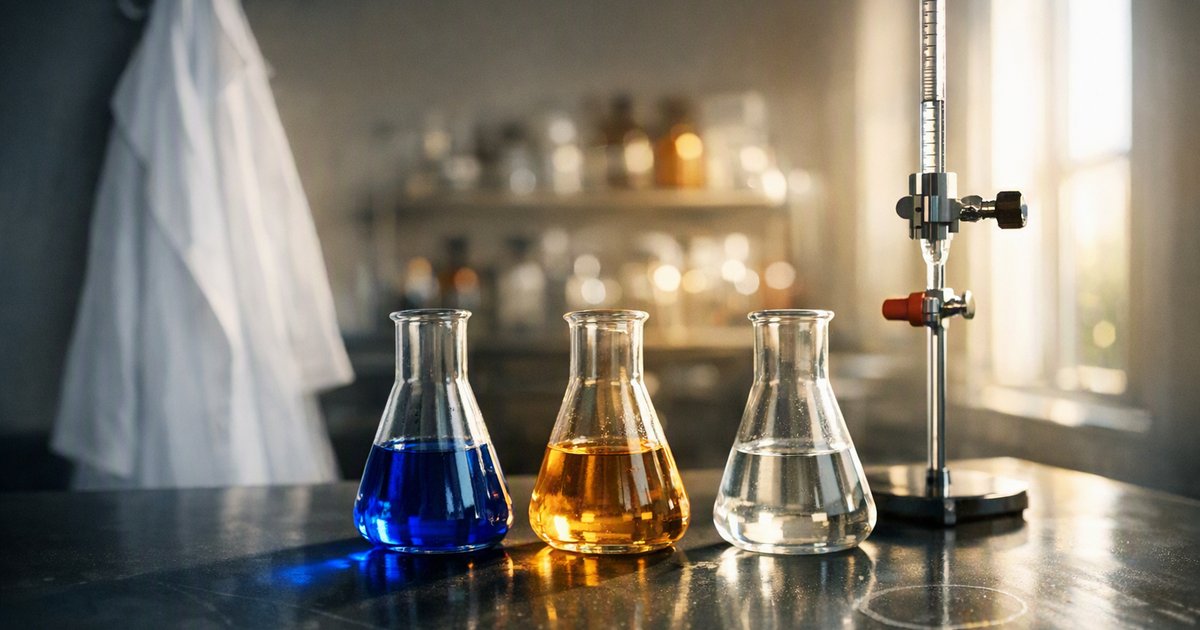
Titrations are among the most examined practical procedures. The steps are worth committing to memory in order, because examiners award marks for sequence as well as content.
- Rinse the burette with the solution it will contain (e.g. the acid), then fill it and record the initial reading.
- Use a volumetric pipette to transfer a fixed volume of the other solution (e.g. the alkali) into a conical flask.
- Add two or three drops of a suitable indicator (methyl orange or phenolphthalein, depending on the acid-base combination).
- Add the solution from the burette slowly, swirling the flask, until the indicator changes colour permanently. This is the end-point.
- Record the final burette reading and calculate the volume added (titre).
- Repeat until you obtain concordant results (titres within 0.10 cm3 of each other).
Paper chromatography and Rf values
Paper chromatography separates dissolved substances based on how far they travel up (or along) a piece of chromatography paper when a solvent moves through it. Substances that are more soluble in the solvent travel further; those with a stronger attraction to the paper stay closer to the origin.
The Rf value (retention factor) quantifies how far a substance has moved relative to the solvent front:
Rf = distance moved by substance / distance moved by solvent front
Both distances are measured from the pencil baseline (not the bottom edge of the paper). An Rf value is always between 0 and 1, and it is characteristic of a substance under fixed conditions (same solvent, same temperature, same paper).
Rf = 4.2 / 6.0 = 0.70
If a known substance has an Rf of 0.70 under the same conditions, the dye is likely the same substance. Two decimal places are standard.
Identification of ions and gases
This is one of the highest-frequency topics across all IGCSE Chemistry papers. Examiners expect you to recall specific tests and their results precisely. Approximate or vague answers lose marks.
Flame tests for metal cations
| Metal ion | Flame colour |
|---|---|
| Lithium, Li+ | Crimson red |
| Sodium, Na+ | Yellow |
| Potassium, K+ | Lilac |
| Calcium, Ca2+ | Orange-red |
| Copper(II), Cu2+ | Blue-green |
The procedure is straightforward: dip a clean nichrome wire loop into concentrated hydrochloric acid, then into the solid sample, and hold it in the edge of a Bunsen flame. Between tests, clean the wire by dipping it in acid and heating until no colour is produced.
Tests for gases
| Gas | Test | Positive result |
|---|---|---|
| Hydrogen (H2) | Hold a burning splint at the mouth of a test tube | Burns with a squeaky pop |
| Oxygen (O2) | Hold a glowing splint inside the gas | Splint relights |
| Carbon dioxide (CO2) | Bubble through limewater (calcium hydroxide solution) | Limewater turns milky (cloudy white) |
| Ammonia (NH3) | Hold damp red litmus paper in the gas | Litmus turns blue |
| Chlorine (Cl2) | Hold damp litmus paper in the gas | Litmus is bleached white |
Precipitation tests for anions and cations
Certain ions form characteristic insoluble precipitates when mixed with specific reagents. The colour and solubility of the precipitate confirm the ion present.
- Chloride (Cl-) - add dilute nitric acid then silver nitrate solution. White precipitate of silver chloride forms.
- Bromide (Br-) - same reagents. Cream precipitate of silver bromide.
- Iodide (I-) - same reagents. Yellow precipitate of silver iodide.
- Sulfate (SO42-) - add dilute hydrochloric acid then barium chloride solution. White precipitate of barium sulfate.
For cations, adding sodium hydroxide solution produces coloured precipitates that help distinguish between metal ions:
- Copper(II), Cu2+ - blue precipitate (insoluble in excess NaOH)
- Iron(II), Fe2+ - green precipitate (insoluble in excess)
- Iron(III), Fe3+ - brown precipitate (insoluble in excess)
- Aluminium, Al3+ - white precipitate (dissolves in excess NaOH to give a colourless solution)
- Calcium, Ca2+ - white precipitate (insoluble in excess)
- Ammonium, NH4+ - no precipitate, but warming the mixture releases ammonia gas (test with damp red litmus)
Chemical tests for water
Two classic tests confirm the presence of water:
- Anhydrous cobalt(II) chloride paper - turns from blue to pink in the presence of water.
- Anhydrous copper(II) sulfate - turns from white to blue when water is added.
These tests confirm the presence of water but do not confirm its purity. To test whether a sample is pure water, measure its boiling point (100 degrees Celsius at standard pressure) or melting point (0 degrees Celsius). A sharp transition at these exact values confirms purity.
Distillation in detail
Distillation appears in almost every IGCSE Chemistry examination series, either as a direct question or embedded inside a longer practical scenario. Simple distillation is appropriate when you want to collect the solvent from a solution. The solution is heated in a round-bottomed flask, the vapour passes through a condenser where cold water circulates around the outside, and the condensed liquid (the distillate) is collected in a receiving vessel. The thermometer sits at the top of the flask to measure the temperature of the vapour, not the liquid.
Fractional distillation is used when two or more miscible liquids need to be separated. The fractionating column, packed with glass beads or similar material, provides a large surface area for repeated condensation and re-evaporation. The liquid with the lowest boiling point reaches the top of the column first and passes into the condenser. In an industrial context, this is the basis for separating crude oil into fractions, a topic that connects directly to organic chemistry in the IGCSE syllabus.
Practical tips for Paper 5 and Paper 6
Students sitting the practical papers often lose marks on procedural details rather than chemical knowledge. A few habits make a measurable difference to your score.
- Always record burette readings to two decimal places (e.g. 23.50, not 23.5). The second decimal place must be 0 or 5.
- When drawing a results table, include headings with units in the header row, not repeated in every cell.
- For chromatography, draw the baseline in pencil (not pen), because ink dissolves in the solvent and contaminates the result.
- In any experiment involving gas collection, check that all joints are sealed before starting. A loose bung means gas escapes and your volume reading is too low.
- When heating a solution to crystallise a salt, stop heating when crystals begin to form at the edge of the evaporating dish. Over-heating decomposes many salts.
Bringing it all together
Experimental techniques and chemical analysis form the backbone of IGCSE Chemistry assessment. The best candidates treat this topic not as a set of isolated facts but as an interconnected toolkit. A titration question might require you to name apparatus, describe a procedure, and identify the salt produced. A qualitative analysis question might combine flame tests with precipitation reactions and gas tests in a single extended response. The overlap between practical skills and theoretical knowledge is especially visible in the Cambridge mark schemes, where a question about salt preparation might test your ability to choose a separation technique, write an ionic equation, and name the product in a single five-mark answer.
Practise working through past paper questions systematically, and you will find that the same patterns repeat with reassuring regularity. Build a reference card of the gas tests and flame test colours, test yourself until you can recall them without hesitation, and then focus your remaining revision time on the procedural descriptions that examiners reward with full marks.

A thorough guide to the experimental and analytical techniques tested in IGCSE Chemistry (0620). Covers apparatus selection, separation methods, titration procedure, paper chromatography with Rf calculations, and the full suite of ion and gas identification tests that examiners expect you to recall under timed conditions.



Àsìkò méjì (Comment(s))