Thermal physics: what holds it together
Thermal physics connects three ideas that, taken together, explain how energy enters, moves through, and transforms matter. The kinetic particle model describes what particles do. Thermal properties tell you how much energy a substance needs to heat up or change state. Energy transfer mechanisms describe how that energy travels from one place to another. For IGCSE Physics (0625), these strands appear regularly across Papers 2, 4, and 6, and Cambridge examiners reward candidates who can move cleanly between particle-level explanations and measurable, macroscopic outcomes.
The sections below follow the syllabus structure, with key equations, worked problems, and corrections for the errors that lose marks most often.
States of matter and the kinetic particle model
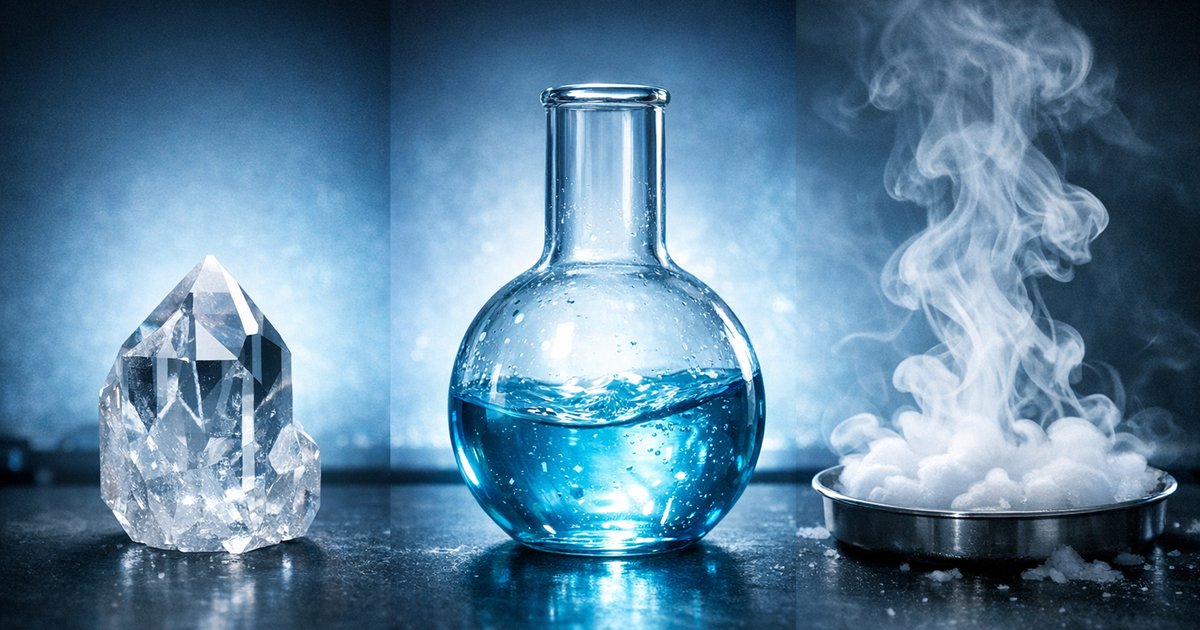
Every substance exists as a solid, liquid, or gas. The kinetic particle model explains the differences between these states in terms of particle arrangement, separation, and motion.
| Property | Solid | Liquid | Gas |
|---|---|---|---|
| Arrangement | Regular, closely packed lattice | Irregular, close together but free to move past each other | Random, widely spaced |
| Separation | Very small (particles touching) | Small (slightly more than solid) | Large (much greater than particle size) |
| Motion | Vibrate about fixed positions | Move randomly with limited range | Move randomly at high speed in all directions |
| Shape | Fixed | Takes shape of container | Fills entire container |
| Volume | Fixed | Fixed | Variable (compressible) |
Precision matters here. Exam answers that say particles in a solid "don't move" lose marks. They vibrate. Answers that describe gas particles as "floating" are too vague. Particles in a gas travel in straight lines between collisions, changing direction randomly.
Particle diagrams
Cambridge expects candidates to represent each state using simple particle diagrams: circles packed in neat rows for solids, irregular clusters for liquids, and widely scattered circles for gases. The diagrams must show relative spacing and disorder increasing from solid to gas. Neglecting the spacing difference between liquid and gas is a common error. The gap should be visibly larger for gas particles.
Changes of state
Heating or cooling a substance can change its state. The standard transitions and their names are:
- Melting: solid to liquid
- Boiling / evaporation: liquid to gas
- Condensation: gas to liquid
- Freezing / solidification: liquid to solid
- Sublimation: solid directly to gas (Extended only)
A critical principle: during a change of state, temperature stays constant even though energy is still being supplied or removed. That energy breaks or forms the bonds between particles rather than increasing their kinetic energy. On a heating curve, this shows as a flat plateau at the melting point and another at the boiling point. Candidates who can sketch and interpret these curves correctly pick up straightforward marks.
Temperature, motion, and absolute zero
Temperature measures the average kinetic energy of particles in a substance. Hotter particles move faster. Cooler particles move more slowly. This relationship is direct and proportional on the Kelvin scale.
The Celsius scale, used across most of continental Europe and the wider scientific world, sets 0 degrees C at the melting point of pure ice and 100 degrees C at the boiling point of water under standard atmospheric pressure. The Kelvin scale begins at absolute zero (-273 degrees C, or 0 K), the lowest temperature theoretically achievable. At absolute zero, particles possess the minimum kinetic energy and cannot be slowed further.
To convert between the two scales:
T (K) = T (degrees C) + 273
Gas pressure and the particle model
Gas particles collide with the walls of their container, and each collision exerts a tiny force. The total force per unit area is the gas pressure. If the temperature of a gas increases at constant volume, the particles move faster, hit the walls harder and more often, and the pressure rises. If the volume decreases at constant temperature, the same number of particles hits a smaller surface area, again increasing the pressure.
For Extended candidates, the gas laws formalise these relationships:
- Boyle's law: pV = constant (at constant temperature)
- Charles's law: V/T = constant (at constant pressure, T in kelvin)
- Pressure law: p/T = constant (at constant volume, T in kelvin)
All three combine into: p1V1 / T1 = p2V2 / T2. Using Celsius instead of Kelvin in these equations is one of the most frequent calculation errors on the paper.
Thermal properties of materials
Specific heat capacity
Different substances require different amounts of energy to raise their temperature by the same amount. The specific heat capacity (c) quantifies this: it is the energy required to raise the temperature of 1 kg of a substance by 1 degrees C (or 1 K).
E = mcΔT
where E is energy in joules, m is mass in kilograms, c is specific heat capacity in J/(kg degrees C), and ΔT is the temperature change.
| Substance | Specific heat capacity / J/(kg degrees C) |
|---|---|
| Water | 4200 |
| Aluminium | 900 |
| Copper | 390 |
| Iron / steel | 450 |
| Oil | 2100 |
Water's high specific heat capacity explains why coastal cities from Amsterdam to Cape Town experience milder temperature swings than inland regions. The sea absorbs and releases vast quantities of energy with only modest temperature changes, buffering the local climate. This is a favourite IGCSE example, and understanding it in particle terms strengthens your answer: water molecules require more energy input per degree because of the strong hydrogen bonds between them.
Specific latent heat
Latent heat is the energy absorbed or released during a change of state at constant temperature. Two types exist:
- Specific latent heat of fusion (Lf): energy to convert 1 kg of solid to liquid at the melting point
- Specific latent heat of vaporisation (Lv): energy to convert 1 kg of liquid to gas at the boiling point
E = mL
where E is energy in joules, m is mass in kg, and L is specific latent heat in J/kg.
The latent heat of vaporisation is always much larger than the latent heat of fusion for the same substance, because converting liquid to gas requires breaking all remaining intermolecular bonds and greatly increasing particle separation. For water: Lf = 334 000 J/kg, Lv = 2 260 000 J/kg. That factor-of-seven difference is worth remembering: it explains why steam burns are so much more dangerous than boiling water burns. The steam releases an enormous amount of latent heat as it condenses on skin.
Transfer of thermal energy
Thermal energy moves from hotter regions to cooler ones by three mechanisms: conduction, convection, and radiation. Each operates differently, and IGCSE candidates need to describe each precisely, explain the underlying particle or wave behaviour, and identify real-world applications.
Conduction
Conduction transfers thermal energy through a material without the material itself moving. Particles at the hot end vibrate with greater amplitude, colliding with neighbouring particles and passing kinetic energy along the chain. In metals, conduction is especially effective because free electrons carry energy rapidly through the lattice, then transfer it through collisions with ions deeper in the material.
This is why a copper saucepan heats up much faster than a wooden spoon sitting in the same pot. Metals are good thermal conductors. Non-metals, liquids, and gases are generally poor conductors (good insulators). Trapped air is one of the most effective insulators available, which is why double-glazed windows, duvets, and cavity wall insulation all work on the same principle: trapping layers of still air to prevent convection and relying on air's poor conduction.
Convection
Convection transfers thermal energy through fluids (liquids and gases) by bulk movement of the fluid itself. When part of a fluid is heated, it expands, becomes less dense, and rises. Cooler, denser fluid sinks to replace it, creating a convection current. This cycle continues as long as a temperature difference exists.
Convection cannot occur in solids, because the particles are locked in fixed positions and cannot flow. It also cannot occur in a vacuum, since there's no fluid to carry the energy.
Thermal radiation
Radiation is the transfer of thermal energy by infrared electromagnetic waves. Unlike conduction and convection, radiation requires no medium and can travel through a vacuum. This is how the Sun's energy reaches Earth across 150 million kilometres of empty space.
All objects emit and absorb infrared radiation. The rate depends on surface properties:
| Surface type | Emission | Absorption |
|---|---|---|
| Dark, matt | Good emitter | Good absorber |
| Light, shiny | Poor emitter | Poor absorber (good reflector) |
This explains practical choices that you'll see across different climates. Solar water heaters use dark, matt panels to absorb maximum radiation. Emergency survival blankets are shiny to reflect body heat inward. Houses across southern Europe and North Africa are often painted white to reflect sunlight and reduce internal temperatures.
Evaporation and boiling compared
Both processes convert liquid to gas, but they differ in important ways that examiners test directly.
| Feature | Evaporation | Boiling |
|---|---|---|
| Temperature | Occurs at any temperature below boiling point | Occurs only at the boiling point |
| Location | Surface of the liquid only | Throughout the liquid |
| Bubbles | No bubbles | Bubbles form within the liquid |
| Rate | Gradual | Rapid |
| Energy source | Other particles in the liquid | External heat source |
Evaporation produces a cooling effect because the fastest, most energetic particles escape from the surface, lowering the average kinetic energy of those that remain. This is why sweating cools the body, and why a wet hand feels cold in a breeze. Increasing the surface area, raising the temperature, lowering the humidity, or increasing air movement over the surface all speed up evaporation.
Worked examples
Worked example 1: Specific heat capacity
A 2.0 kg aluminium block is heated from 20 degrees C to 120 degrees C. The specific heat capacity of aluminium is 900 J/(kg degrees C). Calculate the energy required.
- ΔT = 120 - 20 = 100 degrees C
- E = mcΔT = 2.0 x 900 x 100 = 180 000 J = 180 kJ
Worked example 2: Latent heat
Calculate the energy needed to convert 0.50 kg of water at 100 degrees C into steam at 100 degrees C. The specific latent heat of vaporisation of water is 2 260 000 J/kg.
- E = mL = 0.50 x 2 260 000 = 1 130 000 J = 1130 kJ
No temperature change occurs here. All the energy goes into breaking intermolecular bonds.
Worked example 3: Combined heating problem
How much energy is needed to heat 0.20 kg of ice at 0 degrees C to water at 50 degrees C? Use Lf = 334 000 J/kg and cwater = 4200 J/(kg degrees C).
- Energy to melt ice: E1 = mLf = 0.20 x 334 000 = 66 800 J
- Energy to heat water from 0 degrees C to 50 degrees C: E2 = mcΔT = 0.20 x 4200 x 50 = 42 000 J
- Total energy: E = 66 800 + 42 000 = 108 800 J = 109 kJ (3 s.f.)
Worked example 4: Gas law (Extended)
A gas occupies 600 cm3 at a pressure of 100 kPa and a temperature of 27 degrees C. It is heated to 127 degrees C at constant pressure. Find the new volume.
- Convert to kelvin: T1 = 27 + 273 = 300 K; T2 = 127 + 273 = 400 K
- At constant pressure: V1/T1 = V2/T2
- V2 = V1 x T2 / T1 = 600 x 400 / 300 = 800 cm3
Frequent errors and corrections
| Error | Why it costs marks | Fix |
|---|---|---|
| Saying particles "expand" when heated | Particles don't change size; they move faster and spread apart | State that particles gain kinetic energy and the space between them increases |
| Using degrees C in gas law calculations | The proportional relationships only hold in kelvin | Always convert: T(K) = T(degrees C) + 273 |
| Confusing latent heat with specific heat capacity | Different equations apply to different situations | Ask: is the temperature changing? If yes, use E = mcΔT. If the substance is changing state at constant temperature, use E = mL |
| Omitting "no net movement of particles" for conduction | The definition requires it | State that energy transfers through vibrations and collisions, without bulk flow of material |
| Claiming convection works in solids | Particles in solids cannot flow | Restrict convection to fluids (liquids and gases) |
| Describing radiation as needing a medium | Radiation is the only mechanism that works through a vacuum | Explicitly state that infrared radiation can travel through a vacuum |
Self-check questions
Attempt each problem before looking at the answers below.
- A gas at 300 K occupies 500 cm3. The temperature rises to 450 K at constant pressure. What is the new volume?
- Calculate the energy required to heat 3.0 kg of water from 25 degrees C to 75 degrees C. (c = 4200 J/(kg degrees C))
- How much energy is released when 0.40 kg of steam at 100 degrees C condenses to water at 100 degrees C? (Lv = 2 260 000 J/kg)
- Explain why a metal spoon feels colder than a wooden spoon at the same room temperature.
- State two differences between evaporation and boiling.
Exam strategy for thermal physics
Thermal physics questions split into two broad types: qualitative explanations using the particle model, and calculations using E = mcΔT, E = mL, or the gas laws. Both types appear frequently across IGCSE papers.
For particle model questions, examiners mark for precise vocabulary. "The particles move faster" earns credit. "The stuff gets more energetic" does not. Always specify what happens to particle motion, spacing, and energy. When explaining changes of state, distinguish between kinetic energy (motion) and potential energy (bonds): temperature stays constant because the energy input increases potential energy as bonds break, not kinetic energy.
For calculations, show every step. State the equation, substitute with units, and give the answer to the appropriate number of significant figures. Combined-stage problems (heating, then melting, then heating again) are standard on Paper 4. Break them into separate calculations and add the results. The most common mark lost is forgetting to convert minutes to seconds or Celsius to kelvin.
Practical questions on Paper 6 sometimes involve measuring specific heat capacity or latent heat using an electrical heater, a joulemeter, and a balance. Know the method, the precautions (insulation to reduce heat loss, stirring for uniform temperature distribution), and how to calculate c or L from the experimental data. Examiners also expect candidates to identify the main source of error, which is almost always heat loss to the surroundings.

A clear guide to thermal physics for Cambridge IGCSE Physics (0625), covering the kinetic particle model, states of matter, specific heat capacity and latent heat, gas laws, and all three mechanisms of thermal energy transfer, with worked examples and targeted exam preparation.


Maoni