The nature of acids and bases
Acids and bases sit at the centre of an enormous number of reactions in chemistry, and the IGCSE syllabus reflects that. A secure understanding of their properties, the way we classify oxides, and the methods by which salts are prepared will serve you well across Papers 3, 4, 5 and 6. This topic connects directly to electrochemistry, organic chemistry, and the reactivity series, so the time invested here pays dividends across the entire specification.
An acid is a substance that dissolves in water to produce hydrogen ions (H+). In aqueous solution, these hydrogen ions are responsible for the characteristic properties of acids: they turn blue litmus red, react with metals above hydrogen in the reactivity series, and neutralise bases. A base is a metal oxide or hydroxide that reacts with an acid to form a salt and water. When a base is soluble in water, we call it an alkali, and it produces hydroxide ions (OH−) in solution. Common alkalis include sodium hydroxide (NaOH), potassium hydroxide (KOH), and calcium hydroxide (Ca(OH)2).
The key reaction between acids and alkalis is neutralisation:
H+(aq) + OH−(aq) → H2O(l)
This ionic equation applies to every acid-alkali neutralisation, regardless of which specific acid and alkali are used.
Reactions of acids
Acids undergo three families of reaction that examiners test repeatedly:
- Acid + metal → salt + hydrogen gas. For example: Mg + 2HCl → MgCl2 + H2. The metal must be above hydrogen in the reactivity series for this reaction to proceed. Copper, silver, and gold do not react with dilute acids because they sit below hydrogen. You can test for hydrogen gas by holding a burning splint at the mouth of a test tube: a squeaky pop confirms its presence.
- Acid + base (or alkali) → salt + water. This is a neutralisation reaction. For example: NaOH + HNO3 → NaNO3 + H2O. Insoluble bases such as copper(II) oxide also react: CuO + H2SO4 → CuSO4 + H2O.
- Acid + carbonate → salt + water + carbon dioxide. For example: CaCO3 + 2HCl → CaCl2 + H2O + CO2. The carbon dioxide produced turns limewater milky, which is the standard test for this gas.
Notice the pattern: the name of the salt is always built from the metal (or ammonium) and the acid radical. Hydrochloric acid gives chlorides, sulfuric acid gives sulfates, and nitric acid gives nitrates. Being able to predict the salt name from the acid and the metal or base is a skill examiners expect at both Core and Extended tier.
Reactions of bases
Bases react with acids (as above) and also with ammonium salts when heated, releasing ammonia gas. This is a standard test: warm an unknown substance with sodium hydroxide solution, and if ammonia is released (detected by damp red litmus turning blue), the substance contains an ammonium compound. Ammonia has a distinctive sharp, pungent smell. The equation for a typical reaction is:
NH4Cl + NaOH → NaCl + H2O + NH3
Indicators and the pH scale
Indicators are substances whose colour depends on the pH of the solution. Three indicators appear on the IGCSE syllabus, and you should know all three:
| Indicator | Colour in acid | Colour in neutral solution | Colour in alkali |
|---|---|---|---|
| Litmus | Red | Purple | Blue |
| Methyl orange | Red | Orange | Yellow |
| Thymolphthalein | Colourless | Colourless | Blue |
The pH scale runs from 0 to 14. Values below 7 indicate acidity (the lower the number, the more acidic the solution), 7 is neutral, and values above 7 indicate alkalinity (the higher the number, the more alkaline). Universal indicator paper or solution gives a continuous colour change across this range: red at pH 1, orange at pH 3-4, yellow at pH 5-6, green at pH 7, blue at pH 8-9, and purple at pH 13-14. A pH meter provides a precise numerical reading and is more accurate than indicator paper.
Strong and weak acids
A strong acid (such as hydrochloric, sulfuric, or nitric acid) ionises completely in water: every molecule produces H+ ions. A weak acid (such as ethanoic acid or citric acid) ionises only partially, so an equilibrium exists between the undissociated molecules and the ions. At the same concentration, a strong acid has a lower pH, a faster reaction rate with metals and carbonates, and a higher electrical conductivity than a weak acid. The same distinction applies to bases: sodium hydroxide is a strong alkali (fully ionised), while ammonia solution is a weak alkali (partially ionised).
Oxides and their classification
Oxides are compounds of an element with oxygen, and they fall into four categories that examiners expect you to distinguish clearly:
| Type of oxide | Behaviour | Examples |
|---|---|---|
| Basic oxide | Reacts with acids to form salt + water; does not react with alkalis | CuO, MgO, Fe2O3 |
| Acidic oxide | Reacts with alkalis to form salt + water; does not react with acids | CO2, SO2, SO3, P4O10 |
| Amphoteric oxide | Reacts with both acids and alkalis to form salt + water | Al2O3, ZnO, PbO |
| Neutral oxide | Reacts with neither acids nor alkalis | H2O, CO, NO |
As a broad rule, metal oxides tend to be basic (or amphoteric for metals near the boundary of the periodic table such as aluminium and zinc), while non-metal oxides tend to be acidic. Water is the most familiar neutral oxide. Carbon monoxide, despite containing a non-metal, is also neutral because it does not form an acid or base in water.
Amphoteric oxides deserve particular attention because they are a favourite of examiners. Aluminium oxide reacts with hydrochloric acid to give aluminium chloride and water, and it also reacts with sodium hydroxide solution to give sodium aluminate and water. Zinc oxide behaves similarly, producing zinc chloride with HCl and sodium zincate with NaOH.
Preparation of salts
Salt preparation is one of the most frequently examined practical topics in IGCSE Chemistry. The method you choose depends on whether the salt you want is soluble or insoluble, and you need to know the solubility rules to make that decision.
Solubility rules
- All nitrates are soluble.
- All sodium, potassium, and ammonium salts are soluble.
- Most chlorides are soluble, except silver chloride (AgCl) and lead(II) chloride (PbCl2).
- Most sulfates are soluble, except barium sulfate (BaSO4), calcium sulfate (CaSO4), and lead(II) sulfate (PbSO4).
- Most carbonates and hydroxides are insoluble, except those of sodium, potassium, and ammonium.
Preparing soluble salts
There are two principal routes:
- Excess solid method - used when one reactant is an insoluble base, carbonate, or metal. Add the solid in excess to the warm acid, so that all the acid reacts. Filter off the unreacted solid, then evaporate the filtrate gently to concentrate it. Allow the solution to cool and crystallise. This method works well for salts such as copper(II) sulfate (from CuO and H2SO4) or zinc chloride (from Zn and HCl). The excess solid ensures no unreacted acid remains in the final product.
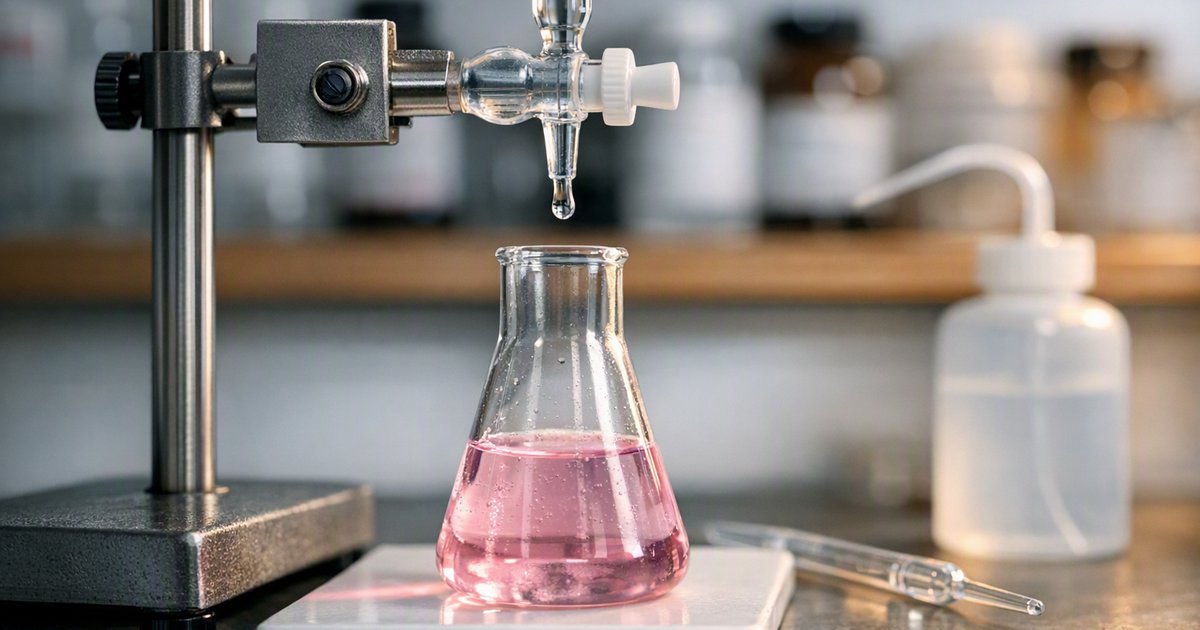
- Titration - used when both reactant and product are soluble and no convenient insoluble excess is available, typically for preparing sodium, potassium, or ammonium salts. Using a burette, add the acid to a measured volume of alkali (from a pipette) until the indicator shows the end point. Record the volume of acid needed. Then repeat the experiment using exactly that volume of acid but without any indicator, so the salt is not contaminated. Evaporate the resulting solution to crystallise the pure salt.
Warm dilute sulfuric acid in a beaker. Add black copper(II) oxide powder in small portions, stirring after each addition. Continue until no more CuO dissolves and excess black powder remains at the bottom. Filter the mixture to remove excess CuO. Gently heat the blue filtrate to evaporate about half the water, then leave to cool and crystallise. Collect the blue crystals by filtration and pat dry with filter paper.
Preparing insoluble salts by precipitation
An insoluble salt is made by mixing two soluble solutions that together produce the insoluble product as a precipitate. For example, to make lead(II) iodide:
- Mix lead(II) nitrate solution with potassium iodide solution.
- Pb(NO3)2(aq) + 2KI(aq) → PbI2(s) + 2KNO3(aq)
- A bright yellow precipitate of lead(II) iodide forms immediately.
- Filter the mixture to collect the precipitate.
- Wash the residue with distilled water to remove soluble impurities such as potassium nitrate.
- Dry between sheets of filter paper or in a warm oven at low temperature.
The choice of starting materials is guided by the solubility rules above. Both starting compounds must be soluble (so they can be mixed as solutions), while the desired product must be insoluble (so it precipitates out). Barium sulfate, for instance, can be made by mixing barium chloride solution with sodium sulfate solution.
Common exam pitfalls
- Confusing strong with concentrated: strength is about ionisation, concentration is about how much solute is dissolved per unit volume. A weak acid at high concentration can still be hazardous, and a strong acid at low concentration can be safe to handle.
- Forgetting to state "excess" in salt preparation: when describing the excess solid method, you must state that the base or metal is added in excess to ensure all the acid has reacted. Without this, the examiner cannot award full marks.
- Misidentifying amphoteric oxides: aluminium oxide and zinc oxide are the two you must know for the Cambridge IGCSE exam. They react with both acids and alkalis, a property that distinguishes them from straightforward basic oxides.
- Writing incomplete word equations: acid + carbonate always produces three products (salt, water, and carbon dioxide). Omitting the gas costs a mark.
- Choosing the wrong salt preparation method: if the salt is insoluble, use precipitation. If the salt is soluble and you have an insoluble reactant, use the excess solid method. If both reactant and product are soluble, use titration. Selecting the correct method is worth 2-3 marks on a typical structured question.
Self-check questions
- State the colour of methyl orange in a solution of pH 3 and in a solution of pH 10.
- Write a balanced equation for the reaction between zinc oxide and dilute hydrochloric acid. Classify zinc oxide.
- Describe, step by step, how you would prepare a pure, dry sample of barium sulfate starting from barium chloride solution and sodium sulfate solution.
- Explain why a 0.1 mol/dm3 solution of ethanoic acid has a higher pH than a 0.1 mol/dm3 solution of hydrochloric acid.
- A student adds excess magnesium ribbon to dilute sulfuric acid. Name the salt formed, state the gas produced, and describe one observation the student would make during the reaction.
Acids, bases, and salts connect to almost every other topic in IGCSE Chemistry, from electrochemistry to organic acids. A precise understanding of the definitions, the indicator table, oxide classification, the solubility rules, and the three main preparation methods will give you a reliable foundation for both the theory papers and the practical examination.

A thorough examination of acids, bases, and salts as tested in IGCSE Chemistry (0620), covering the characteristic properties of acids and bases, indicator behaviour, the pH scale, oxide classification, and the principal methods of salt preparation including titration and precipitation.


Comentário(s)