WAEC SSCE - Animal Husbandry - 2025 (Essay)
Pergunta 1 Relatório
(a)(i) State three advantages of introduction in animal improvement programme. (ii) State three disadvantages of selection in animal improvement programme.
(b) List four methods of artificial selection.
(c) Give four physical features of animals which could be selected for breeding.
(d) Mention six features of a good laying chicken.o
(a)(i) Advantages of Introduction to Animal improvement Programme: -It brings animals of desirable traits into the farm. -Resuits in improved breeding program. -It brings variety into the farm/ genetic diversity/genetic variability. -Enhances productivity/high productivity. -Helps to incorporate and stabilize đesirable traits in the farm. -Perform better and are able to adapt to local conditions. -Resistance to pests. -Resistance to diseases. (ii) Disadvantages of selection in animal improvement programme: - May lead to the elimination of some existing desirable traits. -It is time-consuming. -It is expensive/high cost is needed. -It is tedious and stressful. -It requires skilled labor or expertise/technique. -No new desirable characteristics are introduced. -Requires up-to-date records that may not be present. -No guarantee that the desired traits would be passed on to the offspring. -Mutation could occur.
(b) Methods of artificial selection: - Mass selection/individual selection. -Progeny selection.-Family selection. -Pedigree selection. -Within family selection/sib selection body size.
(c) Physical features of animals to be selected for breeding: - Good body conformation of animals/body size. -Animals with good dentition and jaw/beak. -Animals with good feet/legs. -Animals with good coat/plumage color ANin2is without deformity in male/female reproductive organs. -Animals with appropriate nunber of eat -Acfive when allowed to moye/thriftiness. -No discharge from orifices. -Male must have a high libido. -Good temperament. -Good health. -Mothering ability/fecundity.
(d) Features of a good laying chicken: - Possession of glossy plumage/attractive feathers. -Possession of wide, moist cloaca. -Bright Ted comb and wattle. -Consistent optimal feed intake. -Soft and pliable abdomen. -Broad flexible pelvic bone. - Absence of broodiness. -Strong and well-curved beak. -Bright eyes which are weil opened and alert.- small, lean, and proportionate head. -Short and strong neck. Smooth and oily skin. -Broad and straight back. -Long, deep and proportionate body. Consistent optimal water intake.
Detalhes da Resposta
(a)(i) Advantages of Introduction to Animal improvement Programme: -It brings animals of desirable traits into the farm. -Resuits in improved breeding program. -It brings variety into the farm/ genetic diversity/genetic variability. -Enhances productivity/high productivity. -Helps to incorporate and stabilize đesirable traits in the farm. -Perform better and are able to adapt to local conditions. -Resistance to pests. -Resistance to diseases. (ii) Disadvantages of selection in animal improvement programme: - May lead to the elimination of some existing desirable traits. -It is time-consuming. -It is expensive/high cost is needed. -It is tedious and stressful. -It requires skilled labor or expertise/technique. -No new desirable characteristics are introduced. -Requires up-to-date records that may not be present. -No guarantee that the desired traits would be passed on to the offspring. -Mutation could occur.
(b) Methods of artificial selection: - Mass selection/individual selection. -Progeny selection.-Family selection. -Pedigree selection. -Within family selection/sib selection body size.
(c) Physical features of animals to be selected for breeding: - Good body conformation of animals/body size. -Animals with good dentition and jaw/beak. -Animals with good feet/legs. -Animals with good coat/plumage color ANin2is without deformity in male/female reproductive organs. -Animals with appropriate nunber of eat -Acfive when allowed to moye/thriftiness. -No discharge from orifices. -Male must have a high libido. -Good temperament. -Good health. -Mothering ability/fecundity.
(d) Features of a good laying chicken: - Possession of glossy plumage/attractive feathers. -Possession of wide, moist cloaca. -Bright Ted comb and wattle. -Consistent optimal feed intake. -Soft and pliable abdomen. -Broad flexible pelvic bone. - Absence of broodiness. -Strong and well-curved beak. -Bright eyes which are weil opened and alert.- small, lean, and proportionate head. -Short and strong neck. Smooth and oily skin. -Broad and straight back. -Long, deep and proportionate body. Consistent optimal water intake.
Pergunta 2 Relatório
(a) Explain each of the following terms as used in animal nutrition (i) ration (ii) balanced diet (iii) maintenance ration (iv) production ration (v) malnutrition.
(b) Give two uses of each of the following animal products: (i) honey (ii) wool (iii) horn (iv) milk (d) egg.
(a) Explanation of Terms used in Nutrition:
(i) Ration: (I) It is the amount of feed or diet given to an animal in a day/24 hours.
(2) It could be straight/individual ingredient or mix ration.
(3) It should be in wet or dry form.
(4) It could be in form of pellets, matched, block etc.
(ii) Balanced Diet:
(1) It is the feed that contains all the nutrients in the right proportion.
(2) It is for growth and production of an animal
(3) It is the feed that contains all the nutrient requirements of animals/different classes of animals
(iii) Maintenance Ration: (1) It is the amount of feed that is given to an animal to sustain its live weight.
(2)The purpose is to reduce the cost of management/feeding.
(3) To keep the animal alive for the intended purpose/future purpose.
(4) It is less expensive.
(iv) Production Ration: (1) It is the amount of feed supplied to an animal to promote growth and production.
(2) It is excess of maintenance requirement.
(3) It is more expensive to carry out.
(v) Malnutrition: (1 )It occurs in firm animals when they are fed with in-adequate or excess feed or unbalanced diet.
(2) It is an unhealthy condition which manifest in farm animals.
(3) It may result in production losses.
(b) Uses of Animal Products: (i) Honey: (1) Source of feed for animals/ additives/supplements
(2) Source of food humans/natural sweetener.
(3) Used for dressing of wounds/burns.
(4)Used in brewing honey beers.
(5) Used in confectionery industry.
(6) Used as a preservative.
(ii) Wool: (1) Used for insulation. (2) Used for the manufacture of brushes.
(3) Used as clothing material/seat covers/unholstery.
(4) Used in the manufacture of blankets and rugs. (5) Used for decoration/aesthetics.
(iii) Horn: (1) Used for manufacturing knife handles. (2) Used in the manufacture of fertilizer. (3) Used in the preparation of glues and buttons. (4)Used for aesthetics. (5) Used as music instrument/cultural use.
(iv) Milk: (1 ) Food for humans. (2) For feeding young livestock. (3) Used for making confectioneries. e.g biscuit, bread , cake. (4) Used in the preparation of dairy products, e.g yogurt, butter, ice cream.
(v) Egg: (1) It is used as feed for animal/egg shell for calcium. (2) It is used for the manufacture of vaccines/medicinal uses/drugs.
(3) Manufacture of adhesives/paints/power. (4) Food for humans. (5) Used in cosmetics. (6) Used for securing powder.
Detalhes da Resposta
(a) Explanation of Terms used in Nutrition:
(i) Ration: (I) It is the amount of feed or diet given to an animal in a day/24 hours.
(2) It could be straight/individual ingredient or mix ration.
(3) It should be in wet or dry form.
(4) It could be in form of pellets, matched, block etc.
(ii) Balanced Diet:
(1) It is the feed that contains all the nutrients in the right proportion.
(2) It is for growth and production of an animal
(3) It is the feed that contains all the nutrient requirements of animals/different classes of animals
(iii) Maintenance Ration: (1) It is the amount of feed that is given to an animal to sustain its live weight.
(2)The purpose is to reduce the cost of management/feeding.
(3) To keep the animal alive for the intended purpose/future purpose.
(4) It is less expensive.
(iv) Production Ration: (1) It is the amount of feed supplied to an animal to promote growth and production.
(2) It is excess of maintenance requirement.
(3) It is more expensive to carry out.
(v) Malnutrition: (1 )It occurs in firm animals when they are fed with in-adequate or excess feed or unbalanced diet.
(2) It is an unhealthy condition which manifest in farm animals.
(3) It may result in production losses.
(b) Uses of Animal Products: (i) Honey: (1) Source of feed for animals/ additives/supplements
(2) Source of food humans/natural sweetener.
(3) Used for dressing of wounds/burns.
(4)Used in brewing honey beers.
(5) Used in confectionery industry.
(6) Used as a preservative.
(ii) Wool: (1) Used for insulation. (2) Used for the manufacture of brushes.
(3) Used as clothing material/seat covers/unholstery.
(4) Used in the manufacture of blankets and rugs. (5) Used for decoration/aesthetics.
(iii) Horn: (1) Used for manufacturing knife handles. (2) Used in the manufacture of fertilizer. (3) Used in the preparation of glues and buttons. (4)Used for aesthetics. (5) Used as music instrument/cultural use.
(iv) Milk: (1 ) Food for humans. (2) For feeding young livestock. (3) Used for making confectioneries. e.g biscuit, bread , cake. (4) Used in the preparation of dairy products, e.g yogurt, butter, ice cream.
(v) Egg: (1) It is used as feed for animal/egg shell for calcium. (2) It is used for the manufacture of vaccines/medicinal uses/drugs.
(3) Manufacture of adhesives/paints/power. (4) Food for humans. (5) Used in cosmetics. (6) Used for securing powder.
Pergunta 3 Relatório
(a) Explain each of the following terms as used in animal husbandry:
(i) coprophagy: (ii) rumination (iii) candling (iv) tethering.
(b) List four local materials which could be used for constructing a goat house.
(c)(i) Name the three members of the honey bee colony. (ii) State five ways in which honey beekeeping is important.
(a) Explanation of Terms:
(i) Coprophagy: Process by which rabbits/animals reingest their soft feaces to recover lost nutrients. It helps the animals to utilize nutrients more efficiently. It is done in the early hours of the day.
(ii) Rumination: It is a process in which swallowed feed is regurgitated, rechewed, resalivated, and reswallowed by ruminants. It ensures that fibrous materials are reduced to smaller sizes for proper digestion. -It is done when the animal's at rest.
(iii) Candling: This is the process by which presumed fertile eggs are placed on a device called candler with a light source below in a dark room to detect the fertility of the egg. - It is done on the 9th and 19th day of incubation/ 14 days.
(iv) Tethering: This is a method of restraining in which an animal is tied to a stake using rope so that the animals' movement is restricted around the radius of the rope. it helps to prevent animals from destroying crop farms.
(b) Local Materials used for Constructing Goat House:
- Raffia/palm frond
- Grass/thatch.
- Plank/sticks/wood.
- Bamboo.
- Plantain/banana leaves.
- Clay/bricks.
- Rope/twine.
(c)(i) Members of Honey Bee Colony:
- Queen
- Drone/king
- Worker
- Brood
(ii) Importance of Honey bee Keeping:
- Production of honey/food/food for man,
- Production of enzymes/invertase.
- Production Serves as a means of employment.
- Sources as foreign exchange.
- Sources of Brood income
- Bee help to pollinate crops.
- Honey is medicinal.
- Educational/research.
Detalhes da Resposta
(a) Explanation of Terms:
(i) Coprophagy: Process by which rabbits/animals reingest their soft feaces to recover lost nutrients. It helps the animals to utilize nutrients more efficiently. It is done in the early hours of the day.
(ii) Rumination: It is a process in which swallowed feed is regurgitated, rechewed, resalivated, and reswallowed by ruminants. It ensures that fibrous materials are reduced to smaller sizes for proper digestion. -It is done when the animal's at rest.
(iii) Candling: This is the process by which presumed fertile eggs are placed on a device called candler with a light source below in a dark room to detect the fertility of the egg. - It is done on the 9th and 19th day of incubation/ 14 days.
(iv) Tethering: This is a method of restraining in which an animal is tied to a stake using rope so that the animals' movement is restricted around the radius of the rope. it helps to prevent animals from destroying crop farms.
(b) Local Materials used for Constructing Goat House:
- Raffia/palm frond
- Grass/thatch.
- Plank/sticks/wood.
- Bamboo.
- Plantain/banana leaves.
- Clay/bricks.
- Rope/twine.
(c)(i) Members of Honey Bee Colony:
- Queen
- Drone/king
- Worker
- Brood
(ii) Importance of Honey bee Keeping:
- Production of honey/food/food for man,
- Production of enzymes/invertase.
- Production Serves as a means of employment.
- Sources as foreign exchange.
- Sources of Brood income
- Bee help to pollinate crops.
- Honey is medicinal.
- Educational/research.
Pergunta 4 Relatório
(a) Define the term animal improvement.
(b) Explain briefly the following terms as used in animal improvement:
- cross breeding;
- out-breeding.
(d) Complete the table below:
| Farm animal |
Name of mature female |
Gestation period (days) |
| Sheep |
…………………… |
…………………….. |
| Pig |
…………………… |
…………………….. |
| Rabbit |
…………………… |
…………………….. |
(a) Definition of animal improvement:
It refers to means/techiques of developing/breeding/producing animals of better traits/characters over the existing ones /parents
OR
It is a means/technique of introduction/selection/breeding of animals with better/outstanding traits/character/genes/allele over the existing ones
(b) Explanation of the terms;
Cross breeding;
- It is the mating of proven quality animals from
- different breeds but the same species e.g. Muturu x White Fulani.
- It leads to production of heterosis/hybrid vigour
Out breeding;
- It is the mating of unrelated animals of the same breed
- It recovers certain traits that may have been lost due to other breeding methods.
- New traits are introduced in the offspring/young ones
(d) Completion of the table
| Farm animal |
Name of mature female |
Gestation period (days) |
| Sheep |
Ewe |
140-150 |
| Pig |
Sow |
113-115 |
| Rabbit |
Doe |
28-32 |
Detalhes da Resposta
(a) Definition of animal improvement:
It refers to means/techiques of developing/breeding/producing animals of better traits/characters over the existing ones /parents
OR
It is a means/technique of introduction/selection/breeding of animals with better/outstanding traits/character/genes/allele over the existing ones
(b) Explanation of the terms;
Cross breeding;
- It is the mating of proven quality animals from
- different breeds but the same species e.g. Muturu x White Fulani.
- It leads to production of heterosis/hybrid vigour
Out breeding;
- It is the mating of unrelated animals of the same breed
- It recovers certain traits that may have been lost due to other breeding methods.
- New traits are introduced in the offspring/young ones
(d) Completion of the table
| Farm animal |
Name of mature female |
Gestation period (days) |
| Sheep |
Ewe |
140-150 |
| Pig |
Sow |
113-115 |
| Rabbit |
Doe |
28-32 |
Pergunta 5 Relatório
(a) Name three internal organs found in each of the following regions of a farm animal: (i) Thoracic region; (ii) Abdominal region.
(b)(i) List four records that could be kept by a poultry farmer. (ii) State four reasons for keeping records in poultry production.
(c)(i) State three damages that could be caused by rats in a deep litter house. (ii) Mention three ways of controlling rats on animal farm
(a) Internal Organs Found in each Region of Farm Animals: (i) Thoracic region: - Heart. -Trachea. -Lungs. -Diaphragm. -Oesophagus/gullet/throat. (ii) Abdominai region: -Liver. -Stomach/Rumen/ ecticullun/omasun/abomasun -kidney. -Fallopian tubeloviduct. -Spleen. -Pancreas. -Large intestine. -Small intestine. -Ureter. -Uterus. -Ovary. -Gall bladder. (b) (i) Records that could be kept by a poultry farmer: - Production record. -Inventory record. -Purchase record. -Input record. -Sales record/ marketing record. -Labour record. -Farm diary. -Income and expenditure record. -Health records/drug. regime record/ill health. -Mortality record. -Routine management record. (ii) Reasons for keeping records in poultry production: - Enables larmers to detect changes in price of produce, -Shows the financial position of the farm. -Helps to know all activities carried out on the farm, -For taking managpmen decision, -For taxation purposes. -For procuring loan. -To detect fraudulent practices on the farm. -For computing farmer's net worth. -For budgeting. -1o assess production performance. (c)(i) Damages that could be caused by rats in a deep litter house: - Acts as vectors of diseases. -Compete with birds for feed, -Contaminate feed. -Waste feed. -Can kill the birds. -Destroy poultry equipment -Destroy poultry house. -Contaminate water. -Waste water. -Compete with birds for water. -Cause panic/scare/stampede. (ii) Ways of controlling rats on animal farms: - Clear bush around the farm. -Trapping with baits/glue board. -Fencing/surround with wire netting. -Use of predators, e.g cats. -Sealing off all holes, -Use rodenticides/rat poison.
Detalhes da Resposta
(a) Internal Organs Found in each Region of Farm Animals: (i) Thoracic region: - Heart. -Trachea. -Lungs. -Diaphragm. -Oesophagus/gullet/throat. (ii) Abdominai region: -Liver. -Stomach/Rumen/ ecticullun/omasun/abomasun -kidney. -Fallopian tubeloviduct. -Spleen. -Pancreas. -Large intestine. -Small intestine. -Ureter. -Uterus. -Ovary. -Gall bladder. (b) (i) Records that could be kept by a poultry farmer: - Production record. -Inventory record. -Purchase record. -Input record. -Sales record/ marketing record. -Labour record. -Farm diary. -Income and expenditure record. -Health records/drug. regime record/ill health. -Mortality record. -Routine management record. (ii) Reasons for keeping records in poultry production: - Enables larmers to detect changes in price of produce, -Shows the financial position of the farm. -Helps to know all activities carried out on the farm, -For taking managpmen decision, -For taxation purposes. -For procuring loan. -To detect fraudulent practices on the farm. -For computing farmer's net worth. -For budgeting. -1o assess production performance. (c)(i) Damages that could be caused by rats in a deep litter house: - Acts as vectors of diseases. -Compete with birds for feed, -Contaminate feed. -Waste feed. -Can kill the birds. -Destroy poultry equipment -Destroy poultry house. -Contaminate water. -Waste water. -Compete with birds for water. -Cause panic/scare/stampede. (ii) Ways of controlling rats on animal farms: - Clear bush around the farm. -Trapping with baits/glue board. -Fencing/surround with wire netting. -Use of predators, e.g cats. -Sealing off all holes, -Use rodenticides/rat poison.
Pergunta 6 Relatório
(a) Define the following terms:
- hay
- silage.
(b)(i) Name two types of pasture.
(ii) State four advantages of establishing a grass-legume pasture.
(iii) State three advantages of rotational grazing. [3 marks]
(c) Draw and label the digestive tract of a hen.
a) Definition of the terms hay and silage;
(i) Hay: This is a cut and dried forage (stored) for feeding farm animals
Silage : This is a cut and fermented forage in an anaerobic condition for feeding farm animals
(b) (i) Name two types of pasture
- Grassland.
- Heathland.
- Machair.
- Maquis.
- Moorland.
- Potrero (landform)
- Prairie.
- Rangeland
(ii) Advantages of establishing a grass-legume pasture
- It suppresses weed
- Improves nutritional quality of the forage/balanced diet
- Legumes fertilize the soil for grass to grow/nitrogen fixation
- Optimal usage of the land
- It enhances proliferation of soil fauna and flora leading to
- improved soil structure, texture and aeration
- Reduces evapotranspiration or water loss
- It prevents erosion
- Legume trails on the grass for more production/High yield/
- improved income
- Legume serves as source of protein for the livestock
- It is more acceptable to ruminants
- It reduces leaching
(iii) Advantages of rotational grazing
- Prevents overgrazing
- Allows for the regeneration of grazed forage
- It controls parasites/diseases/pests
- Promotes efficient utilisation of pasture
- Reduces soil compaction/maintenance of soil structure
(c) 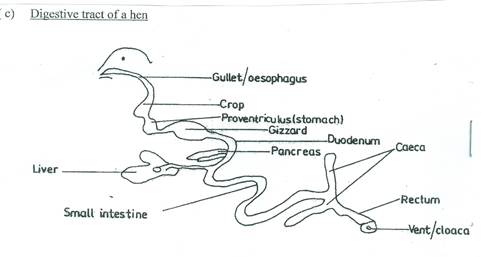
Detalhes da Resposta
a) Definition of the terms hay and silage;
(i) Hay: This is a cut and dried forage (stored) for feeding farm animals
Silage : This is a cut and fermented forage in an anaerobic condition for feeding farm animals
(b) (i) Name two types of pasture
- Grassland.
- Heathland.
- Machair.
- Maquis.
- Moorland.
- Potrero (landform)
- Prairie.
- Rangeland
(ii) Advantages of establishing a grass-legume pasture
- It suppresses weed
- Improves nutritional quality of the forage/balanced diet
- Legumes fertilize the soil for grass to grow/nitrogen fixation
- Optimal usage of the land
- It enhances proliferation of soil fauna and flora leading to
- improved soil structure, texture and aeration
- Reduces evapotranspiration or water loss
- It prevents erosion
- Legume trails on the grass for more production/High yield/
- improved income
- Legume serves as source of protein for the livestock
- It is more acceptable to ruminants
- It reduces leaching
(iii) Advantages of rotational grazing
- Prevents overgrazing
- Allows for the regeneration of grazed forage
- It controls parasites/diseases/pests
- Promotes efficient utilisation of pasture
- Reduces soil compaction/maintenance of soil structure
(c)


