Where mensuration fits and why it carries weight
Mensuration occupies a distinctive position within the IGCSE Mathematics syllabus. It sits at the intersection of number work and geometry: candidates must recall formulae, substitute values accurately, and handle units with care, all while interpreting two-dimensional diagrams of three-dimensional objects. The topic appears reliably across both the Core and Extended tiers, and questions range from straightforward area calculations worth two marks to multi-step problems involving composite solids that can carry six or more marks on Paper 4. Competence in mensuration therefore has a disproportionate effect on the overall grade.
The word itself comes from the Latin mensura, meaning measurement. In practice, it covers every calculation that answers the question "how much?" for a shape: how far around it (perimeter or circumference), how much surface it covers (area), how much space it occupies (volume), and how much material is needed to wrap or coat it (surface area). Mastering these calculations requires two things: knowing which formula applies and handling units correctly from start to finish.
Units of measure: the foundation
Before any formula becomes useful, a candidate must be fluent in metric unit conversions. Errors at this stage propagate through every subsequent calculation, and examiners frequently set traps by mixing units within a single question.
Length conversions
| Conversion | Factor | Direction |
|---|---|---|
| mm to cm | divide by 10 | smaller unit to larger |
| cm to m | divide by 100 | smaller unit to larger |
| m to km | divide by 1000 | smaller unit to larger |
The reverse operations multiply by the same factors. The critical principle for area and volume conversions is that the factor must be squared or cubed respectively. Converting cm to m divides by 100, but converting cm2 to m2 divides by 1002 = 10,000, and converting cm3 to m3 divides by 1003 = 1,000,000.
Area and perimeter of standard shapes
The syllabus expects candidates to calculate the perimeter and area of four core quadrilaterals and the triangle, then to apply these to compound shapes formed by combining or subtracting standard figures.
Formula reference
| Shape | Perimeter | Area |
|---|---|---|
| Rectangle | 2(l + w) | l x w |
| Triangle | a + b + c | 1/2 x base x height |
| Parallelogram | 2(a + b) | base x perpendicular height |
| Trapezium | a + b + c + d | 1/2(a + b) x h |
Two points deserve emphasis. First, the height in every area formula must be perpendicular to the chosen base, not a slant length. Second, the trapezium formula uses the two parallel sides (often labelled a and b) and the perpendicular distance between them. Candidates who confuse a slant side with the height lose the marks entirely.
Worked example 1: area of a trapezium
A trapezium has parallel sides of 8 cm and 14 cm, with a perpendicular height of 5 cm. Find its area.
- Identify the parallel sides: a = 8 cm, b = 14 cm.
- Identify the perpendicular height: h = 5 cm.
- Apply the formula: A = 1/2(a + b) x h = 1/2(8 + 14) x 5 = 1/2 x 22 x 5 = 55 cm2.
Circles, arcs and sectors
Circle mensuration requires confident recall of two formulae and the ability to adapt them for partial circles.
- Circumference: C = 2 x pi x r (equivalently C = pi x d)
- Area: A = pi x r2
An arc is a fraction of the circumference, and a sector is the corresponding fraction of the full circle's area. The fraction in both cases is theta/360, where theta is the angle at the centre in degrees.
- Arc length: (theta/360) x 2 x pi x r
- Sector area: (theta/360) x pi x r2
Worked example 2: arc length and sector area
A sector has radius 9 cm and angle 120 degrees. Find (a) the arc length and (b) the sector area. Give answers to 3 significant figures.
- Arc length = (120/360) x 2 x pi x 9 = (1/3) x 18pi = 6pi = 18.8 cm (3 s.f.).
- Sector area = (120/360) x pi x 92 = (1/3) x 81pi = 27pi = 84.8 cm2 (3 s.f.).
Surface area and volume of 3D solids
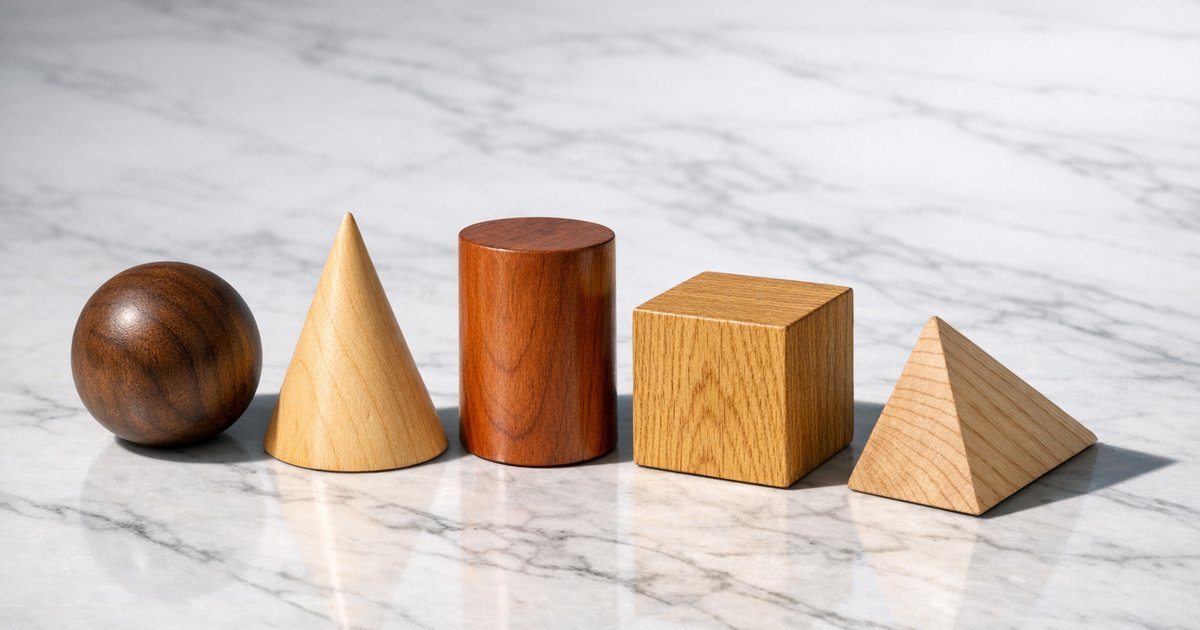
Three-dimensional mensuration divides into two tiers of complexity. Core-tier candidates work with prisms and cylinders. Extended-tier candidates must also handle cones, spheres, pyramids, and frustums. The formulae for the more complex solids are provided on the formula sheet in the exam, but candidates are expected to know when each applies and to substitute correctly.
Prisms
A prism is any solid with a uniform cross-section. Its volume equals the area of the cross-section multiplied by the length (or depth) of the prism. A cuboid is a rectangular prism; a triangular prism has a triangular cross-section; a cylinder is a circular prism.
- Volume of any prism: V = area of cross-section x length
- Surface area of any prism: 2 x (area of cross-section) + (perimeter of cross-section) x length
Cylinders
- Volume: V = pi x r2 x h
- Curved surface area: CSA = 2 x pi x r x h
- Total surface area: TSA = 2 x pi x r x h + 2 x pi x r2
Worked example 3: volume of a cylinder
A cylindrical water tank has radius 0.35 m and height 1.2 m. Find the capacity of the tank in litres.
- Volume = pi x (0.35)2 x 1.2 = pi x 0.1225 x 1.2 = 0.147pi = 0.4618... m3.
- Convert to cm3: 0.4618... x 1,000,000 = 461,800 cm3 (to 4 s.f.).
- Convert to litres: 461,800 / 1000 = 461.8 litres (to 4 s.f.).
Notice how the unit conversion from m3 to cm3 uses the cubed factor of 1003 = 1,000,000. This is the single most frequent source of error in volume conversion questions on IGCSE papers.
Cones (Extended)
- Volume: V = 1/3 x pi x r2 x h
- Curved surface area: CSA = pi x r x l, where l is the slant height
The slant height l, the radius r, and the perpendicular height h form a right-angled triangle at the apex-to-base centre line. Candidates frequently need Pythagoras' theorem to find the missing dimension: l2 = r2 + h2.
Spheres (Extended)
- Volume: V = 4/3 x pi x r3
- Surface area: SA = 4 x pi x r2
Pyramids (Extended)
- Volume: V = 1/3 x base area x perpendicular height
The base can be any polygon. For a square-based pyramid, the base area is simply side2. Surface area requires calculating the area of each triangular face individually and adding the base.
Worked example 4: composite solid
A solid consists of a hemisphere of radius 6 cm mounted on top of a cylinder of the same radius and height 10 cm. Find the total volume.
- Volume of cylinder = pi x 62 x 10 = 360pi cm3.
- Volume of full sphere = 4/3 x pi x 63 = 288pi cm3.
- Volume of hemisphere = 288pi / 2 = 144pi cm3.
- Total volume = 360pi + 144pi = 504pi = 1580 cm3 (3 s.f.).
Frustums (Extended)
A frustum is the portion of a cone or pyramid that remains after the top is sliced off by a cut parallel to the base. Its volume is calculated by subtracting the volume of the removed small cone (or pyramid) from the volume of the original large cone (or pyramid). The key step is establishing the dimensions of the removed portion using similar triangles.
Worked example 5: frustum volume
A cone of height 15 cm and base radius 9 cm has its top removed by a horizontal cut 10 cm from the base. Find the volume of the frustum.
- The cut is 10 cm from the base, so the removed cone has height 15 - 10 = 5 cm.
- By similar triangles, the radius of the small cone = 9 x (5/15) = 3 cm.
- Volume of large cone = 1/3 x pi x 92 x 15 = 405pi cm3.
- Volume of small cone = 1/3 x pi x 32 x 5 = 15pi cm3.
- Volume of frustum = 405pi - 15pi = 390pi = 1230 cm3 (3 s.f.).
Compound shapes: a systematic approach
Many IGCSE mensuration questions present irregular shapes that must be decomposed into standard components. The process is consistent regardless of whether the question asks for area, perimeter, or volume.
- Identify the standard shapes that compose (or subtract from) the figure.
- Calculate each component separately, keeping full precision in intermediate steps.
- Add or subtract the components as required.
- Round only at the final step, to the degree of accuracy the question specifies.
A common variant involves a shape with a region removed. For example, a rectangular metal plate with a circular hole cut from its centre has area equal to the rectangle's area minus the circle's area. Candidates who round intermediate values before the final subtraction often arrive at an answer that differs from the exact value by enough to lose an accuracy mark.
Common mistakes and how to avoid them
| Mistake | Why it loses marks | Correction |
|---|---|---|
| Using slant height instead of perpendicular height in area or volume formulae | Produces an incorrect numerical answer. No method marks are available if the wrong dimension is substituted. | Always check whether the height in the formula must be perpendicular. Draw a right-angled triangle to identify it if necessary. |
| Forgetting to square or cube the conversion factor for area/volume units | The answer is out by a factor of 10, 100, or 1000. | For area conversions, square the linear factor. For volume conversions, cube it. Write the conversion explicitly: 1 m2 = 10,000 cm2. |
| Mixing units within a single calculation | The answer carries no meaningful unit and will be wrong. | Convert all measurements to the same unit before substituting into any formula. |
| Rounding intermediate values | Accumulated rounding error can push the final answer outside the acceptable tolerance. | Store full calculator values or use the pi button. Round only at the final step. |
| Confusing diameter with radius | Substituting the diameter where the formula requires the radius doubles or quadruples the answer. | Read the question carefully. If the diameter is given, halve it before substituting. |
| Omitting the base when calculating total surface area | The answer gives only the curved or lateral surface area, not the full surface. | Distinguish between "curved surface area" and "total surface area." The latter always includes the base(s). |
Self-check questions
- Convert 4.5 m2 to cm2.
- A parallelogram has base 12 cm and perpendicular height 7 cm. Its slant side is 9 cm. Find the area and the perimeter.
- A sector of a circle has radius 10 cm and angle 72 degrees. Find the arc length and the sector area, giving answers in terms of pi.
- A triangular prism has a cross-section that is a right-angled triangle with legs 5 cm and 12 cm. The prism is 20 cm long. Find its volume and total surface area.
- A cone has base radius 4 cm and slant height 10 cm. Find the perpendicular height, the volume, and the curved surface area.
- A hemisphere has diameter 18 cm. Find its volume and its total surface area (including the flat circular face).
- A cylindrical tank of radius 50 cm and height 1.2 m is filled with water. How many litres does it hold?
- A compound shape consists of a rectangle 8 cm by 5 cm with a semicircle of diameter 5 cm attached to one of the shorter sides. Find the total area and the total perimeter.
- A frustum is formed by cutting a cone of height 20 cm and base radius 12 cm at a height of 8 cm from the base. Find the radius of the top circle and the volume of the frustum.
- A metal sphere of radius 6 cm is melted down and recast into a cylinder of radius 4 cm. Find the height of the cylinder.
Each question above targets a specific sub-topic and mirrors the style of IGCSE past paper questions. Working through them with full written solutions, including units at every stage, builds the precision that examiners reward.

A structured revision guide to mensuration for Cambridge IGCSE Mathematics (0580), covering metric unit conversions, area and perimeter of standard shapes, circles and sectors, surface area and volume of 3D solids, and compound shape strategies, with worked examples and common mistake analysis throughout.



Opmerking(en)