WAEC SSCE - Animal Husbandry - 2024 (Essay)
Vraag 1 Verslag
(a) Define the following terms:
- hay
- silage.
(b)(i) Name two types of pasture.
(ii) State four advantages of establishing a grass-legume pasture.
(iii) State three advantages of rotational grazing. [3 marks]
(c) Draw and label the digestive tract of a hen.
a) Definition of the terms hay and silage;
(i) Hay: This is a cut and dried forage (stored) for feeding farm animals
Silage : This is a cut and fermented forage in an anaerobic condition for feeding farm animals
(b) (i) Name two types of pasture
- Grassland.
- Heathland.
- Machair.
- Maquis.
- Moorland.
- Potrero (landform)
- Prairie.
- Rangeland
(ii) Advantages of establishing a grass-legume pasture
- It suppresses weed
- Improves nutritional quality of the forage/balanced diet
- Legumes fertilize the soil for grass to grow/nitrogen fixation
- Optimal usage of the land
- It enhances proliferation of soil fauna and flora leading to
- improved soil structure, texture and aeration
- Reduces evapotranspiration or water loss
- It prevents erosion
- Legume trails on the grass for more production/High yield/
- improved income
- Legume serves as source of protein for the livestock
- It is more acceptable to ruminants
- It reduces leaching
(iii) Advantages of rotational grazing
- Prevents overgrazing
- Allows for the regeneration of grazed forage
- It controls parasites/diseases/pests
- Promotes efficient utilisation of pasture
- Reduces soil compaction/maintenance of soil structure
(c) 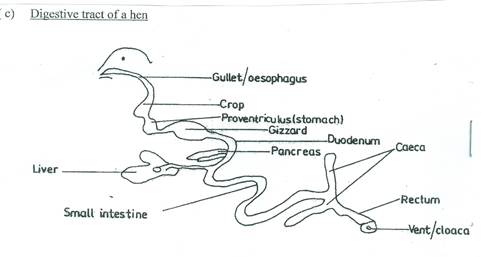
Antwoorddetails
a) Definition of the terms hay and silage;
(i) Hay: This is a cut and dried forage (stored) for feeding farm animals
Silage : This is a cut and fermented forage in an anaerobic condition for feeding farm animals
(b) (i) Name two types of pasture
- Grassland.
- Heathland.
- Machair.
- Maquis.
- Moorland.
- Potrero (landform)
- Prairie.
- Rangeland
(ii) Advantages of establishing a grass-legume pasture
- It suppresses weed
- Improves nutritional quality of the forage/balanced diet
- Legumes fertilize the soil for grass to grow/nitrogen fixation
- Optimal usage of the land
- It enhances proliferation of soil fauna and flora leading to
- improved soil structure, texture and aeration
- Reduces evapotranspiration or water loss
- It prevents erosion
- Legume trails on the grass for more production/High yield/
- improved income
- Legume serves as source of protein for the livestock
- It is more acceptable to ruminants
- It reduces leaching
(iii) Advantages of rotational grazing
- Prevents overgrazing
- Allows for the regeneration of grazed forage
- It controls parasites/diseases/pests
- Promotes efficient utilisation of pasture
- Reduces soil compaction/maintenance of soil structure
(c)
Vraag 2 Verslag
a) List three equipment used on a dairy farm.
b) Outline the steps involved in the pasteurization of milk.
c) State four roles of each of the following agents in the marketing of animal products:
(i) wholesaler;
(ii) retailer.
d) State three advantages of each of the following agents involved in the marketing of animal products:
(i) marketing boards;
(ii) co-operative societies.
(a) Equipment used on a dairy farm;
- Feed trough
- Water trough
- Forage harvester/sickle/baler
- Milking machine
- Milk test cup
- Weighing scale
- Drenching bottles
- Buckets/container/headpan
- Restraining rope/stanchion stall
- Knife/cutlass/matchet
- Homogenizer
- Pasteurizer
- Milk tank
- Refrigerator
- Wheelbarrow
- Shovel/spade
- Calving box
- Coding machine
- First aid box
- Rake
- Hay fork
- Digger
- Castrator
(b) Steps involved in the pasteurization of milk;
- Collect milk
- Heat to appropriate temperature
- Maintain temperature for a specific period of time
- Allow to cool
- Store at low temperature
(c) Roles of agents in the marketing of animal products;
- Wholesaler
- buy in bulk/large quantity
- provide processing facilities
- provide storage facilities
- make advertisement
- sell to retailers
- provide transportation facilities
- buy produce from the farmers directly
- usually provide credit facilities to farmers and retailers
- relay information from retailers to farmers and vice versa
Retailer
- buy from wholesalers
- sell directly to consumers
- provide storage facilities
- package the products/processing facility
- provide credit facilities to consumers
- relay information from consumers to wholesalers
- make goods readily available/accessible
(d) Advantages of agents in the marketing of animal products;
- Marketing Boards
- stabilize prices
- provide credit facility to farmers
- offer quality control services
- provide storage facilities
- help to transport produce
- prevent wastage of farm produce
- provide advice and technical support/provision of information
- provide organized ready market/even distribution of produce
- generate revenue for the government
- ensure compliance to rules and regulations
(ii) Co-operative societies
- grant loans to members at affordable rates/credit facilities
- provide goods and services at cheap rates
- provide storage facilities/equipment/inputs to members
- organize extension services/close contact
- have negotiation/bargaining power
- make advertisement
- stimulate competition
- give dividends to members
Antwoorddetails
(a) Equipment used on a dairy farm;
- Feed trough
- Water trough
- Forage harvester/sickle/baler
- Milking machine
- Milk test cup
- Weighing scale
- Drenching bottles
- Buckets/container/headpan
- Restraining rope/stanchion stall
- Knife/cutlass/matchet
- Homogenizer
- Pasteurizer
- Milk tank
- Refrigerator
- Wheelbarrow
- Shovel/spade
- Calving box
- Coding machine
- First aid box
- Rake
- Hay fork
- Digger
- Castrator
(b) Steps involved in the pasteurization of milk;
- Collect milk
- Heat to appropriate temperature
- Maintain temperature for a specific period of time
- Allow to cool
- Store at low temperature
(c) Roles of agents in the marketing of animal products;
- Wholesaler
- buy in bulk/large quantity
- provide processing facilities
- provide storage facilities
- make advertisement
- sell to retailers
- provide transportation facilities
- buy produce from the farmers directly
- usually provide credit facilities to farmers and retailers
- relay information from retailers to farmers and vice versa
Retailer
- buy from wholesalers
- sell directly to consumers
- provide storage facilities
- package the products/processing facility
- provide credit facilities to consumers
- relay information from consumers to wholesalers
- make goods readily available/accessible
(d) Advantages of agents in the marketing of animal products;
- Marketing Boards
- stabilize prices
- provide credit facility to farmers
- offer quality control services
- provide storage facilities
- help to transport produce
- prevent wastage of farm produce
- provide advice and technical support/provision of information
- provide organized ready market/even distribution of produce
- generate revenue for the government
- ensure compliance to rules and regulations
(ii) Co-operative societies
- grant loans to members at affordable rates/credit facilities
- provide goods and services at cheap rates
- provide storage facilities/equipment/inputs to members
- organize extension services/close contact
- have negotiation/bargaining power
- make advertisement
- stimulate competition
- give dividends to members
Vraag 3 Verslag
(a) Explain each of the following terms as used in animal husbandry:
(i) coprophagy: (ii) rumination (iii) candling (iv) tethering.
(b) List four local materials which could be used for constructing a goat house.
(c)(i) Name the three members of the honey bee colony. (ii) State five ways in which honey beekeeping is important.
(a) Explanation of Terms:
(i) Coprophagy: Process by which rabbits/animals reingest their soft feaces to recover lost nutrients. It helps the animals to utilize nutrients more efficiently. It is done in the early hours of the day.
(ii) Rumination: It is a process in which swallowed feed is regurgitated, rechewed, resalivated, and reswallowed by ruminants. It ensures that fibrous materials are reduced to smaller sizes for proper digestion. -It is done when the animal's at rest.
(iii) Candling: This is the process by which presumed fertile eggs are placed on a device called candler with a light source below in a dark room to detect the fertility of the egg. - It is done on the 9th and 19th day of incubation/ 14 days.
(iv) Tethering: This is a method of restraining in which an animal is tied to a stake using rope so that the animals' movement is restricted around the radius of the rope. it helps to prevent animals from destroying crop farms.
(b) Local Materials used for Constructing Goat House:
- Raffia/palm frond
- Grass/thatch.
- Plank/sticks/wood.
- Bamboo.
- Plantain/banana leaves.
- Clay/bricks.
- Rope/twine.
(c)(i) Members of Honey Bee Colony:
- Queen
- Drone/king
- Worker
- Brood
(ii) Importance of Honey bee Keeping:
- Production of honey/food/food for man,
- Production of enzymes/invertase.
- Production Serves as a means of employment.
- Sources as foreign exchange.
- Sources of Brood income
- Bee help to pollinate crops.
- Honey is medicinal.
- Educational/research.
Antwoorddetails
(a) Explanation of Terms:
(i) Coprophagy: Process by which rabbits/animals reingest their soft feaces to recover lost nutrients. It helps the animals to utilize nutrients more efficiently. It is done in the early hours of the day.
(ii) Rumination: It is a process in which swallowed feed is regurgitated, rechewed, resalivated, and reswallowed by ruminants. It ensures that fibrous materials are reduced to smaller sizes for proper digestion. -It is done when the animal's at rest.
(iii) Candling: This is the process by which presumed fertile eggs are placed on a device called candler with a light source below in a dark room to detect the fertility of the egg. - It is done on the 9th and 19th day of incubation/ 14 days.
(iv) Tethering: This is a method of restraining in which an animal is tied to a stake using rope so that the animals' movement is restricted around the radius of the rope. it helps to prevent animals from destroying crop farms.
(b) Local Materials used for Constructing Goat House:
- Raffia/palm frond
- Grass/thatch.
- Plank/sticks/wood.
- Bamboo.
- Plantain/banana leaves.
- Clay/bricks.
- Rope/twine.
(c)(i) Members of Honey Bee Colony:
- Queen
- Drone/king
- Worker
- Brood
(ii) Importance of Honey bee Keeping:
- Production of honey/food/food for man,
- Production of enzymes/invertase.
- Production Serves as a means of employment.
- Sources as foreign exchange.
- Sources of Brood income
- Bee help to pollinate crops.
- Honey is medicinal.
- Educational/research.
Vraag 4 Verslag
a)(i) Explain the term monogastric.
(ii) Give two examples of monogastric animals.
(b) Explain each of the following terms as used in animal nutrition: (i) concentrate: (ii) additive.
(c) State four ways in which roughage is important in the diet of farm animals.
(d) List four materials which could be used in milking cow.
(e) Mention two animals each which could be fed on each of the following forms of prepared feed: (i) pellets: (ii) mash.
(a) (i) Explanation of the Term Monogastric: A monogastric is a farm animal with simple stomach. They have simple digestive system. They can be herbivores or non-herbivores.
(ii) Examples of Monogastrics:
- pig
- rabbit
- horse
- poultry
- grasscutter
- donkey
(b) Explanation of terms;
(i) Concentrate: Are animal feeds that are high in nutrients but low in fibre. They are highly digestible. Could be protein or carbohydrate.
(ii) Additives: Substances added to feed in small quantities. They supply nutrients or non-nutrients. It could be in form of liquid/solid.
(c) Importance of Roughage in the Diet of Farm Animals:
- It provides bulk in animal feed.
- Enhances bowel movement.
- Prevents constipation by binding with feed.
- Serves as a source of energy in animals.
- Serves as substrate and habitat for microbes in animals.
(d) Materials used in Milking Cows:
- Milking machine.
- Milking chute/rope.
- Milk testing cup.
- Cheese cloth
- Milking pails/bucket
(e) Animals Fed on Prepared Feed:
(i) Pellets: Rabbits, Grasscutter, Poultry, Ruminant, Camel, Snails, Pig, Horse, Donkey, Guinea pig
(ii) Mash: Rabbits, Grass Cutter, Poultry, Ruminant, Camel, Snails, Pig, Horse, Donkey, Guinea Pig
Antwoorddetails
(a) (i) Explanation of the Term Monogastric: A monogastric is a farm animal with simple stomach. They have simple digestive system. They can be herbivores or non-herbivores.
(ii) Examples of Monogastrics:
- pig
- rabbit
- horse
- poultry
- grasscutter
- donkey
(b) Explanation of terms;
(i) Concentrate: Are animal feeds that are high in nutrients but low in fibre. They are highly digestible. Could be protein or carbohydrate.
(ii) Additives: Substances added to feed in small quantities. They supply nutrients or non-nutrients. It could be in form of liquid/solid.
(c) Importance of Roughage in the Diet of Farm Animals:
- It provides bulk in animal feed.
- Enhances bowel movement.
- Prevents constipation by binding with feed.
- Serves as a source of energy in animals.
- Serves as substrate and habitat for microbes in animals.
(d) Materials used in Milking Cows:
- Milking machine.
- Milking chute/rope.
- Milk testing cup.
- Cheese cloth
- Milking pails/bucket
(e) Animals Fed on Prepared Feed:
(i) Pellets: Rabbits, Grasscutter, Poultry, Ruminant, Camel, Snails, Pig, Horse, Donkey, Guinea pig
(ii) Mash: Rabbits, Grass Cutter, Poultry, Ruminant, Camel, Snails, Pig, Horse, Donkey, Guinea Pig
Vraag 5 Verslag
a) (i) State Five benefits of keeping bees
(ii) Outline the steps involved in establishing an apiary
b) (i) State Five ways of enhancing the productivity of a pig farm
(ii) State Five management practices that are carried out on piglets from birth to weaning
(a) (i) Benefits of keeping bees;
- Honey production/food
- Employment/job creation
- Prevention of extinction of bees
- For research / education
- Kept for protection/security/defense
- Kept as hobby/leisure
- Bee sting is medicinal
- Source of foreign exchange
- Bees are pollinating agents of crops -
- Source of raw materials/propolis/wax/royal jelly
- Income generation/high marketability
- Biodiversity/maintenance of ecosystem
(ii) Steps involved in establishing an apiary;
- Site selection/identification of a suitable location=
- Clearing of the site/create a stand
- Installation of beehive/set up a beehive
- Bait the beehive/stock the beehive with bees
- Inspection for colonization/rebaiting/restocking
- Set up warning signs
(b) (i) Ways of enhancing the productivity of a pig farm;
- Ensure proper sanitation
- Minimize food wastage
- Give good quality feed/balanced
- Pest control
- Ensure proper record keeping
- Rear good quality breeds
- Provision of adequate water
- Brooding of piglets
- Regular deworming
- Provision of good housing
- Provision of wallowing facility
- Vaccination
- Training of farm workers
- Control of pests
- Good breeding programme/control of inbreeding
- Culling of diseased/unproductive/aggressive animals
- Sell at an appropriate age/adopt good marketing strategy
- Control disease/prevent disease outbreak/biosecurity/isolation of sick
- animals
- Administration of drugs
(ii) Management practices carried out on piglets from birth to weaning;
- Isolation of sick piglets
- Giving of iron injection
- Clipping of needle teeth
- Use of guard rails
- Allowing access to plenty of water
- Ensuring good sanitation
- Prevention of crushing/creep feeding
- Provision of veterinary care
- Provision of nutritious/balanced diet
- Fostering of orphaned piglets
- Proper identification of animals
- Provision of straw as bedding at early age
- Cutting of umbilical cord and apply a tincture of iodine
- Castration of males not required for breeding
- Clearing of mucous from the nostril
- Allowing access to colostrum/regular breastfeeding
Antwoorddetails
(a) (i) Benefits of keeping bees;
- Honey production/food
- Employment/job creation
- Prevention of extinction of bees
- For research / education
- Kept for protection/security/defense
- Kept as hobby/leisure
- Bee sting is medicinal
- Source of foreign exchange
- Bees are pollinating agents of crops -
- Source of raw materials/propolis/wax/royal jelly
- Income generation/high marketability
- Biodiversity/maintenance of ecosystem
(ii) Steps involved in establishing an apiary;
- Site selection/identification of a suitable location=
- Clearing of the site/create a stand
- Installation of beehive/set up a beehive
- Bait the beehive/stock the beehive with bees
- Inspection for colonization/rebaiting/restocking
- Set up warning signs
(b) (i) Ways of enhancing the productivity of a pig farm;
- Ensure proper sanitation
- Minimize food wastage
- Give good quality feed/balanced
- Pest control
- Ensure proper record keeping
- Rear good quality breeds
- Provision of adequate water
- Brooding of piglets
- Regular deworming
- Provision of good housing
- Provision of wallowing facility
- Vaccination
- Training of farm workers
- Control of pests
- Good breeding programme/control of inbreeding
- Culling of diseased/unproductive/aggressive animals
- Sell at an appropriate age/adopt good marketing strategy
- Control disease/prevent disease outbreak/biosecurity/isolation of sick
- animals
- Administration of drugs
(ii) Management practices carried out on piglets from birth to weaning;
- Isolation of sick piglets
- Giving of iron injection
- Clipping of needle teeth
- Use of guard rails
- Allowing access to plenty of water
- Ensuring good sanitation
- Prevention of crushing/creep feeding
- Provision of veterinary care
- Provision of nutritious/balanced diet
- Fostering of orphaned piglets
- Proper identification of animals
- Provision of straw as bedding at early age
- Cutting of umbilical cord and apply a tincture of iodine
- Castration of males not required for breeding
- Clearing of mucous from the nostril
- Allowing access to colostrum/regular breastfeeding
Vraag 6 Verslag
(a) State three changes that take place after the chopped forage has been compressed and covered in silage preparation.
(b) Give two reasons each for carrying out each of the following practices in pasture management; (i) weeding; (ii) controlled burning; (iii) Irrigation; (iv) Fertilizer application; (v) Liming.
(c) State two functions of phosphorus in animal nutrition.
(d) Complete the table below by ticking (✔) the appropriate column to indicate the effect of low temperature on farm animals.
| Parameter | Increase | Decrease | Normal |
| (i) Water intake | |||
| (ii) Grazing time | |||
| (iii) Milk yield | |||
| (iv) Feed intake | |||
| (v) Egg production |
(a) Changes that take place after chopped forage has been compressed and covered in silage preparation: - Oxygen is used up. -Carbon dioxide is increased. -Rise in temperature of ensiled mass. Bacterial ferment carbohydrates to produce lactic acid. -Fruity smell/alcoholic smell/esters produced. -pH is lowered. -Breakdown of fibre due to fermentation. -Gradual compression of ensiling material occurs/reduction in bulkiness. -Colour changes to olive green.
(b) Reasons for carrying out various practices in pasture management: (i) Weeding: - Reduces competition for air, water, nutrients, and space. -For better growth of herbage/good yield. -Get rid of pests. -Get rid of diseases. -Removes poisonous plants/obnoxious weeds. -Minimizes incidence of predators. -Enhances free movement. (ii) Controlled burning: - Kills eggs, and larvae of parasites/kills parasites. -Destroys old herbage/gets rid of old plants/regeneration. -Promotes new growth of pasture grass. -Controls weed. -Controls vermin. -Controls diseases. -Increases mineral content of soil. -Reduces soil acidity. -Controls pests. -Eliminates predators. (iii) Irrigation: - Maintains good growth of herbage. -For good yield/crop productivity. -For all-year-round production of pasture. -Availability of quality pasture. -Reduces dustiness. (iv) Fertilizer application: - For good growth of herbage quality grass and legume. -For high carrying capacity. -For higher yield/higher production. -For increased nutrients of pasture/fertility. -Neutralizes alkalinity. -Organic fertilizers improve soil structure. (v) Liming: - Neutralizes soil acidity/increases soil pH. -Improves soil structure. -Destroys the eggs of liver fluke. -Increases soil nutrients e.g. CaCo3/ fertility.
(c) Functions of phosphorus in animal nutrition: - For bone formation. -For teeth formation. -For eggshell formation. -For acid-base balance. -For the metabolism of fats and carbohydrates. -For milk production. -Precursor for protein synthesis.
(d) Parameters of farm animals when the temperature is low.
| Parameter | Increase | Decrease | Normal |
| (i) Water intake | ✔ | ||
| (ii) Grazing time | ✔ | ||
| (iii) Milk yield | ✔ | ||
| (iv) Feed intake | ✔ | ||
| (v) Egg production | ✔ |
Antwoorddetails
(a) Changes that take place after chopped forage has been compressed and covered in silage preparation: - Oxygen is used up. -Carbon dioxide is increased. -Rise in temperature of ensiled mass. Bacterial ferment carbohydrates to produce lactic acid. -Fruity smell/alcoholic smell/esters produced. -pH is lowered. -Breakdown of fibre due to fermentation. -Gradual compression of ensiling material occurs/reduction in bulkiness. -Colour changes to olive green.
(b) Reasons for carrying out various practices in pasture management: (i) Weeding: - Reduces competition for air, water, nutrients, and space. -For better growth of herbage/good yield. -Get rid of pests. -Get rid of diseases. -Removes poisonous plants/obnoxious weeds. -Minimizes incidence of predators. -Enhances free movement. (ii) Controlled burning: - Kills eggs, and larvae of parasites/kills parasites. -Destroys old herbage/gets rid of old plants/regeneration. -Promotes new growth of pasture grass. -Controls weed. -Controls vermin. -Controls diseases. -Increases mineral content of soil. -Reduces soil acidity. -Controls pests. -Eliminates predators. (iii) Irrigation: - Maintains good growth of herbage. -For good yield/crop productivity. -For all-year-round production of pasture. -Availability of quality pasture. -Reduces dustiness. (iv) Fertilizer application: - For good growth of herbage quality grass and legume. -For high carrying capacity. -For higher yield/higher production. -For increased nutrients of pasture/fertility. -Neutralizes alkalinity. -Organic fertilizers improve soil structure. (v) Liming: - Neutralizes soil acidity/increases soil pH. -Improves soil structure. -Destroys the eggs of liver fluke. -Increases soil nutrients e.g. CaCo3/ fertility.
(c) Functions of phosphorus in animal nutrition: - For bone formation. -For teeth formation. -For eggshell formation. -For acid-base balance. -For the metabolism of fats and carbohydrates. -For milk production. -Precursor for protein synthesis.
(d) Parameters of farm animals when the temperature is low.
| Parameter | Increase | Decrease | Normal |
| (i) Water intake | ✔ | ||
| (ii) Grazing time | ✔ | ||
| (iii) Milk yield | ✔ | ||
| (iv) Feed intake | ✔ | ||
| (v) Egg production | ✔ |


