The building blocks of every living thing
Every organism on Earth, from the smallest bacterium to the largest whale, is constructed from the same handful of molecular families. For IGCSE Biology, you need a precise understanding of three of these families - carbohydrates, proteins and fats - along with the food tests used to detect them and, at the Extended level, the structure of DNA. This topic appears in nearly every exam session, and the questions tend to reward students who know exact procedures, exact colour changes and exact chemical compositions. Approximation will not earn you the marks.
Chemical elements in biological molecules
The first thing the syllabus requires is that you state which chemical elements are present in each molecule type. The table below is the definitive reference.
| Molecule type | Chemical elements present | Examples |
|---|---|---|
| Carbohydrates | Carbon (C), Hydrogen (H), Oxygen (O) | Glucose, starch, glycogen, cellulose |
| Fats and oils (lipids) | Carbon (C), Hydrogen (H), Oxygen (O) | Animal fats, plant oils |
| Proteins | Carbon (C), Hydrogen (H), Oxygen (O), Nitrogen (N), sometimes Sulfur (S) | Enzymes, haemoglobin, antibodies, muscle fibres |
Large molecules from small: monomers and polymers
Biological molecules follow a consistent architectural principle: small, simple units join together to form large, complex molecules. The syllabus states this directly, and a table is the clearest way to organise the relationships.
| Large molecule (polymer) | Small molecule (monomer) | Key function |
|---|---|---|
| Starch | Glucose | Energy storage in plants |
| Glycogen | Glucose | Energy storage in animals (stored in liver and muscles) |
| Cellulose | Glucose | Structural component of plant cell walls |
| Proteins | Amino acids | Growth, repair, enzymes, antibodies, hormones |
| Fats and oils | Fatty acids + glycerol | Energy storage, insulation, cell membrane structure |
Notice that starch, glycogen and cellulose are all made from the same monomer: glucose. What makes them different is the way the glucose units are arranged and bonded. Starch is a coiled chain suited to compact storage. Cellulose consists of straight chains bundled into tough fibres - precisely the property that makes plant cell walls rigid.
The five food tests
This section is one of the most examined parts of the entire IGCSE Biology syllabus. You must know the reagent, the method, and the exact colour change for each test. The table below provides the complete reference.
| Test for | Reagent | Method | Negative result | Positive result |
|---|---|---|---|---|
| Starch | Iodine solution | Add a few drops of iodine solution to the food sample | Stays brown/orange | Turns blue-black |
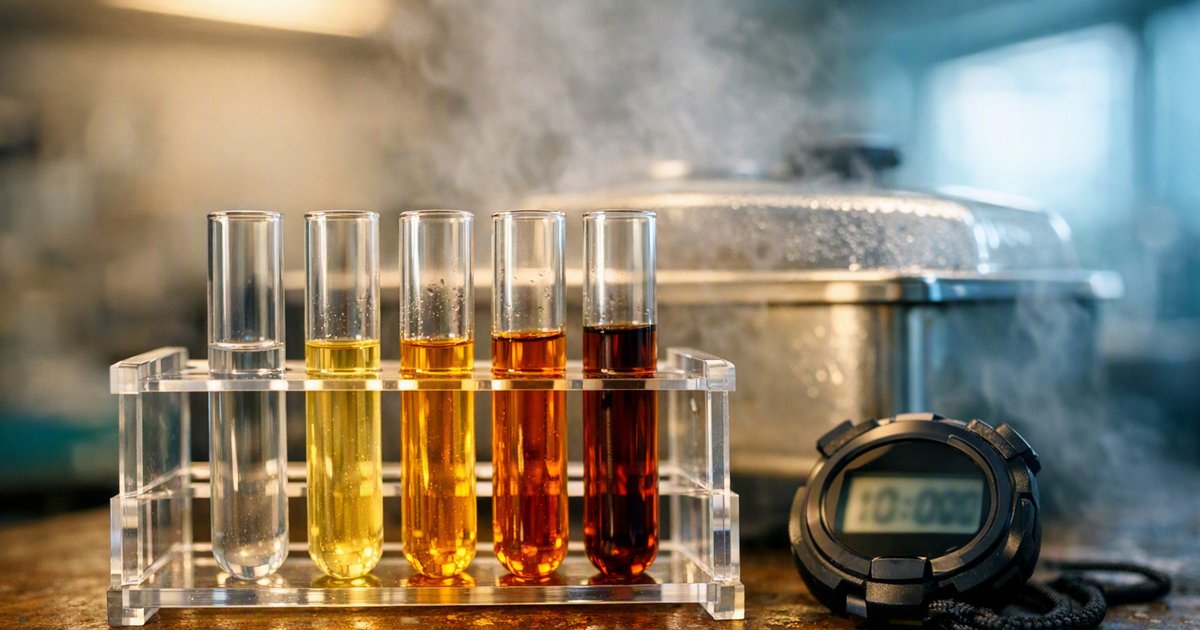
| Reducing sugars (e.g. glucose) | Benedict's solution | Add Benedict's solution to the sample and heat in a water bath at approximately 80 degrees C for 2-3 minutes | Stays blue | Turns green, then yellow, then orange, then brick-red (depending on sugar concentration) |
| Proteins | Biuret reagent (sodium hydroxide + copper sulfate solution) | Add sodium hydroxide solution, then add a few drops of dilute copper sulfate solution and mix gently | Stays blue | Turns lilac/purple |
| Fats and oils | Ethanol (then water) | Dissolve the food sample in ethanol, then pour the ethanol solution into water | Solution stays clear | A cloudy white emulsion forms |
| Vitamin C | DCPIP solution (a blue dye) | Add the food sample drop by drop to DCPIP solution | DCPIP stays blue | DCPIP is decolourised (turns colourless) |
Practical points that examiners test
The food tests are not only examined as theory questions. Examiners frequently ask about the practical details of carrying out these tests correctly. The following points are drawn from mark schemes and examiner reports.
- Benedict's test requires heating. Simply mixing Benedict's solution with a sugar at room temperature will produce no change. The sample must be heated in a water bath (not over a direct flame, which is a safety hazard and introduces uneven heating). The standard temperature is approximately 80 degrees C, maintained for two to three minutes.
- The Benedict's colour change is a gradient. A trace of sugar produces a green colour. A moderate amount gives orange. A high concentration gives a brick-red precipitate. If a question asks for the result of a positive test, state "brick-red" or describe the full gradient - do not simply write "red."
- Iodine turns blue-black, not blue. This is one of the most common marking errors across all IGCSE Biology papers. Writing "blue" instead of "blue-black" will cost the mark.
- The ethanol emulsion test is a two-step process. First dissolve the sample in ethanol, then pour the ethanol into water. The white emulsion only forms when the ethanol-fat solution meets water. If you add water to the food directly, nothing happens.
- Biuret test: add the reagents in order. Sodium hydroxide first, then copper sulfate. The colour change is lilac or purple, not violet or blue-purple. Use the exact term from the syllabus.
- DCPIP is decolourised, not "turned clear." The precise term is decolourised. The more vitamin C present in the sample, the fewer drops needed to decolourise the DCPIP.
Worked example: interpreting food test results
A student tests four food samples (A, B, C and D) with iodine solution, Benedict's solution and biuret reagent. The results are shown in the table below.
| Sample | Iodine test | Benedict's test (heated) | Biuret test |
|---|---|---|---|
| A | Blue-black | Stayed blue | Stayed blue |
| B | Stayed brown | Brick-red | Stayed blue |
| C | Stayed brown | Stayed blue | Lilac |
| D | Blue-black | Orange | Lilac |
Analysis:
- Sample A contains starch only (positive iodine, negative for sugar and protein).
- Sample B contains reducing sugar only (positive Benedict's at brick-red intensity).
- Sample C contains protein only (positive biuret).
- Sample D contains starch, some reducing sugar (orange rather than brick-red indicates a moderate concentration) and protein. This is consistent with a complex food such as bread, which contains starch, some maltose from starch breakdown, and gluten protein.
Extended: the structure of DNA
Students following the Extended syllabus must describe the structure of DNA (deoxyribonucleic acid). The key facts are precise and non-negotiable in the exam.
- Two strands coiled around each other to form a double helix - a shape resembling a twisted ladder.
- Each strand contains a sequence of chemicals called bases.
- The bases on opposite strands pair up and form bonds that hold the two strands together, like the rungs of the ladder.
- The bases always pair in a fixed pattern: A pairs with T (adenine with thymine), and C pairs with G (cytosine with guanine). This is called complementary base pairing.
The sequence of bases along a DNA strand carries the genetic code - it determines the order in which amino acids are assembled to build proteins. This connects directly to the topic of inheritance and variation later in the syllabus. Understanding that DNA controls protein synthesis through its base sequence is a foundational concept that examiners expect you to articulate clearly.
Why DNA matters for biological molecules
DNA is itself a biological molecule, and its structure illustrates the same principle seen throughout this topic: small units (nucleotides containing a base, a sugar and a phosphate group) are linked together to form a very large molecule. Although the syllabus does not require you to describe nucleotide structure in detail, understanding that DNA follows the monomer-polymer pattern reinforces the central theme of biological molecules.
Common exam mistakes
- Writing "blue" instead of "blue-black" for the iodine test. The positive result for starch is specifically blue-black. Omitting "black" is treated as an incorrect answer on most mark schemes.
- Saying Benedict's solution turns "red." The correct term is brick-red. Even better, describe the full gradient: green to yellow to orange to brick-red, which demonstrates understanding that the colour indicates concentration.
- Forgetting to mention heating for the Benedict's test. If a question asks you to describe the procedure, you must state that the mixture is heated (in a water bath). Without heat, no reaction occurs.
- Confusing the ethanol emulsion test procedure. You dissolve the sample in ethanol first, then pour the ethanol into water. Students who write "add ethanol and water to the food" miss the point that the fat must first dissolve in the ethanol before the emulsion can form.
- Listing the wrong elements for proteins. Proteins contain carbon, hydrogen, oxygen and nitrogen. Students sometimes forget nitrogen, which is the element that distinguishes proteins from carbohydrates and fats.
- Confusing starch and glycogen. Both are made from glucose and used for energy storage, but starch is the storage molecule in plants and glycogen is the storage molecule in animals. Do not mix them up.
- Getting DNA base pairs wrong. A pairs with T, C pairs with G. There is no flexibility here. If a question gives you one strand and asks for the complementary strand, apply the rule mechanically: wherever you see A, write T; wherever you see C, write G; and vice versa.
Self-check questions
- State the three chemical elements present in carbohydrates and the additional element found in proteins.
- Name the small molecules from which (a) starch, (b) proteins and (c) fats are built.
- Describe the procedure and expected result for a positive Benedict's test on a glucose solution.
- A student adds iodine solution to a food sample and observes a brown colour. What does this result tell you?
- Explain why the ethanol emulsion test requires two steps rather than simply adding ethanol to the food sample.
- Extended: A section of one DNA strand has the base sequence A T C G G T. Write out the complementary base sequence on the opposite strand.
- Extended: Describe two structural features of a DNA molecule.

A thorough guide to biological molecules for IGCSE Biology, covering carbohydrates, proteins, fats and DNA structure alongside the five standard food tests, with tables, worked examples, common exam mistakes and self-check questions.


Nkwupụta(enwe)