WAEC SSCE - Animal Husbandry - 2025 (Essay)
Ajụjụ 1 Ripọtì
Outline the steps involved in the processing of beeswax
Steps involved in the processing of beeswax
- Fill a cooking pot with water
- Heat water over fire
- Add beeswax to the warm water in the pot
- Pour all the molten beeswax into a moulding container
- Allow it to solidify
- Remove/evacuate wax
- Store in a cool dry place
Akọwa Nkọwa
Steps involved in the processing of beeswax
- Fill a cooking pot with water
- Heat water over fire
- Add beeswax to the warm water in the pot
- Pour all the molten beeswax into a moulding container
- Allow it to solidify
- Remove/evacuate wax
- Store in a cool dry place
Ajụjụ 2 Ripọtì
(a) Define the following terms:
- hay
- silage.
(b)(i) Name two types of pasture.
(ii) State four advantages of establishing a grass-legume pasture.
(iii) State three advantages of rotational grazing. [3 marks]
(c) Draw and label the digestive tract of a hen.
a) Definition of the terms hay and silage;
(i) Hay: This is a cut and dried forage (stored) for feeding farm animals
Silage : This is a cut and fermented forage in an anaerobic condition for feeding farm animals
(b) (i) Name two types of pasture
- Grassland.
- Heathland.
- Machair.
- Maquis.
- Moorland.
- Potrero (landform)
- Prairie.
- Rangeland
(ii) Advantages of establishing a grass-legume pasture
- It suppresses weed
- Improves nutritional quality of the forage/balanced diet
- Legumes fertilize the soil for grass to grow/nitrogen fixation
- Optimal usage of the land
- It enhances proliferation of soil fauna and flora leading to
- improved soil structure, texture and aeration
- Reduces evapotranspiration or water loss
- It prevents erosion
- Legume trails on the grass for more production/High yield/
- improved income
- Legume serves as source of protein for the livestock
- It is more acceptable to ruminants
- It reduces leaching
(iii) Advantages of rotational grazing
- Prevents overgrazing
- Allows for the regeneration of grazed forage
- It controls parasites/diseases/pests
- Promotes efficient utilisation of pasture
- Reduces soil compaction/maintenance of soil structure
(c) 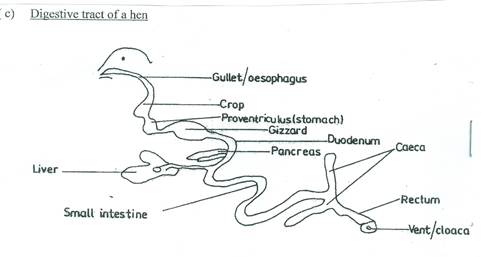
Akọwa Nkọwa
a) Definition of the terms hay and silage;
(i) Hay: This is a cut and dried forage (stored) for feeding farm animals
Silage : This is a cut and fermented forage in an anaerobic condition for feeding farm animals
(b) (i) Name two types of pasture
- Grassland.
- Heathland.
- Machair.
- Maquis.
- Moorland.
- Potrero (landform)
- Prairie.
- Rangeland
(ii) Advantages of establishing a grass-legume pasture
- It suppresses weed
- Improves nutritional quality of the forage/balanced diet
- Legumes fertilize the soil for grass to grow/nitrogen fixation
- Optimal usage of the land
- It enhances proliferation of soil fauna and flora leading to
- improved soil structure, texture and aeration
- Reduces evapotranspiration or water loss
- It prevents erosion
- Legume trails on the grass for more production/High yield/
- improved income
- Legume serves as source of protein for the livestock
- It is more acceptable to ruminants
- It reduces leaching
(iii) Advantages of rotational grazing
- Prevents overgrazing
- Allows for the regeneration of grazed forage
- It controls parasites/diseases/pests
- Promotes efficient utilisation of pasture
- Reduces soil compaction/maintenance of soil structure
(c)
Ajụjụ 3 Ripọtì
(a) Name three internal organs found in each of the following regions of a farm animal: (i) Thoracic region; (ii) Abdominal region.
(b)(i) List four records that could be kept by a poultry farmer. (ii) State four reasons for keeping records in poultry production.
(c)(i) State three damages that could be caused by rats in a deep litter house. (ii) Mention three ways of controlling rats on animal farm
(a) Internal Organs Found in each Region of Farm Animals: (i) Thoracic region: - Heart. -Trachea. -Lungs. -Diaphragm. -Oesophagus/gullet/throat. (ii) Abdominai region: -Liver. -Stomach/Rumen/ ecticullun/omasun/abomasun -kidney. -Fallopian tubeloviduct. -Spleen. -Pancreas. -Large intestine. -Small intestine. -Ureter. -Uterus. -Ovary. -Gall bladder. (b) (i) Records that could be kept by a poultry farmer: - Production record. -Inventory record. -Purchase record. -Input record. -Sales record/ marketing record. -Labour record. -Farm diary. -Income and expenditure record. -Health records/drug. regime record/ill health. -Mortality record. -Routine management record. (ii) Reasons for keeping records in poultry production: - Enables larmers to detect changes in price of produce, -Shows the financial position of the farm. -Helps to know all activities carried out on the farm, -For taking managpmen decision, -For taxation purposes. -For procuring loan. -To detect fraudulent practices on the farm. -For computing farmer's net worth. -For budgeting. -1o assess production performance. (c)(i) Damages that could be caused by rats in a deep litter house: - Acts as vectors of diseases. -Compete with birds for feed, -Contaminate feed. -Waste feed. -Can kill the birds. -Destroy poultry equipment -Destroy poultry house. -Contaminate water. -Waste water. -Compete with birds for water. -Cause panic/scare/stampede. (ii) Ways of controlling rats on animal farms: - Clear bush around the farm. -Trapping with baits/glue board. -Fencing/surround with wire netting. -Use of predators, e.g cats. -Sealing off all holes, -Use rodenticides/rat poison.
Akọwa Nkọwa
(a) Internal Organs Found in each Region of Farm Animals: (i) Thoracic region: - Heart. -Trachea. -Lungs. -Diaphragm. -Oesophagus/gullet/throat. (ii) Abdominai region: -Liver. -Stomach/Rumen/ ecticullun/omasun/abomasun -kidney. -Fallopian tubeloviduct. -Spleen. -Pancreas. -Large intestine. -Small intestine. -Ureter. -Uterus. -Ovary. -Gall bladder. (b) (i) Records that could be kept by a poultry farmer: - Production record. -Inventory record. -Purchase record. -Input record. -Sales record/ marketing record. -Labour record. -Farm diary. -Income and expenditure record. -Health records/drug. regime record/ill health. -Mortality record. -Routine management record. (ii) Reasons for keeping records in poultry production: - Enables larmers to detect changes in price of produce, -Shows the financial position of the farm. -Helps to know all activities carried out on the farm, -For taking managpmen decision, -For taxation purposes. -For procuring loan. -To detect fraudulent practices on the farm. -For computing farmer's net worth. -For budgeting. -1o assess production performance. (c)(i) Damages that could be caused by rats in a deep litter house: - Acts as vectors of diseases. -Compete with birds for feed, -Contaminate feed. -Waste feed. -Can kill the birds. -Destroy poultry equipment -Destroy poultry house. -Contaminate water. -Waste water. -Compete with birds for water. -Cause panic/scare/stampede. (ii) Ways of controlling rats on animal farms: - Clear bush around the farm. -Trapping with baits/glue board. -Fencing/surround with wire netting. -Use of predators, e.g cats. -Sealing off all holes, -Use rodenticides/rat poison.
Ajụjụ 4 Ripọtì
(a). Explain each of the following terms as used in livestock production. i. parasite; ii pest
(b). Name three: (i) ectoparasites of sheep; (ii) insect pests of sheep
(c). State four damages that could be caused by pests in cattle.
(d). Give six signs that could be observed in a sick rabbit.
(a). Explanation of terms used in livestock production: PARASITES (i) Parasites are organisms that in fest livestock. -They can be ectoparasites or endoparasites. – They obtain nutrients from animals. – Causes damage to the animal/host. (ii). Pest: - Pests are organisms that attack animals, stored products, animals' products and farm structures. - They could be insect or non- insect pests. – They cause damage to farm produce. - They contaminate produce.
(b)(i). Ectoparasites of sheep. - Lice. -Ticks. - Mites. Sheep keds. Fleas. - Bugs. – (ii). Insect pests of sheep - Housely. – Blowfly. Tsetse fly. Soldier ants. Wool maggot/maggot. Botfly/warble flies. Sheep lices/lice. - Biting midges/mites. -Black flies. -Mosquitoes. – Stable fly.
(c) Damage caused by Pests in cattle - Storage of blood/anaemia. -Could lead to death. -Coma. - Unthirfiness/rough coat. - Transmits diseases/vectors of diseases/sickness. -Irritation.– Damage the hide/reduces the quality of hide. - Loss ofyield/produce. -Causes wounds. -Reduces market value.
(d) Signs that could be observed in a sick rabbit: - Isolation. - Loss of appetite/ anorexia. -Loss of weight/emaciation. Oozing of blood from natural openings. -Rough fur/coat. - Swelling ofthe joints. - Increase in body temperature. - Diarrhoea. - Blood-stained faeces. - Anaemia, - Ocular discharge,- Ear discharge. - Nasal discharge. Pneumonia. – Coughing/sneezing. - Excessive salivation. - Distended stomach.-Lameness. -Coma.- Dullness/ unthriftiness, - Low water intake. Constipation. difficult breathing. death. - weakness. - Wobbly gait/waddling gait. - Undue noise making. Abortion.-Alopccia/loss of hair.
Akọwa Nkọwa
(a). Explanation of terms used in livestock production: PARASITES (i) Parasites are organisms that in fest livestock. -They can be ectoparasites or endoparasites. – They obtain nutrients from animals. – Causes damage to the animal/host. (ii). Pest: - Pests are organisms that attack animals, stored products, animals' products and farm structures. - They could be insect or non- insect pests. – They cause damage to farm produce. - They contaminate produce.
(b)(i). Ectoparasites of sheep. - Lice. -Ticks. - Mites. Sheep keds. Fleas. - Bugs. – (ii). Insect pests of sheep - Housely. – Blowfly. Tsetse fly. Soldier ants. Wool maggot/maggot. Botfly/warble flies. Sheep lices/lice. - Biting midges/mites. -Black flies. -Mosquitoes. – Stable fly.
(c) Damage caused by Pests in cattle - Storage of blood/anaemia. -Could lead to death. -Coma. - Unthirfiness/rough coat. - Transmits diseases/vectors of diseases/sickness. -Irritation.– Damage the hide/reduces the quality of hide. - Loss ofyield/produce. -Causes wounds. -Reduces market value.
(d) Signs that could be observed in a sick rabbit: - Isolation. - Loss of appetite/ anorexia. -Loss of weight/emaciation. Oozing of blood from natural openings. -Rough fur/coat. - Swelling ofthe joints. - Increase in body temperature. - Diarrhoea. - Blood-stained faeces. - Anaemia, - Ocular discharge,- Ear discharge. - Nasal discharge. Pneumonia. – Coughing/sneezing. - Excessive salivation. - Distended stomach.-Lameness. -Coma.- Dullness/ unthriftiness, - Low water intake. Constipation. difficult breathing. death. - weakness. - Wobbly gait/waddling gait. - Undue noise making. Abortion.-Alopccia/loss of hair.
Ajụjụ 5 Ripọtì
(a) State four advantages if artificial insemination.
(b) State five functions of the rumen.
(a) Advantages of artificial insemination
- It is cheaper to import semen/transport semen than the live male
- Optimal use of semen/one male can be used for several females
- The semen of a desired sire can be used even after death
- Less space is required to keep male animals for breeding purpose
- Saves the cost of maintaining males
- Semen of old/injured animals/overweight sires can be used
- It helps in planning breeding programme
- Minimal labour is required to keep sire for
- breeding purpose
- Prevents the spread of sexually transmitted diseases
- It aids better record keeping
- There is high rate of conception and productivity/breeding efficiency
(b) Functions of the rumen
- Temporary storage of food
- Digestion of feed nutrients
- Soften fibre/feed
- Fermentation of cellulose/fibre/feed
- Provides suitable environment for microbial protein synthesis
- Synthesis of vitamins B complex and K
- Production of enteric gas e.g CH4, CO2, H2
- Production of volatile fatty acids e.g. acetate, butyrate, propionate
- Absorption of certain nutrient occurs from the wall of the rumen
- Assists in the act of rumination
- Utilization of non-protein nitrogenous compounds
- Accommodates micro-organisms
- Mixing/churning of digesta/regurgitation
- Serves as passage way of digesta/chyme to the reticulum
Akọwa Nkọwa
(a) Advantages of artificial insemination
- It is cheaper to import semen/transport semen than the live male
- Optimal use of semen/one male can be used for several females
- The semen of a desired sire can be used even after death
- Less space is required to keep male animals for breeding purpose
- Saves the cost of maintaining males
- Semen of old/injured animals/overweight sires can be used
- It helps in planning breeding programme
- Minimal labour is required to keep sire for
- breeding purpose
- Prevents the spread of sexually transmitted diseases
- It aids better record keeping
- There is high rate of conception and productivity/breeding efficiency
(b) Functions of the rumen
- Temporary storage of food
- Digestion of feed nutrients
- Soften fibre/feed
- Fermentation of cellulose/fibre/feed
- Provides suitable environment for microbial protein synthesis
- Synthesis of vitamins B complex and K
- Production of enteric gas e.g CH4, CO2, H2
- Production of volatile fatty acids e.g. acetate, butyrate, propionate
- Absorption of certain nutrient occurs from the wall of the rumen
- Assists in the act of rumination
- Utilization of non-protein nitrogenous compounds
- Accommodates micro-organisms
- Mixing/churning of digesta/regurgitation
- Serves as passage way of digesta/chyme to the reticulum
Ajụjụ 6 Ripọtì
(a)(i) Explain the term malnutrition as used in Animal Husbandry. (ii) If 10,000 layers were fed with a diet containing 60% maize, I.5% fishmeal, 289% groundnut cake, and I.5% oyster shell name the limiting ingredients that are not included in the diet. (iii) State two importance of each of the nutrients named in 2 (a)(ii).
(b). Give two reasons why a poultry farmer should keep farm records. c. State four ways in which liver fluke could be prevented from completing its life cycle.
a(i). Explanation of malnutrition in animal husbandry. - Malnutrition is a condition caused by feeding animals a diet that is deficient in essential nutrients, -It is a condition resulting from feeding animals with a diet in excess of essential nutrients. - It could also occur when an animal cannot utilize nutrients in feed given, due to ill health, stress, or other factors, – It could occur when the right quantity of feed is not given to the animal. -Nutrients in the feed are not in the right proportions. (ii). Limiting ingredients that are not included in the diet. -Fibre source c.g. wheat offal, rice bran, maize offal, PKC. - Mineral- vitamin premix. -Common salt/table salt. -Toxin binder/detoxifier. - Vegetable oil/ palm oil- (iii). Importance of limiting ingredients - Fibre - Adds bulk to the feed. - Improves bowel movement. - Improves digestibility. - Reduces incidence of diarrhea in farm animals. -Minerals vitamin premix. -Useful in egg formation. - Improves immunity against disease. – Aids proper absorption of nutrients. – Used in bone formation -Common Salt- Improves palatability. - Promotes activities of enzymes. Supplies sodium and chlorine to the animal. -Increases feed intake. - Improves water intake. - Vegetable Oil/Palm oil -Reduce dustiness of feed. - Improve palatability/acceptability. Improve energy content of the feed.- Improve carotene or vitamin A content of feed. -Toxin Binder/detoxifier - Binds toxin in feed/ - Growth promoter. - Builds immunity. – Traps fungal pathogens.
b.Reasons for keeping farm records by a poultry farmer. - Shows the financial position of the farm. - Enables the farmer to know all the activities carried out on the farm. -For taking management decisions/planning. - For estimating annual tax. – Necessary in obtaining loans. - Helps to detect fraudulent practices on the farm. - Enables the farmer to detect changes in prices. – Used for computing farmer's net worth/farm inventory. - Serves as a requirement to receive awards/levies. -Aids appropriate budgeting. – For purpose of auditing. To assess productivity.
c.Ways of preventing liver fluke from completing its life cycle. - Periodic burning of pasture. - Use of clean, uncontaminated water. -Use of lime to prevent eggs from hatching/liming. Elimination of water snails by introducing docks, -Controls of weeds in ponds and riversides, - Avoid grazing animals on marshy areas. Ensure proper drainage of pasture lands.
Akọwa Nkọwa
a(i). Explanation of malnutrition in animal husbandry. - Malnutrition is a condition caused by feeding animals a diet that is deficient in essential nutrients, -It is a condition resulting from feeding animals with a diet in excess of essential nutrients. - It could also occur when an animal cannot utilize nutrients in feed given, due to ill health, stress, or other factors, – It could occur when the right quantity of feed is not given to the animal. -Nutrients in the feed are not in the right proportions. (ii). Limiting ingredients that are not included in the diet. -Fibre source c.g. wheat offal, rice bran, maize offal, PKC. - Mineral- vitamin premix. -Common salt/table salt. -Toxin binder/detoxifier. - Vegetable oil/ palm oil- (iii). Importance of limiting ingredients - Fibre - Adds bulk to the feed. - Improves bowel movement. - Improves digestibility. - Reduces incidence of diarrhea in farm animals. -Minerals vitamin premix. -Useful in egg formation. - Improves immunity against disease. – Aids proper absorption of nutrients. – Used in bone formation -Common Salt- Improves palatability. - Promotes activities of enzymes. Supplies sodium and chlorine to the animal. -Increases feed intake. - Improves water intake. - Vegetable Oil/Palm oil -Reduce dustiness of feed. - Improve palatability/acceptability. Improve energy content of the feed.- Improve carotene or vitamin A content of feed. -Toxin Binder/detoxifier - Binds toxin in feed/ - Growth promoter. - Builds immunity. – Traps fungal pathogens.
b.Reasons for keeping farm records by a poultry farmer. - Shows the financial position of the farm. - Enables the farmer to know all the activities carried out on the farm. -For taking management decisions/planning. - For estimating annual tax. – Necessary in obtaining loans. - Helps to detect fraudulent practices on the farm. - Enables the farmer to detect changes in prices. – Used for computing farmer's net worth/farm inventory. - Serves as a requirement to receive awards/levies. -Aids appropriate budgeting. – For purpose of auditing. To assess productivity.
c.Ways of preventing liver fluke from completing its life cycle. - Periodic burning of pasture. - Use of clean, uncontaminated water. -Use of lime to prevent eggs from hatching/liming. Elimination of water snails by introducing docks, -Controls of weeds in ponds and riversides, - Avoid grazing animals on marshy areas. Ensure proper drainage of pasture lands.


