Your Hand Warmer Is a Chemistry Lesson
Ever cracked open one of those disposable hand warmers on a cold day and felt it heat up in seconds? That little pouch just ran a chemical reaction that released energy into your hands. Now think about the opposite: an instant cold pack you snap after a sports injury, and it turns ice-cold almost immediately. That one absorbed energy from its surroundings.
Two reactions. Two opposite energy stories. And both of them show up constantly in your Cambridge IGCSE Chemistry exam.
Let's break down exactly what exothermic and endothermic reactions are, how to spot them, how to draw their energy diagrams, and how to crush the calculation questions that come up on Paper 2 and Paper 4.
Key Facts: Exothermic and Endothermic at a Glance
- Exothermic reactions release heat energy to the surroundings. The temperature of the surroundings rises.
- Endothermic reactions absorb heat energy from the surroundings. The temperature of the surroundings falls.
- The prefix exo- means "out" (energy exits the reaction). The prefix endo- means "in" (energy enters the reaction).
- Bond breaking is always endothermic (requires energy). Bond making is always exothermic (releases energy).
- Energy level diagrams show reactants and products at different heights to represent energy changes.
- Bond energy calculations let you predict whether an overall reaction is exothermic or endothermic.
What Exactly Is an Exothermic Reaction?
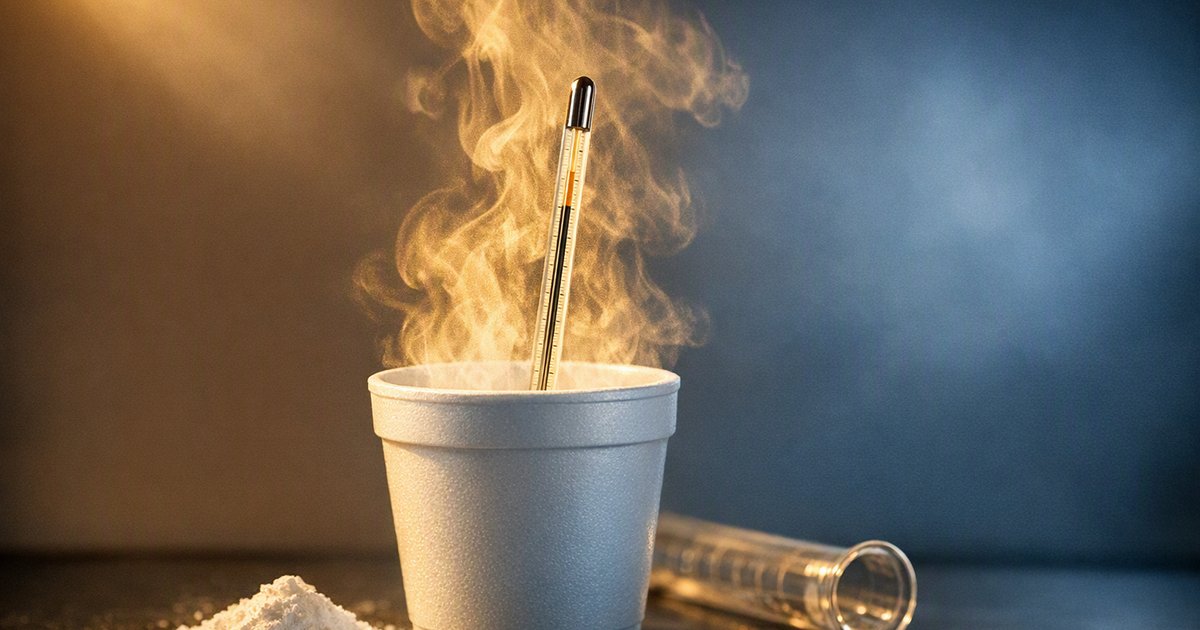
An exothermic reaction transfers thermal energy to its surroundings. If you held a thermometer near the reaction, you would see the temperature go up.
Think of it this way: the chemicals have stored energy inside their bonds. During the reaction, the products end up with less energy than the reactants started with. That leftover energy gets dumped into the surroundings as heat.
Common Exothermic Examples You Need to Know
- Combustion - burning fuels like methane (CH4 + 2O2 → CO2 + 2H2O). This is probably the most obvious one. Fire is hot for a reason.
- Neutralisation - mixing an acid with a base. Pour dilute hydrochloric acid into sodium hydroxide solution, and the beaker gets warm.
- Respiration - the reaction happening in every cell in your body right now. Glucose reacts with oxygen to release energy that keeps you alive.
- Oxidation of metals - iron rusting is actually exothermic, just very slow. Those hand warmers? Iron powder oxidising rapidly inside a sealed pouch.
What Exactly Is an Endothermic Reaction?
An endothermic reaction absorbs thermal energy from its surroundings. The thermometer reading goes down.
Here, the products end up with more energy than the reactants started with. The extra energy had to come from somewhere, and that somewhere is the surroundings. That is why endothermic reactions feel cold.
Common Endothermic Examples You Need to Know
- Thermal decomposition - heating calcium carbonate to break it into calcium oxide and carbon dioxide. You need to keep supplying heat, which tells you the reaction is absorbing energy.
- Photosynthesis - plants absorb light energy to convert carbon dioxide and water into glucose. No sunlight, no reaction. The energy input is essential.
- Dissolving ammonium nitrate in water - this is the reaction inside instant cold packs. The beaker gets noticeably cold to the touch.
- Citric acid reacting with sodium hydrogencarbonate (baking soda) - a classic demonstration where the temperature drops measurably.
Exothermic vs Endothermic: Side-by-Side Comparison
Stick this table in your revision notes. It covers everything you need for a quick comparison.
| Feature | Exothermic | Endothermic |
|---|---|---|
| Energy transfer | Releases energy to surroundings | Absorbs energy from surroundings |
| Temperature change | Surroundings get hotter | Surroundings get cooler |
| Energy of products vs reactants | Products have less energy | Products have more energy |
| Energy diagram | Reactants higher than products | Reactants lower than products |
| Everyday examples | Burning fuel, neutralisation, respiration | Thermal decomposition, photosynthesis, cold packs |
| Bond energy relationship | Energy released by bonds formed > energy needed to break bonds | Energy needed to break bonds > energy released by bonds formed |
Energy Level Diagrams: How to Draw Them
Energy level diagrams (also called reaction profile diagrams) are one of the most common diagram questions in IGCSE Chemistry. Here is exactly how they work.
Exothermic Energy Level Diagram
Picture a set of steps going downward:
- Draw a horizontal line near the top of your diagram. Label it "Reactants".
- Draw a second horizontal line lower down. Label it "Products".
- Between the two lines, draw a downward arrow and label it with the energy change (this is the energy released).
- Draw a hump (curve) rising above the reactant line and then coming back down to the product line. The peak of this hump represents the activation energy - the minimum energy needed to start the reaction.
The key visual: reactants are higher than products. Energy has been released, so the products sit at a lower energy level.
Endothermic Energy Level Diagram
Now flip it. The steps go upward:
- Draw a horizontal line near the bottom. Label it "Reactants".
- Draw a second horizontal line higher up. Label it "Products".
- Draw an upward arrow between them and label it with the energy absorbed.
- Draw the activation energy hump rising above the product line and then coming back down to meet it.
The key visual here: reactants are lower than products. Energy has been absorbed, so the products sit at a higher energy level.
Bond Energy Calculations (Extended Curriculum)
This section is for students on the Extended syllabus (Papers 3 and 4). If you are sitting Core only, you can skip ahead, but honestly? Understanding this will make the whole topic click better.
Here is the fundamental rule:
- Breaking bonds requires energy (endothermic process).
- Making bonds releases energy (exothermic process).
To find the overall energy change of a reaction, you calculate:
Energy change = Total energy to break bonds (in reactants) - Total energy released by forming bonds (in products)
- If the answer is positive, the reaction is endothermic (more energy went in than came out).
- If the answer is negative, the reaction is exothermic (more energy came out than went in).
Worked Example: Combustion of Hydrogen
The reaction: 2H2 + O2 → 2H2O
Given bond energies:
| Bond | Bond Energy (kJ/mol) |
|---|---|
| H-H | 436 |
| O=O | 498 |
| O-H | 463 |
Step 1: Calculate energy needed to break all bonds in the reactants.
- 2 molecules of H2: 2 x 1 H-H bond = 2 x 436 = 872 kJ
- 1 molecule of O2: 1 x 1 O=O bond = 1 x 498 = 498 kJ
- Total energy in (bonds broken) = 872 + 498 = 1370 kJ
Step 2: Calculate energy released by forming all bonds in the products.
- 2 molecules of H2O: each has 2 O-H bonds = 2 x 2 x 463 = 1852 kJ
- Total energy out (bonds formed) = 1852 kJ
Step 3: Calculate the overall energy change.
- Energy change = 1370 - 1852 = -482 kJ
The answer is negative, so this reaction is exothermic. That makes sense: burning hydrogen releases a lot of heat.
Common Exam Mistakes (And How to Avoid Them)
After years of examining IGCSE Chemistry scripts, certain mistakes come up again and again. Here are the big ones.
- Mixing up exothermic and endothermic. The number one error. Students write "exothermic" but then describe a temperature decrease, or vice versa. Use the prefix trick: exo = exit = energy leaves = temperature rises. Endo = enter = energy enters the reaction = temperature falls.
- Saying bond breaking is exothermic. Nope. Breaking bonds always requires energy input. Think about snapping a stick: you have to put effort in to break it. Forming bonds is what releases energy.
- Drawing energy diagrams upside down. For exothermic, reactants go on top (they have more energy). For endothermic, products go on top. If your arrow points downward in an exothermic diagram, that is the energy being released.
- Forgetting to count all the bonds. In the calculation, students often forget there are two O-H bonds in each water molecule, or miscounting bonds in more complex molecules. Write out the structural formula and count carefully.
- Confusing activation energy with the overall energy change. The hump on the diagram is the activation energy. The height difference between reactants and products is the overall energy change. They are two different things.
Worked Exam-Style Question
(a) Is this reaction exothermic or endothermic? Explain your answer. [2 marks]
(b) Draw an energy level diagram for this reaction. Label the reactants, products, activation energy, and overall energy change. [3 marks]
(c) Suggest a practical use for this type of reaction. [1 mark]
Model Answer:
(a) The reaction is endothermic. The temperature of the surroundings (water) decreased from 22 degrees C to 15 degrees C, which shows that the reaction absorbed heat energy from the water.
(b) For the energy level diagram:
- Draw a horizontal line at a lower level labelled "Reactants (ammonium nitrate + water)".
- Draw a horizontal line at a higher level labelled "Products (ammonium ions + nitrate ions in solution)".
- Draw an upward arrow between the two lines labelled "energy absorbed".
- Draw a curved hump from the reactant line rising above the product line and back down to the product line. Label the height from reactants to the peak as "activation energy".
(c) This type of reaction is used in instant cold packs for treating sports injuries.
Notice how part (a) follows a pattern: state the answer, then use the data to explain why. That two-step structure is what gets you full marks on "explain" questions in Cambridge IGCSE Chemistry.
How This Topic Connects to the Rest of Your IGCSE Course
Exothermic and endothermic reactions are not an isolated topic. They connect to several other areas you will study:
- Rates of reaction - activation energy (from energy diagrams) links directly to why catalysts speed up reactions. A catalyst lowers the activation energy, making it easier for particles to react.
- Fuels and hydrocarbons - combustion of alkanes is exothermic. This is why we use methane, propane, and octane as fuels.
- Acids and bases - neutralisation is exothermic. You might be asked to plot a temperature change graph during a titration.
- The environment - understanding energy changes in combustion helps explain why burning fossil fuels releases so much thermal energy (and carbon dioxide).
Seeing these connections helps you answer cross-topic questions, which are becoming more common on IGCSE papers.
Quick Self-Check Questions
Test yourself before you move on. Try answering each one in your head (or on paper) before reading the answer.
Answer: Exothermic. The temperature of the surroundings increased, showing that heat energy was released by the reaction.
Answer: Higher. The reactants have more energy than the products. The difference in height represents the energy released.
Answer: Endothermic. Breaking bonds always requires energy input. Forming bonds releases energy.
Answer: Endothermic. A positive energy change means more energy was needed to break bonds than was released by forming them. The reaction absorbed energy overall.
Answer: Dissolving ammonium nitrate in water. The temperature of the water drops noticeably, showing that the process absorbs heat energy from the surroundings.
Final Thoughts
Exothermic and endothermic reactions are one of those IGCSE Chemistry topics that sound simple on the surface but trip students up with the details. The definitions are straightforward, but the exam questions test whether you can apply them: reading temperature data, drawing correct energy diagrams, and doing bond energy calculations without losing track of your signs.
The good news? Once you get the core logic - energy out versus energy in - everything else follows from that. Nail the definitions, practise drawing those energy level diagrams until you can do them in your sleep, and always double-check your bond calculations by asking: "Does my answer make sense for this type of reaction?"
You have got this.

This visual guide breaks down exothermic and endothermic reactions for Cambridge IGCSE Chemistry students. It covers definitions, real-world examples, energy level diagrams, bond energy calculations, and common exam pitfalls - all in a clear, student-friendly format with worked examples and self-check questions.

Sharhi(ko)