The Periodic Table is your best friend in chemistry
Think of the Periodic Table as a seating plan for a very large school assembly. Every element has its own assigned seat, and where it sits tells you almost everything about how it behaves. Once you understand the layout, you can predict reactions, spot trends, and answer exam questions with real confidence. For IGCSE Chemistry, the Periodic Table is one of the most rewarding topics to master because the patterns are consistent and logical.
How the table is organised
Elements are arranged in order of increasing proton number (atomic number). Rows running left to right are called periods, and columns running top to bottom are called groups. The group number tells you how many electrons sit in the outermost shell of that element's atoms, which is the single biggest factor in determining chemical behaviour.
Imagine a street of houses. Every house on the same side of the road (same group) has a similar front door design. Houses further along the street (higher period) are bigger, but they still share that door style. That shared design is the outer-shell electron configuration, and it is why elements in the same group react in similar ways.
Metallic to non-metallic character across a period
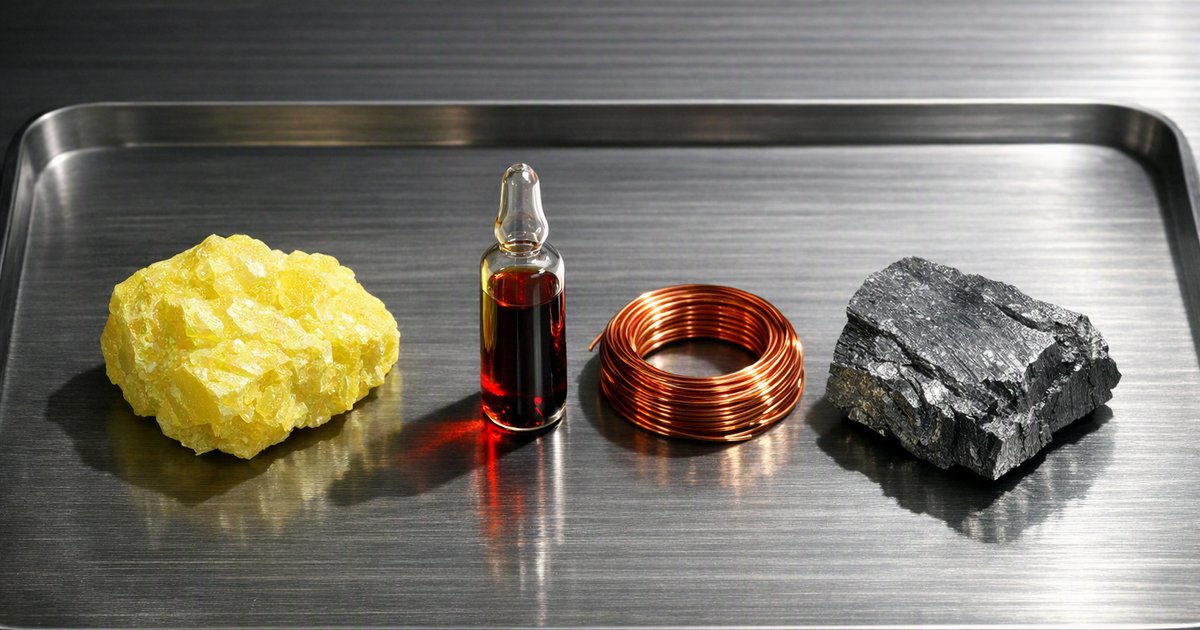
As you move from left to right across a period, elements change from metals to metalloids to non-metals. On the far left you find highly reactive metals like sodium and potassium. In the middle sit the transition metals. On the right you meet non-metals like sulfur, chlorine, and the noble gases at the very end. This trend repeats in every period, like a recurring pattern in wallpaper.
Group number and ion charge
There is a neat shortcut here. Elements in Group I form ions with a 1+ charge. Group II elements form 2+ ions. Group VI elements form 2- ions, and Group VII elements form 1- ions. The group number either matches the positive charge directly or, for non-metals, tells you how many electrons the atom needs to gain to fill its outer shell.
Group I: the alkali metals
Lithium, sodium, and potassium are the three alkali metals you need to know for IGCSE Chemistry. They are soft enough to cut with a knife, have low densities (lithium, sodium, and potassium all float on water), and are stored under oil because they react so readily with moisture and oxygen in the air.
Their reactions with water follow a clear pattern: the further down the group you go, the more vigorous the reaction becomes. Think of it like a set of fireworks. Lithium is a sparkler - steady and calm. Sodium is a Roman candle - lively and bright. Potassium is a full rocket - fast, fierce, and producing a lilac flame.
| Element | Reaction with water | Observations |
|---|---|---|
| Lithium (Li) | Floats, fizzes steadily, dissolves slowly | Gentle fizzing, hydrogen gas produced, solution turns alkaline (pH rises) |
| Sodium (Na) | Floats, melts into a ball, moves rapidly across surface | Vigorous fizzing, may ignite with yellow flame, hydrogen gas, strongly alkaline solution |
| Potassium (K) | Floats, ignites immediately, moves violently | Lilac flame, spitting, hydrogen gas, very strongly alkaline solution |
All three reactions produce a metal hydroxide and hydrogen gas. The general equation is:
Metal + Water -> Metal hydroxide + Hydrogen
For sodium: 2Na + 2H2O -> 2NaOH + H2
Group VII: the halogens
Fluorine, chlorine, bromine, and iodine are the halogens. Unlike the alkali metals, the halogens become less reactive as you go down the group. Fluorine at the top is the most reactive non-metal in the entire table, while iodine at the bottom reacts sluggishly by comparison.
| Element | State at room temperature | Colour | Reactivity |
|---|---|---|---|
| Fluorine (F2) | Gas | Pale yellow | Most reactive |
| Chlorine (Cl2) | Gas | Yellow-green | Very reactive |
| Bromine (Br2) | Liquid | Red-brown | Moderately reactive |
| Iodine (I2) | Solid | Dark grey (purple vapour) | Least reactive |
Displacement reactions
A more reactive halogen will displace a less reactive halide from its solution. This is like a queue where someone stronger pushes a weaker person out of their spot. If you add chlorine water to potassium bromide solution, the chlorine displaces the bromide:
Cl2 + 2KBr -> 2KCl + Br2
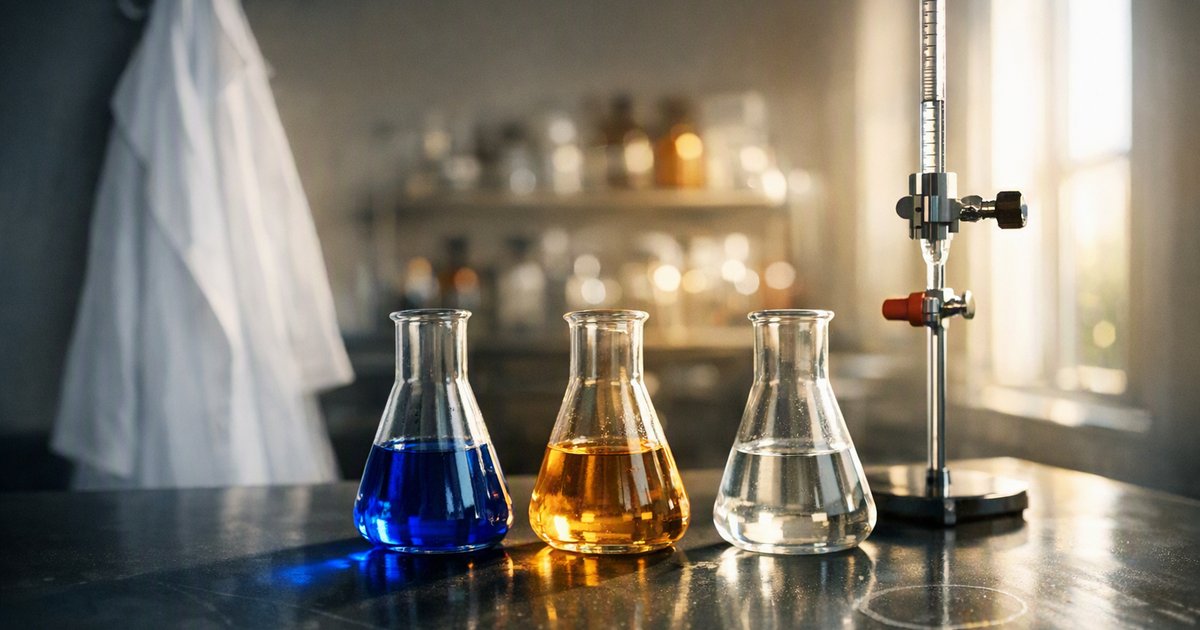
The solution turns orange-brown as bromine is released. But if you add iodine to potassium bromide, nothing happens because iodine is less reactive than bromine.
- Chlorine + potassium bromide: reaction occurs, solution turns orange-brown
- Chlorine + potassium iodide: reaction occurs, solution turns brown
- Bromine + potassium iodide: reaction occurs, solution turns brown
- Bromine + potassium chloride: no reaction
- Iodine + potassium bromide: no reaction
- Iodine + potassium chloride: no reaction
Transition elements
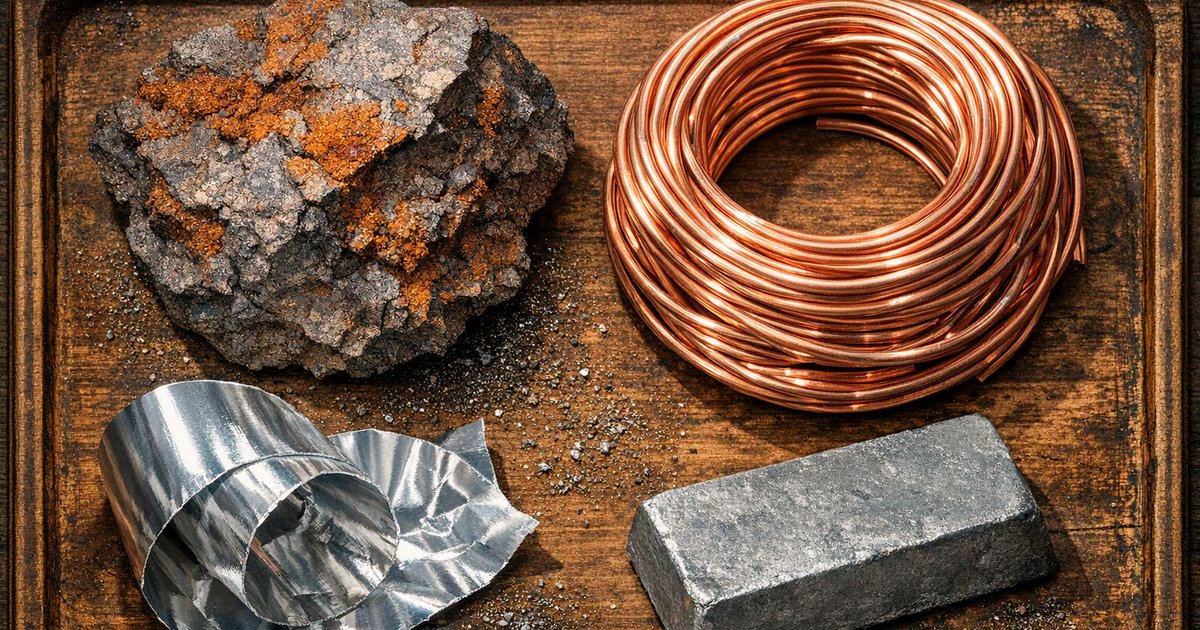
The transition elements sit in the central block of the Periodic Table, between Group II and Group III. Iron, copper, nickel, and zinc are the ones you will encounter most often in IGCSE Chemistry. Compared to the alkali metals, transition elements are harder, denser, have higher melting points, and are much less reactive.
Two standout properties make them easy to remember:
- They form coloured compounds. Copper sulfate is blue, iron(III) oxide is orange-brown, potassium dichromate is orange, and potassium manganate(VII) is purple. If a compound has a strong colour, there is a good chance a transition element is involved.
- They act as catalysts. Iron is used in the Haber process to manufacture ammonia. Manganese(IV) oxide speeds up the decomposition of hydrogen peroxide. Nickel is used in the hydrogenation of vegetable oils.
Transition elements can also form ions with different charges. Iron, for instance, can be Fe2+ (iron(II), forming green compounds) or Fe3+ (iron(III), forming orange-brown compounds). This versatility is part of what makes them so useful in industry.
Noble gases: Group 0
Helium, neon, argon, krypton, and xenon make up Group 0 (sometimes called Group VIII). Their outer electron shells are completely full, which means they have no tendency to lose, gain, or share electrons. The result is that noble gases are chemically inert - they do not form compounds under normal conditions.
Think of them as the introverts of the Periodic Table: perfectly content on their own and uninterested in bonding with anyone else. Their lack of reactivity is precisely what makes them useful:
- Helium fills balloons and airships because it is light and non-flammable
- Neon produces a distinctive red-orange glow in discharge tubes (advertising signs)
- Argon provides an inert atmosphere inside filament light bulbs and during welding
Electronic configuration ties everything together
The reason elements in the same group behave similarly comes down to one thing: they have the same number of electrons in their outer shell. Sodium (2,8,1) and potassium (2,8,8,1) both have one outer electron, so both are reactive metals that lose that electron easily. Chlorine (2,8,7) and bromine (2,8,18,7) both have seven outer electrons, so both are reactive non-metals that gain one electron readily.
If you can write the electronic configuration of an element, you can predict its group, whether it is a metal or non-metal, the charge of its ion, and how it compares in reactivity to its neighbours above and below. That single skill unlocks a large portion of the marks available on this topic in your IGCSE exam.
Quick self-check
- Why do elements in the same group have similar chemical properties?
- Place lithium, sodium, and potassium in order of increasing reactivity with water.
- Predict what happens when bromine water is added to potassium iodide solution. Write the equation.
- Give two characteristic properties of transition elements that distinguish them from Group I metals.
- Explain why noble gases are described as inert.

A complete guide to the Periodic Table for IGCSE Chemistry students, covering how elements are arranged, the behaviour of Group I alkali metals and Group VII halogens, transition elements, and noble gases. Includes reactivity trends, displacement reactions, and exam-focused tips to help you feel confident on test day.


Comentario(s)