The problem is rarely knowledge - it's execution
Most IGCSE Mathematics candidates who underperform don't fail because they haven't studied the syllabus. They fail because they make preventable errors under exam conditions - errors that, once identified, can be systematically eliminated. The difference between a grade C and a grade A often comes down to ten or twelve marks lost to mistakes that the same student wouldn't make in a calm homework setting.
What follows is a structured diagnosis of the most costly errors across the highest-weighted IGCSE Mathematics topics, organised so that each mistake is paired with a clear correction. Treat this as a checklist: work through each one, test yourself honestly, and focus your remaining revision time on the patterns where you're still vulnerable.
Mistake 1: Sign errors in algebraic expansion
This is the single most damaging category of error across all four papers. When expanding brackets that involve negative terms, candidates routinely apply the negative sign to the first term inside the bracket but forget the second.
The wrong approach
Expand 3(2x - 5) - 2(x + 4):
A typical incorrect attempt looks like this:
- 3(2x - 5) = 6x - 15 (correct so far)
- -2(x + 4) = -2x + 8 (wrong - the student applied -2 to x but forgot to apply the negative to +4)
- Result: 6x - 15 - 2x + 8 = 4x - 7 (incorrect)
The correct approach
The negative sign outside the bracket must multiply every term inside, without exception:
- 3(2x - 5) = 6x - 15
- -2(x + 4) = -2x - 8 (negative times positive gives negative)
- Combine: 6x - 15 - 2x - 8 = 4x - 23
Mistake 2: Solving equations by doing different operations to each side
The golden rule of equation solving - whatever you do to one side, you must do to the other - sounds simple. In practice, candidates break it constantly, especially with equations involving fractions or multiple steps.
The wrong approach
Solve (x + 3)/4 = 7:
- Student subtracts 3 from the left side: x/4 = 7 (wrong - they subtracted 3 from the numerator but didn't subtract 3 from the right side)
- Then multiplies by 4: x = 28 (incorrect)
The correct approach
- Multiply both sides by 4: x + 3 = 28
- Subtract 3 from both sides: x = 25
- Check: (25 + 3)/4 = 28/4 = 7. Confirmed.
The check step takes five seconds and catches this class of error completely. If your answer doesn't satisfy the original equation, you know something went wrong, and you can re-examine your steps rather than submitting an incorrect response.
Mistake 3: Converting between fractions, decimals, and percentages in the wrong direction
Candidates frequently confuse the conversion procedures, particularly when moving from a percentage to a decimal or from a fraction to a percentage. The errors multiply when these conversions appear inside a larger problem, such as a percentage increase or decrease question.
| Conversion | Common error | Correct method |
|---|---|---|
| Percentage to decimal | Moving the decimal point the wrong way (e.g. 35% becomes 3.5) | Divide by 100: 35% = 0.35 |
| Decimal to percentage | Adding a % sign without shifting (e.g. 0.6 becomes 0.6%) | Multiply by 100: 0.6 = 60% |
| Fraction to percentage | Dividing the wrong way round (e.g. 3/8 computed as 8 divided by 3) | Divide numerator by denominator, then multiply by 100: 3/8 = 0.375 = 37.5% |
| Percentage of an amount | Using the percentage as a whole number multiplier (e.g. 15% of 240 = 15 x 240) | Convert to decimal first: 0.15 x 240 = 36 |
Percentage increase and decrease - a specific trap
A price of $80 increases by 20%. What's the new price?
Wrong: 20% of 80 = 16, so the new price is 16. (The student forgot to add the increase to the original.)
Also wrong: 80 x 20 = 1600. (The student used 20 instead of 0.20.)
Correct: 80 x 1.20 = 96. Using a multiplier of 1.20 (which is 1 + 0.20) handles the increase in a single step and eliminates the risk of forgetting to add back the original amount.
Mistake 4: Confusing factors, multiples, and primes
These three concepts are among the first topics taught in the IGCSE Mathematics syllabus, yet they continue to cause errors right through to the exam. The confusion is almost always definitional: candidates swap the meanings of factor and multiple.
- Factor: a number that divides exactly into another number. The factors of 12 are 1, 2, 3, 4, 6, and 12.
- Multiple: the result of multiplying a number by an integer. The first five multiples of 12 are 12, 24, 36, 48, and 60.
- Prime: a number with exactly two factors - 1 and itself. Note: 1 is not prime (it has only one factor), and 2 is the only even prime.
The most frequent error is listing multiples when asked for factors, or vice versa. A secondary error is including 1 in a list of prime numbers.
Highest Common Factor vs Lowest Common Multiple
Find the HCF and LCM of 24 and 36:
- Prime factorise both: 24 = 2 x 2 x 2 x 3 = 2^3 x 3. And 36 = 2 x 2 x 3 x 3 = 2^2 x 3^2.
- HCF: take the lowest power of each common prime factor. 2^2 x 3^1 = 4 x 3 = 12.
- LCM: take the highest power of each prime factor that appears in either number. 2^3 x 3^2 = 8 x 9 = 72.
The common mistake here is reversing the rule - taking the highest powers for HCF and lowest for LCM. A simple sanity check: the HCF must be smaller than or equal to both original numbers, and the LCM must be larger than or equal to both. If your HCF is bigger than one of your numbers, you've mixed up the rules.
Mistake 5: Using the wrong formula for surface area and volume
Surface area and volume questions carry high marks on IGCSE Mathematics papers, and the formula sheet provided with the exam does include some (but not all) of the necessary formulae. Candidates make two distinct errors here: using a formula they remember incorrectly, or selecting the wrong formula entirely.
Cylinder: the missing curved surface
The total surface area of a cylinder has three components: two circular ends and the curved surface that wraps around the middle. Candidates routinely calculate only the curved surface area (2 x pi x r x h) and forget the two circles, or calculate only the area of the two circles (2 x pi x r^2) and forget the curved part.
Total surface area of a cylinder = 2 x pi x r x h + 2 x pi x r^2
A useful way to remember: imagine unrolling the cylinder. You get a rectangle (the curved surface, whose width is the circumference 2 x pi x r and whose height is h) plus two circles (the top and bottom). Every surface area question is asking: what are all the faces, and what's the area of each one?
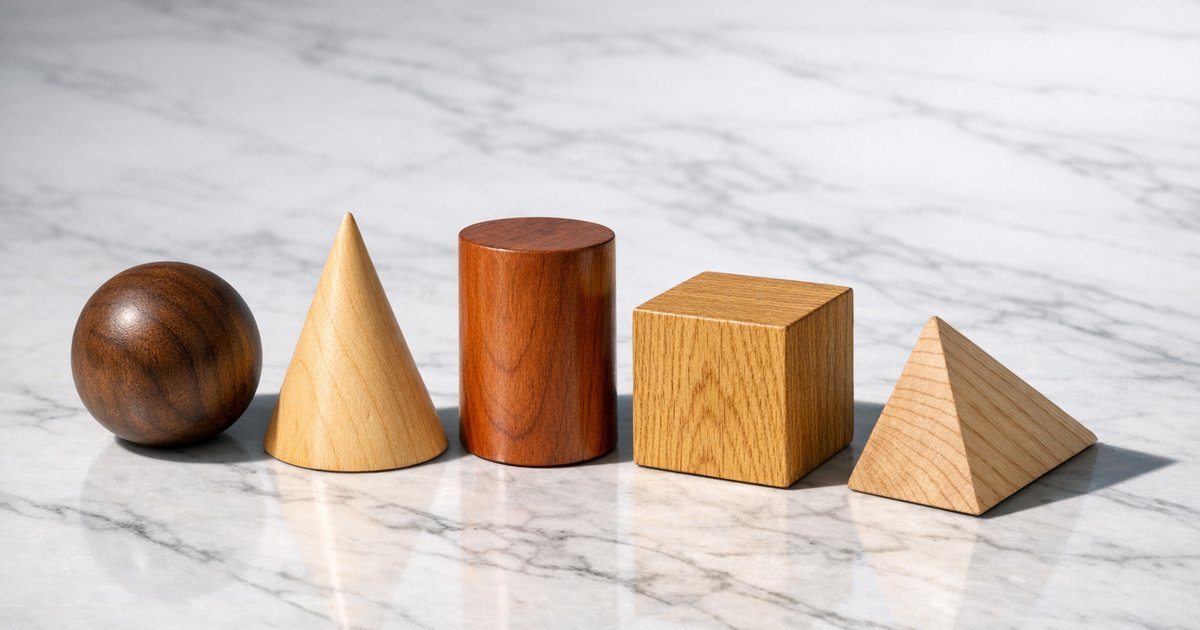
Cone vs pyramid - which formula applies?
| Shape | Volume formula | Common error |
|---|---|---|
| Cylinder | pi x r^2 x h | Using 2 x pi x r x h (that's curved surface area, not volume) |
| Cone | (1/3) x pi x r^2 x h | Forgetting the 1/3 factor, giving the cylinder volume instead |
| Sphere | (4/3) x pi x r^3 | Writing (4/3) x pi x r^2 (confusing with surface area's r^2 term) |
| Pyramid | (1/3) x base area x h | Using (1/2) instead of (1/3), confusing with triangle area |
Mistake 6: Misreading command words
Cambridge uses precise command words, and each one demands a specific type of response. Candidates who treat them as interchangeable lose marks not because they lack mathematical ability, but because they don't answer the question that was actually asked.
| Command word | What it requires | What candidates often do instead |
|---|---|---|
| Write down | State the answer with no working required | Show extensive working, wasting time (though this doesn't lose marks, it costs time) |
| Calculate | Use mathematics to find the answer; working must be shown | Estimate or guess without showing the mathematical process |
| Show that | Prove a given result step by step; the answer is already provided | Write only the final answer (which is already in the question), earning zero marks |
| Explain | Give a mathematical reason in words, often with a supporting calculation | Give a vague, non-mathematical response like "because it's bigger" |
| Give your answer correct to 3 significant figures | Round the final answer to 3 s.f. | Round intermediate calculations, introducing cumulative rounding errors |
The "show that" error deserves special emphasis. When a question says "show that the area is 48 cm^2," the examiners are testing whether you can construct the logical path to that answer. Writing "Area = 48 cm^2" earns nothing. You must start from the given dimensions, apply the correct formula, show each arithmetic step, and arrive at 48. Every line of working carries marks.
Mistake 7: Rounding too early in multi-step calculations
This error appears most frequently in trigonometry, compound interest, and any question requiring two or more sequential calculations. Candidates round their intermediate answer to 3 significant figures (or fewer), then use that rounded value in the next step. The small rounding error from step one gets amplified in step two, producing a final answer that's outside the acceptable tolerance.
Worked example: compound interest
$5,000 is invested at 3.5% compound interest per year. Find the value after 3 years, correct to the nearest dollar.
Wrong approach (rounding each year):
- Year 1: 5000 x 1.035 = 5175 (rounded to nearest dollar)
- Year 2: 5175 x 1.035 = 5356.125, rounded to 5356
- Year 3: 5356 x 1.035 = 5543.46, rounded to 5543
Correct approach (round only at the end):
- Use the compound interest formula: A = 5000 x (1.035)^3
- Calculate (1.035)^3 = 1.108717875...
- A = 5000 x 1.108717875 = 5543.589375
- Round to nearest dollar: $5544
The difference is only $1 in this case, but in questions with more steps or higher interest rates, premature rounding can push the answer outside the mark scheme's acceptable range. The rule is simple: keep full calculator precision throughout, and round only the final answer to whatever degree of accuracy the question specifies.
Mistake 8: Ignoring units in geometry and measurement
A rectangle has dimensions 2.5 m by 80 cm. Find the area in cm^2.
Wrong: 2.5 x 80 = 200 cm^2 (the student multiplied directly without converting metres to centimetres).
Correct: Convert 2.5 m to 250 cm first. Then 250 x 80 = 20,000 cm^2.
The factor-of-100 difference between these answers is enormous, yet this error appears consistently because candidates rush into calculation before checking that all measurements use the same unit. A related trap occurs with volume conversions: 1 m^3 = 1,000,000 cm^3 (not 100 cm^3), because the conversion factor is cubed along with the unit.
Unit conversion checklist for exam day
- Before calculating, underline the units given in the question and the units requested in the answer.
- If they differ, convert all measurements to the target unit before substituting into any formula.
- For area, square the linear conversion factor. For volume, cube it.
- Include units in your final answer. An answer of "20000" without "cm^2" may lose the final accuracy mark on some mark schemes.
Mistake 9: Time management collapse in the final third of the paper
This isn't a mathematical error, but it costs more marks than any single topic misconception. Candidates spend too long on questions in the first two-thirds of the paper - rechecking answers they're already confident about, or persisting with a question they can't crack - and then rush through or entirely skip the final questions, which typically carry the highest marks per question.
A diagnostic question
If you've ever walked out of a maths exam having not attempted the last two questions, the problem isn't that you ran out of time. The problem is that you spent too much time somewhere else. The marks you lost on those unattempted questions almost certainly exceed whatever marginal improvement you gained by triple-checking question 3.
| Paper | Duration | Total marks | Target pace |
|---|---|---|---|
| Paper 1 (Core, non-calc) | 60 min | 56 | ~1 mark per minute |
| Paper 2 (Extended, non-calc) | 90 min | 70 | ~1.3 min per mark |
| Paper 3 (Core, calc) | 120 min | 104 | ~1.15 min per mark |
| Paper 4 (Extended, calc) | 150 min | 130 | ~1.15 min per mark |
Mistake 10: Not showing working on "write down" vs "calculate" questions
This might seem contradictory after discussing command words above, but there's an important nuance. On "calculate" questions worth 3 or more marks, showing no working means that a single numerical error costs all the marks. If you write 2 x pi x 5 x 12 = 376.99 but the correct answer is 376.99 (and you got it right), you earn full marks either way. But if you make a key-press error and write 367.99, having no working visible means the examiner can't award method marks for your correct approach.
The cost-benefit calculation is straightforward:
- Writing your working takes 15-20 seconds per question
- Not writing your working risks losing 2-3 method marks on any question where you make an arithmetic slip
- Across a full paper with perhaps 8-10 multi-mark calculation questions, that's a potential swing of 20 marks for roughly three minutes of writing
There's no scenario where showing working costs you marks. There are many scenarios where not showing working costs you marks. The decision is not close.
Building your personal error log
The mistakes above cover the most common patterns across IGCSE Mathematics, but your own error profile is specific to you. The most effective revision technique for eliminating mistakes is maintaining a personal error log across your practice papers.
- Complete a past paper under timed conditions.
- Mark it using the official Cambridge mark scheme (not a textbook answer key - the mark scheme shows exactly where method marks are awarded).
- For every mark you lost, categorise the error: was it a topic gap (you didn't know the method), a procedure error (you knew the method but executed it incorrectly), or a reading error (you misunderstood what the question asked)?
- Record each error in a table with columns for: paper, question number, topic, error type, and what you should have done.
- Before your next practice paper, review the log. Before the actual exam, review it again.
After three or four papers, patterns will emerge. You might discover that 60% of your lost marks come from sign errors in algebra and premature rounding - two specific, fixable habits. Without the log, those patterns stay invisible, and revision time gets spread uniformly across topics rather than concentrated where it will recover the most marks.
Every mark recovered from eliminating a preventable error is worth exactly as much as a mark earned from learning new content. The difference is that error elimination is faster, more reliable, and more likely to hold under exam pressure. Start with the mistakes that match your own patterns, drill the corrections until they're automatic, and watch your practice paper scores climb.

A methodical breakdown of the most frequent errors IGCSE Mathematics candidates make across algebraic manipulation, equations, fractions, surface area and volume, and exam technique, with step-by-step worked examples showing both the wrong approach and the correct method for each mistake.




Comentario(s)