When a student is preparing for an IGCSE or SSCE examination, more material is not automatically better material. What decides whether revision pays off is narrower: does this resource match the qualification they are sitting, at the tier they are entered for, in the shape the paper will take?
What follows is how we keep study material tied to published examination requirements, how it is checked, what we label clearly, and how anyone can inspect it.
We start with the published specification
Before study material is organised for a subject, we work from the awarding body's own published specification for that qualification.
That means the topics it contains, the learning objectives beneath them, the distinction between core and extended material where a board draws one, and the command words the board uses. Command words matter more than students expect. A question asking a student to state something wants a different answer from one asking them to explain, describe or evaluate, and the marks follow that difference.
Practice should reflect the paper, not just the subject
Knowing a subject and being ready for its examination are separate things. A student can know the material well and still be caught out by a paper whose length, question count or mark distribution they have never met.
So we also represent the examination itself: how many papers a subject has, how long each runs, how many questions it carries, how marks are distributed, and which topics each paper draws on. Practice built this way reflects the structure of the paper a student will sit rather than functioning as a general quiz on the subject.
A paper's own conditions carry across too. A listening exercise can reproduce the relevant constraints on timing and replay, and a speaking exercise can include the preparation and response stages the assessment calls for. Where an answer is better worked out on paper, a student can photograph their handwritten working or diagram and attach it rather than forcing it into a text box.

One objective, several ways to learn it
A student who cannot get anywhere with a page of notes will sometimes understand the same idea instantly from a diagram, or from hearing it explained aloud.
Because resources are connected to specific learning objectives rather than filed loosely under a subject, those routes stay aligned with one another. A Biology note on inheritance is not simply labelled Biology. It is connected to the objective it teaches, and the flashcards, mind map, audio lesson and practice questions for that objective sit alongside it. A student can move from reading, to listening, to revising, to practising, to asking Lazuli, our study companion, without drifting off the part of the syllabus they came to learn.
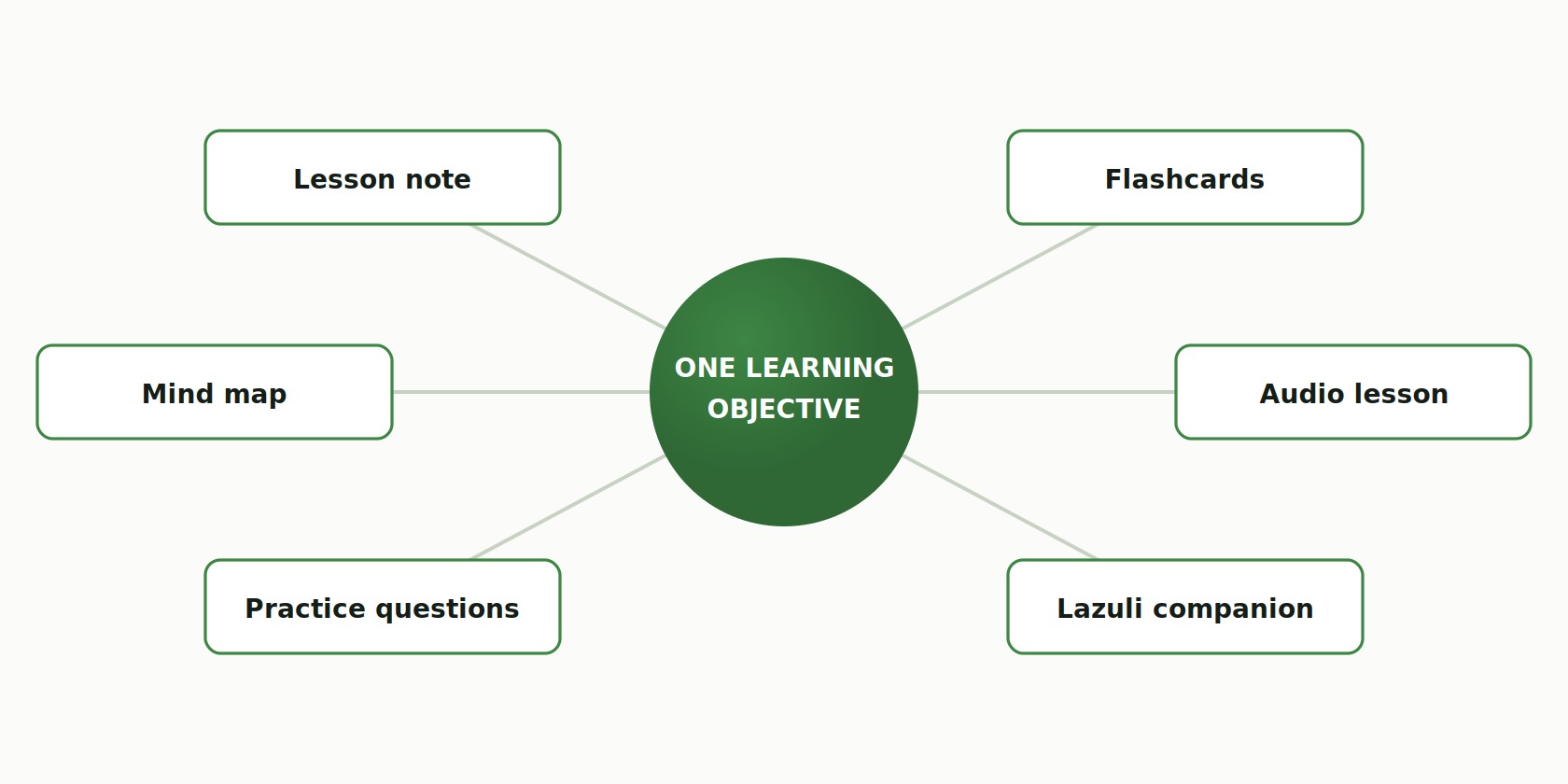
That connection also makes a result more useful than a mark out of forty. Because each question relates to an objective, a completed paper shows which objectives a student has secured and which they have not.
How the material is checked
Two kinds of checking matter here. The first is systematic. Across the library we check what can be established consistently: that an answer is present and singular, that an item aligns with its objective, that explanations agree with their answers, that mark allocations reconcile, that diagrams belong with the item beside them, that a paper's configuration matches the published structure, and that source references resolve.
These checks run across the whole library rather than a sample, which is what makes alignment, consistency and structure dependable at every point a student touches the material.
The second kind is academic judgement, and it is different work: whether an explanation genuinely teaches, whether the difficulty sits right for the tier, whether a question earns its place in exam preparation. Software does not settle those, and across a library of this size we do not claim they have been settled.
Official past questions and our practice material are not the same thing
We hold two different kinds of examination practice, and we tell students which one they are working in.
The first is genuine past examination questions. For WAEC, JAMB and NECO we hold real papers that were actually sat, indexed by year, subject and paper.
The second is Green Bridge practice, revision and mock material. For Cambridge International, Pearson Edexcel and OxfordAQA, much of our question bank is original material created around the published specification and paper structure. It is not historic examination material, it is not produced or endorsed by those awarding bodies, and we do not describe it as past papers.
Both are useful and they do different work. A past paper shows a student what an examiner actually asked. Our IGCSE practice material gives them fresh questions designed around the same published specification, paper structure, command words and mark allocations, which matters once a student has worked through the papers that exist.
Keeping pace when a specification changes
Awarding bodies revise their qualifications, and a revision can affect topics, learning objectives, assessment structure or the papers themselves. Because our material is organised around those published requirements rather than filed by subject alone, affected resources can be identified for updating, reworking or retirement rather than left for a student to discover.
If something looks wrong
No library of this size can honestly promise it contains no mistakes. What matters is whether they can be found and fixed. If a student or teacher believes a question, answer or explanation is wrong, it can be reported from inside the product. Reports are investigated, and material is corrected or returned for review where warranted. A correction reaches every student, not only the person who raised it.
Do not take our word for it
Every lesson note opens with a free preview, so any note can be sampled without an account. A free account opens the full text of our WAEC, NECO and JAMB notes, along with a set of practice papers that can be sat and marked. Flashcards, mind maps, audio lessons and our IGCSE notes sit inside a subscription.
- Choose the exact qualification, board and subject the student is sitting.
- Open a lesson note on a topic already covered at school. The preview is enough to judge the writing; a free account opens a WAEC, NECO or JAMB note in full, to judge against what was taught.
- Sit one of the open practice papers and read the worked explanations. Do they teach, or do they assert?
- Check the explanations against the awarding body's published specification for that topic.
Why this matters
A student sitting an IGCSE paper this year gets one attempt at it. Everything above exists so the hours they spend are spent on the qualification they are entered for, in the form it will actually take.
Ultimately the best test of study material is the material itself. That is why every note opens with a preview, and a free account opens our WAEC, NECO and JAMB notes and a set of practice papers to judge before you pay. Read the questions and the explanations, compare them against the specification, and decide whether they deserve a place in a student’s preparation.

More revision material is not automatically better revision material. What matters is whether it matches the exam a student is actually sitting. Here is how we keep ours aligned to the published specification, how it is checked, and how anyone can judge it for themselves before paying.





Kommentar(e)