Three ways, one cell membrane
Your cells are busy places. Every second, molecules are moving in and out through the cell membrane - oxygen arriving, carbon dioxide leaving, water shifting, glucose being absorbed. But not everything moves the same way. The Cambridge IGCSE Biology syllabus (0610) asks you to understand three distinct mechanisms: diffusion, osmosis and active transport. Each one follows different rules, uses (or doesn't use) energy, and shows up in different biological contexts.
This topic appears in almost every past paper. If you only revise one section of the syllabus thoroughly, make it this one. The good news? Once you understand the logic behind each process, the exam questions become surprisingly predictable.
Diffusion: the basics
Diffusion is the net movement of particles from a region of their higher concentration to a region of their lower concentration (down a concentration gradient), as a result of their random movement. That definition matters - examiners want it almost word for word.
Notice the word "net." Particles don't all march in one direction like commuters on an escalator. They bounce around randomly in every direction. But because there are more particles on the high-concentration side, statistically more of them end up moving toward the low-concentration side than the other way around. The overall (net) movement is from high to low.
Where does the energy come from?
Here is something students often get wrong: diffusion does not require energy from the cell. The energy comes from the kinetic energy of the randomly moving molecules and ions. All particles above absolute zero are constantly jittering and vibrating. That built-in movement is what drives diffusion, which is why it is called a passive process.
Diffusion through the cell membrane
Some substances move into and out of cells by diffusion through the cell membrane. Small, non-polar molecules like oxygen and carbon dioxide pass directly through the phospholipid bilayer. Other molecules use protein channels or carrier proteins embedded in the membrane.
The cell membrane is partially permeable (sometimes called selectively permeable). It lets some molecules through freely, allows others through with help, and blocks the rest entirely. Think of it as a security gate at a concert - some people have all-access passes (small molecules), some need to show ID at a specific entrance (channel proteins), and some are turned away altogether.
Why diffusion matters in living organisms
Diffusion is how your body handles gas exchange. In the lungs, oxygen diffuses from the air in the alveoli (high concentration) into the blood (low concentration). Carbon dioxide does the reverse - it diffuses from the blood into the alveoli to be breathed out. The same principle applies in plant leaves during photosynthesis: carbon dioxide diffuses in through stomata, and oxygen diffuses out.
Diffusion also moves dissolved substances. Glucose and amino acids diffuse from the blood into cells where they are needed. Urea, a waste product, diffuses from liver cells into the blood to be carried to the kidneys.
Four factors that affect the rate of diffusion
The IGCSE syllabus lists four factors you need to know. Each one makes logical sense once you think about what diffusion actually is - random particle movement down a gradient.
| Factor | Effect on rate of diffusion | Why |
|---|---|---|
| Surface area | Larger surface area = faster diffusion | More space for particles to cross at the same time |
| Temperature | Higher temperature = faster diffusion | Particles have more kinetic energy, so they move faster and collide more often |
| Concentration gradient | Steeper gradient = faster diffusion | Bigger difference between regions means more net movement per second |
| Distance | Shorter distance = faster diffusion | Particles reach the other side more quickly when the path is shorter |
Extended content: surface area to volume ratio
If you are sitting the Extended paper, you also need to understand surface area to volume ratio. As a cell gets bigger, its volume increases faster than its surface area. A large cell has relatively less membrane surface for each unit of internal volume, which slows down the rate at which substances can enter or leave. This is one reason why cells stay small - they need a high surface area to volume ratio to exchange materials efficiently.
Osmosis: diffusion's specialist cousin
Osmosis is a special case of diffusion. The formal IGCSE definition is: the net movement of water molecules from a region of higher water potential (dilute solution) to a region of lower water potential (concentrated solution), through a partially permeable membrane.
In simpler terms: water moves from where there is more of it to where there is less of it, through a membrane that lets water through but blocks the solute.
Water potential
You will see the term water potential in IGCSE Biology. Pure water has the highest water potential. When you dissolve something in water (salt, sugar, anything), you lower the water potential. So a dilute solution has a higher water potential than a concentrated solution, and water moves by osmosis from higher water potential to lower water potential.
If two solutions have the same water potential, they are isotonic. No net movement of water occurs. If one solution has a higher water potential than the other, it is hypotonic relative to the other (which is hypertonic). Water moves from the hypotonic solution to the hypertonic one.
Osmosis and plant cells
When a plant cell is placed in a dilute (hypotonic) solution, water enters by osmosis. The vacuole swells, pushing the cytoplasm against the cell wall. The cell becomes turgid. The rigid cell wall prevents the cell from bursting. Turgidity is actually a good thing for plants - it keeps stems upright and leaves firm. A well-watered plant is a turgid plant.
When a plant cell is placed in a concentrated (hypertonic) solution, water leaves by osmosis. The vacuole shrinks, the cytoplasm pulls away from the cell wall, and the cell becomes plasmolysed. This is bad news for the plant. The cell membrane peels away from the wall, and the cell can no longer function properly. A wilted lettuce leaf in salty water is showing you plasmolysis in action.
Between these extremes, a plant cell in an isotonic solution is flaccid - not turgid, not plasmolysed, just limp. The cell is alive but not at its best.
Osmosis and animal cells
Animal cells don't have a cell wall, and that changes everything.
In a dilute (hypotonic) solution, water enters an animal cell by osmosis. Without a rigid wall to push back, the cell swells and eventually bursts (lyses). A red blood cell placed in pure water will swell until it pops.
In a concentrated (hypertonic) solution, water leaves, and the cell shrinks and becomes crenated (wrinkled). Think of a grape turning into a raisin - same idea, different scale.
| Solution type | Plant cell | Animal cell |
|---|---|---|
| Dilute (hypotonic) | Turgid - swells, vacuole full, cell wall prevents bursting | Swells and may burst (lyse) |
| Isotonic (equal) | Flaccid - no net water movement | Normal - no net water movement |
| Concentrated (hypertonic) | Plasmolysed - membrane pulls from wall, vacuole shrinks | Crenated - shrinks and wrinkles |
Investigating osmosis: the potato experiment
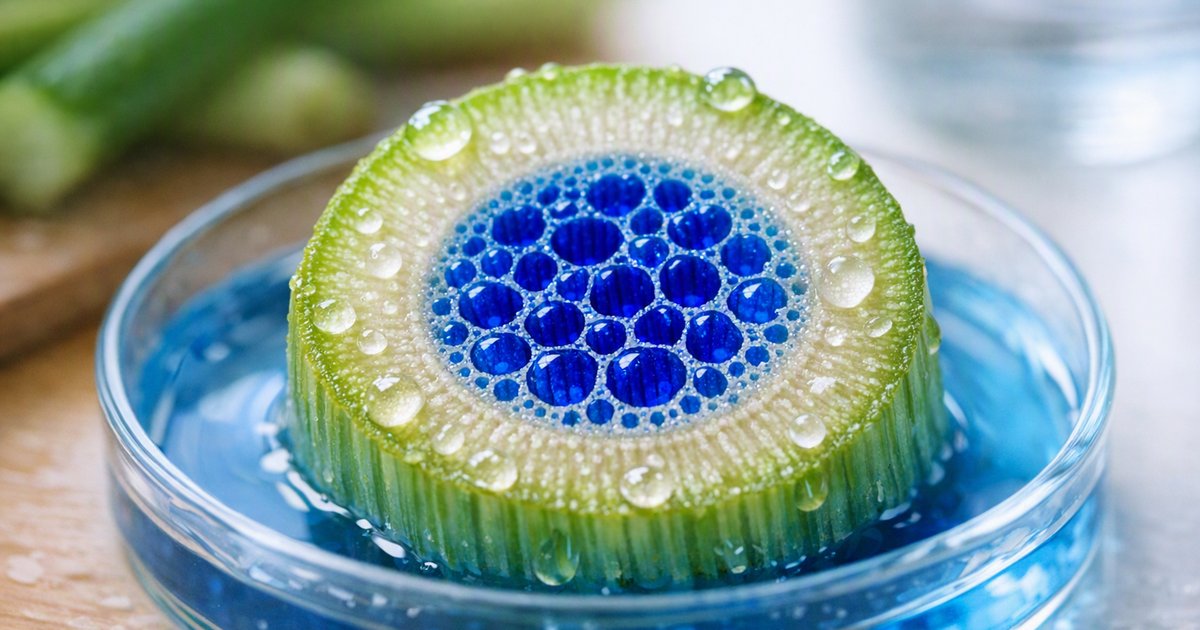
One of the most common IGCSE practicals involves cutting potato cylinders of equal size, placing them in solutions of different sugar concentrations, and measuring the change in mass or length after a set time.
- In dilute solutions, the potato gains mass (water enters by osmosis).
- In concentrated solutions, the potato loses mass (water leaves by osmosis).
- At one particular concentration, there is no change in mass - this is the isotonic point, where the water potential of the potato cells equals the water potential of the solution.
If you plot percentage change in mass on the y-axis against solution concentration on the x-axis, you get a line that crosses zero. That crossing point gives you the concentration of the cell sap.
Active transport: going against the flow
Diffusion and osmosis are passive - particles move down their concentration gradient without the cell spending energy. But sometimes a cell needs to move substances the wrong way, from low concentration to high concentration, against the gradient. That requires active transport.
Active transport is the movement of ions or molecules against a concentration gradient (from a region of lower concentration to a region of higher concentration) using energy from respiration. The energy is supplied as ATP, produced by mitochondria inside the cell. Carrier proteins in the cell membrane use this energy to grab specific molecules and shuttle them across.
Where active transport matters
Two examples come up regularly in the IGCSE exam:
- Mineral ion uptake by root hair cells: The concentration of mineral ions (like nitrate and magnesium) is usually higher inside root cells than in the surrounding soil water. Diffusion would actually move ions out of the root. So the plant uses active transport to pull ions in against the gradient, powered by energy from respiration in the root cell mitochondria.
- Sugar absorption in the small intestine: After digestion, glucose concentration in the intestinal cells can be higher than in the gut. To keep absorbing every last glucose molecule from digested food, the epithelial cells of the villi use active transport to move glucose from the gut lumen into the blood, even when the concentration gradient is working against them.
The big comparison: diffusion vs osmosis vs active transport
Examiners love asking you to compare these three processes. Here is the table you should have in your head when you walk into the exam.
| Feature | Diffusion | Osmosis | Active transport |
|---|---|---|---|
| What moves? | Any molecules or ions | Water molecules only | Specific ions or molecules |
| Direction | High to low concentration (down the gradient) | High to low water potential (down the water potential gradient) | Low to high concentration (against the gradient) |
| Energy required? | No (passive) - uses kinetic energy of particles | No (passive) - uses kinetic energy of water molecules | Yes - from respiration (ATP) |
| Membrane needed? | Not always (can occur in air or solution) | Yes - partially permeable membrane required | Yes - carrier proteins in the membrane |
| Example in the body | Oxygen moving from alveoli into blood | Water moving into root hair cells from soil | Mineral ions absorbed by root hair cells |
Worked example: a typical exam question
Question: A student places a piece of visking tubing (partially permeable membrane) containing a concentrated sugar solution into a beaker of distilled water. After 30 minutes, the visking tubing has become firmer and heavier. Explain why.
Model answer: The distilled water has a higher water potential than the concentrated sugar solution inside the visking tubing. Water molecules move by osmosis from the distilled water (higher water potential) through the partially permeable membrane into the sugar solution (lower water potential). This increases the volume of liquid inside the tubing, making it firmer and heavier.
Question: Root hair cells absorb mineral ions from the soil even when the concentration of ions is higher inside the cell than in the soil. Name the process involved and explain why it requires energy.
Model answer: The process is active transport. The mineral ions are moving against their concentration gradient (from a region of lower concentration in the soil to a region of higher concentration inside the root hair cell). Moving particles against a concentration gradient requires energy, which is provided by respiration in the cell's mitochondria.
Extended content: the role of carrier proteins and protein channels
For Extended candidates, the syllabus expects you to distinguish between two types of membrane transport protein.
- Protein channels are like tunnels through the membrane. They allow specific small ions or water molecules to pass through passively (by diffusion). They don't change shape, and they don't require energy.
- Carrier proteins bind to a specific molecule on one side of the membrane, change shape, and release the molecule on the other side. They can work passively (facilitated diffusion, moving molecules down the gradient) or actively (active transport, moving molecules against the gradient using ATP).
Think of protein channels as revolving doors - anyone the right size just walks through. Carrier proteins are more like lifts - they physically carry you from one floor to another, and going up (against the gradient) uses electricity (ATP).
Common exam mistakes
- Writing "water moves from high concentration to low concentration": For osmosis, you must say "high water potential to low water potential" or "dilute solution to concentrated solution." Saying "high concentration to low concentration" is technically wrong for osmosis because you are describing the water, not the solute.
- Forgetting the membrane for osmosis: Osmosis specifically requires a partially permeable membrane. Diffusion can happen anywhere (in air, in liquid, across a membrane). If there is no membrane, it is just diffusion of water, not osmosis.
- Saying diffusion uses energy from the cell: It doesn't. The energy comes from the kinetic energy of the particles themselves. Calling diffusion "active" will cost you the mark.
- Confusing plasmolysis with lysis: Plasmolysis happens to plant cells in concentrated solutions (the membrane pulls away from the wall). Lysis (bursting) happens to animal cells in dilute solutions. Mixing them up is a common slip.
- Not linking active transport to respiration: When the question asks where the energy comes from, you need to say "respiration" (or "ATP from respiration"). Just saying "energy" is not enough. Some students write "photosynthesis" for root cells - that is wrong. Roots do not photosynthesise; they respire.
- Describing osmosis in cells without naming the water potential difference: "Water goes in" is not enough. You need to compare the water potential of the solution outside with the water potential inside the cell, state which is higher, and then describe the direction of net water movement.
- Ignoring the cell wall when comparing plant and animal cells: The reason plant cells don't burst in dilute solutions is the cell wall. Animal cells lack this wall, so they do burst. If the question asks you to explain the difference, the cell wall is the key point.
Self-check questions
- Define diffusion in terms of net movement, concentration gradient and random movement of particles.
- Name four factors that affect the rate of diffusion and explain why each one has its effect.
- A red blood cell is placed in distilled water. Describe and explain what happens to the cell.
- A plant cell is placed in a concentrated salt solution. Describe the changes to the cell and name the condition of the cell.
- Explain why root hair cells need active transport to absorb mineral ions from the soil, and state the source of energy for this process.
- Copy and complete: Osmosis is the net movement of ______ molecules from a region of ______ water potential to a region of ______ water potential through a ______ membrane.
- A student sets up three identical potato cylinders in solutions of 0%, 10% and 20% sugar. After one hour, the 0% cylinder has gained mass, the 10% is unchanged, and the 20% has lost mass. Explain these results using the term osmosis.
- Compare diffusion and active transport in terms of direction of movement, energy requirement and one named example in a living organism.

A thorough guide to diffusion, osmosis and active transport for IGCSE Biology, covering Core and Extended content with everyday analogies, comparison tables, worked exam answers, common mistakes and self-check questions.


Kommentar(e)